What Happens to Your Brain When You Play Memory Games

On this page (8)
You’ve probably heard that memory games are “good for your brain.” Maybe a friend recommended one, or you saw an ad promising sharper focus in five minutes a day. But what’s actually happening inside your skull when you play?
Not the marketing version. The real, biological, neuroscience version.
Turns out, your brain isn’t just passively enjoying a colourful puzzle. It’s physically restructuring itself. Synapses are strengthening, neural pathways are forming, and brain chemicals are shifting in measurable ways. Some of these changes show up on brain scans within weeks.
Here’s what the science actually says about what goes on between your ears when you sit down to play a memory game.
Your Brain on Memory Games: The 30-Second Version
When you play a memory game, your brain does several things at once. It encodes visual information (taking in shapes, colours, positions), stores it temporarily in working memory, and then retrieves it to answer questions or match patterns.
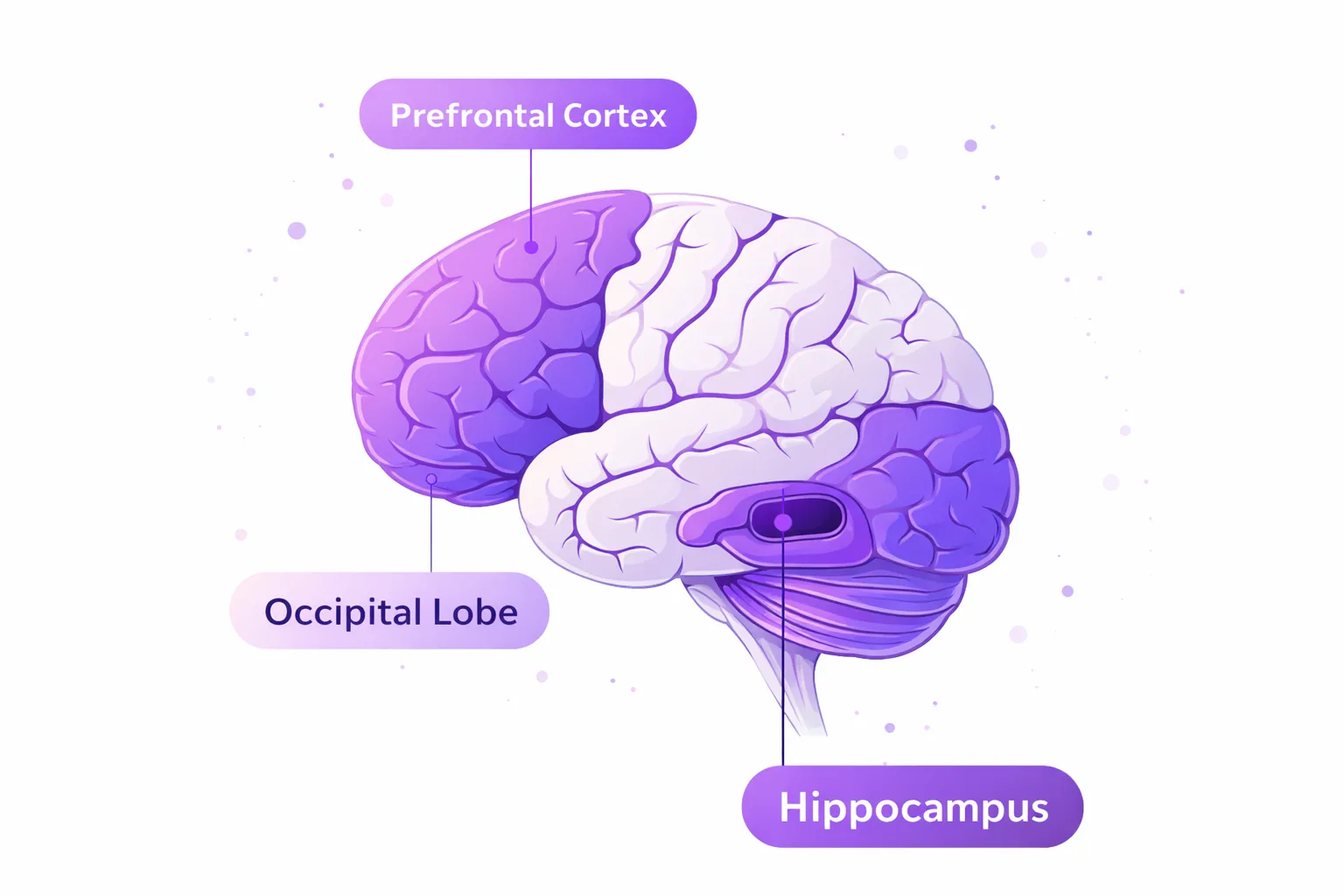
Each of these steps activates different brain regions. The prefrontal cortex handles working memory and decision-making. The occipital lobe processes visual information. And the hippocampus helps convert short-term memories into longer-lasting ones.
What makes this interesting isn’t that your brain is active while you play. That’s obvious. What’s interesting is that repeated activation of these pathways physically changes your brain’s structure. And that’s where neuroplasticity comes in.
Neuroplasticity: Your Brain’s Built-In Upgrade System
For most of the 20th century, scientists believed the adult brain was essentially fixed. You got what you got, and it was all downhill from there. That turned out to be spectacularly wrong.
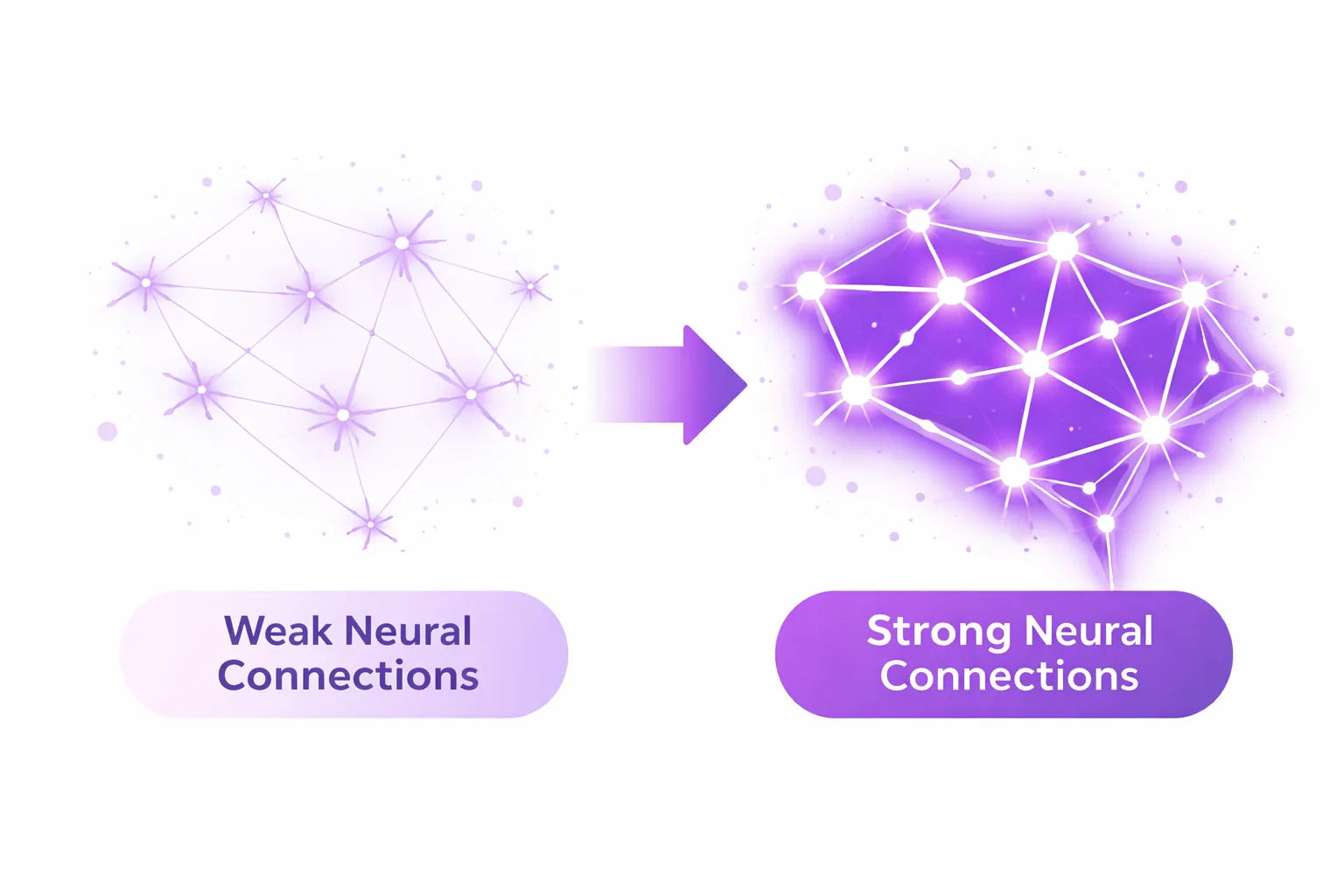
Neuroplasticity is your brain’s ability to reorganise itself by forming new neural connections throughout life. It happens at every age, though the rate and extent change as we get older. When you repeatedly challenge your brain with a specific type of task, the neural networks involved in that task get stronger, faster, and more efficient.
Think of it like a path through a forest. Walk it once and the grass is barely bent. Walk it every day for a month and you’ve worn a clear trail. That’s essentially what’s happening in your brain when you play memory games regularly. The pathways responsible for encoding, storing, and retrieving visual information get reinforced through repeated use.
A 2026 study from NYU found that computerised cognitive exercises actually changed the brain’s white matter, the nerve fibres that connect different brain regions. Participants who completed the exercises showed measurable changes in neuroplasticity, and those changes correlated with improvements in processing speed, attention, and working memory.
What Fires Together, Wires Together
There’s a principle in neuroscience called Hebbian learning, often summarised as “what fires together, wires together.” It was first proposed by Donald Hebb in 1949, and it describes how synapses (the connections between neurons) get stronger when they’re activated repeatedly.
When you play a memory game, you’re forcing specific groups of neurons to fire together over and over. The neurons responsible for noticing a red circle in the top-left corner of a grid fire alongside the neurons responsible for holding that information in working memory. Do this enough times and the synapse between those neurons strengthens. The signal travels faster. The connection becomes more reliable.
This is called long-term potentiation (LTP), and it’s one of the primary mechanisms behind learning and memory formation. It’s not unique to memory games. LTP happens when you learn a language, practise an instrument, or memorise a route to work. But memory games are specifically designed to trigger it efficiently, in focused, repeatable sessions.
The Hippocampus: Your Brain’s Memory Control Room
If your brain has a memory headquarters, it’s the hippocampus. This small, curved structure deep in the temporal lobe is essential for converting short-term memories into long-term ones. It’s also one of the few brain regions where new neurons continue to form in adulthood, a process called neurogenesis.
The hippocampus is particularly responsive to enriched environments and novel stimuli. When you encounter a new pattern in a memory game, a colour arrangement you haven’t seen before or a more complex scene than the last level, your hippocampus lights up. It’s encoding the novelty, comparing it to stored patterns, and strengthening the circuits involved.
Research has shown that activities requiring active recall (retrieving information from memory rather than just recognising it) are especially good at stimulating hippocampal activity. This is why memory games that ask you to reconstruct a scene from scratch, rather than simply picking the right answer from a list, tend to produce stronger training effects.
This is actually the core mechanic behind Blanked. You study a scene, it disappears completely, and you answer questions from memory. That forced recall is exactly the kind of challenge the hippocampus thrives on.
Visual Memory: A Specific Kind of Brain Workout
Not all memory training is the same. Verbal memory (remembering words, names, lists) and visual memory (remembering images, spatial layouts, colours, faces) involve overlapping but distinct brain networks.
Visual memory engages the occipital lobe for initial processing, the parietal lobe for spatial awareness, and the ventral visual stream for object recognition. When you play a game that asks you to remember where objects were positioned, what colour they were, or how many shapes appeared, you’re training this specific network.
Why does that matter? Because visual memory is behind a surprising number of everyday tasks. Remembering where you parked your car. Recognising a face you met once at a conference. Noticing that something has moved in a room. Recalling the layout of a new city after walking through it once. These all rely heavily on your visual memory systems.
Training verbal memory (like memorising vocabulary lists) won’t necessarily improve your visual memory, and vice versa. The specificity matters. If you want to get better at remembering what you see, you need to train with visual tasks.
The Acetylcholine Connection
Here’s where things get really interesting. In 2025, researchers at McGill University published a study showing that brain training exercises can actually boost production of acetylcholine, a neurotransmitter that plays a critical role in memory, attention, and learning.
Acetylcholine is sometimes called the “pay attention” chemical. It helps your brain focus on relevant information and encode new memories. It’s also one of the first neurotransmitter systems to decline with age, and reduced acetylcholine levels are closely linked to Alzheimer’s disease and other forms of dementia.
The McGill study used PET scans to measure acetylcholine production before and after a 10-week training programme. Participants who completed the brain training exercises showed a 2.3% increase in acetylcholine production in the anterior cingulate cortex, a brain region crucial for learning and attention. The control group, who played generic entertainment games, showed no significant change.
This matters because it’s the first study to demonstrate a biochemical mechanism behind brain training benefits. Previous research showed that training improved test scores. This study showed why: the training was literally changing brain chemistry.
How Long Before Your Brain Actually Changes?
This is the practical question everyone wants answered, and the research offers some encouraging timelines.
Functional changes (how efficiently your brain processes information) can appear within days to weeks of consistent training. You might notice you’re recalling details more quickly, or that tasks which used to require effort feel more automatic.
Structural changes (actual physical alterations in neural pathways and brain chemistry) typically take longer. The McGill acetylcholine study showed measurable biochemical changes after 10 weeks. The NYU white matter study also used a training period of several weeks before detecting structural differences on brain scans.
The consensus across the research is fairly consistent:
- 2 to 4 weeks: Noticeable improvements in task performance.
- 6 to 8 weeks: Functional brain changes begin showing up in testing.
- 10 to 12 weeks: Structural and biochemical changes become measurable.
The critical variable isn’t session length. It’s consistency. Research consistently shows that short daily sessions (even 2 to 15 minutes) produce better outcomes than longer sessions done sporadically. This is why apps designed around brief daily play, like Blanked’s 2-minute sessions, align well with what the neuroscience recommends.
What Memory Games Can’t Do (Honesty Corner)
We wouldn’t be doing our job if we only told you the good bits. Memory games have real, measurable effects on your brain. But they’re not a miracle fix, and the research is clear about the limitations.
Transfer effects are limited. Getting better at a memory game doesn’t automatically make you better at unrelated tasks. A 2025 University of Birmingham study found that while participants improved significantly at trained tasks, those improvements didn’t consistently transfer to untrained cognitive measures. You’ll get better at the type of memory you train, but it won’t magically boost your IQ or make you a faster reader.
They’re not a replacement for lifestyle factors. Sleep, exercise, nutrition, and social connection all have stronger evidence for overall cognitive health than any app. The best approach is treating memory games as one part of a broader brain health routine, not the whole thing.
They can’t prevent or cure dementia. While the ACTIVE Trial showed speed-of-processing training reduced dementia risk by 25%, no brain training app can guarantee prevention. If you’re concerned about cognitive decline, speak to a healthcare professional.
The honest pitch? Memory games are like a gym for a specific part of your brain. They work, within their scope. Just don’t expect a bicep curl to improve your marathon time.
If you’re curious about what targeted visual memory training feels like, Blanked is free to try. Two minutes a day, six game modes, and a mascot who will absolutely judge you if you break your streak.
Frequently asked questions
Do memory games change your brain permanently?
Are visual memory games better than word-based brain games?
How many minutes a day should I play memory games?
At what age should you start playing memory games?
Can memory games help with ADHD or focus issues?
Train your memory. Play Blanked free.
A free visual memory game built around how memory actually works. 6 game modes, 400+ levels.
Download on the App Store