How to Play Blanked: Beginner’s Guide (2026)

On this page (16)
Most brain training apps try to do everything at once. Memory, maths, language, attention, processing speed, problem-solving. They spread themselves so thin across cognitive skills that none of them get trained deeply.
Blanked takes the opposite approach. It does one thing, and it does it well: visual memory training. You look at a scene, the scene disappears, and you answer questions about what you just saw. That’s the entire concept. And that simplicity is exactly what makes it effective.
Whether you’ve just downloaded the app or you’re considering it, this guide covers everything you need to know: how the game works, what each mode does, and how to get the most out of your 2 minutes a day.
What Is Blanked?
Blanked is a visual memory training game for iOS. It’s built around a single core principle: your visual memory improves when you regularly practise encoding, storing, and recalling visual information. (For the neuroscience behind why this works, see our post on what happens to your brain when you play memory games.)
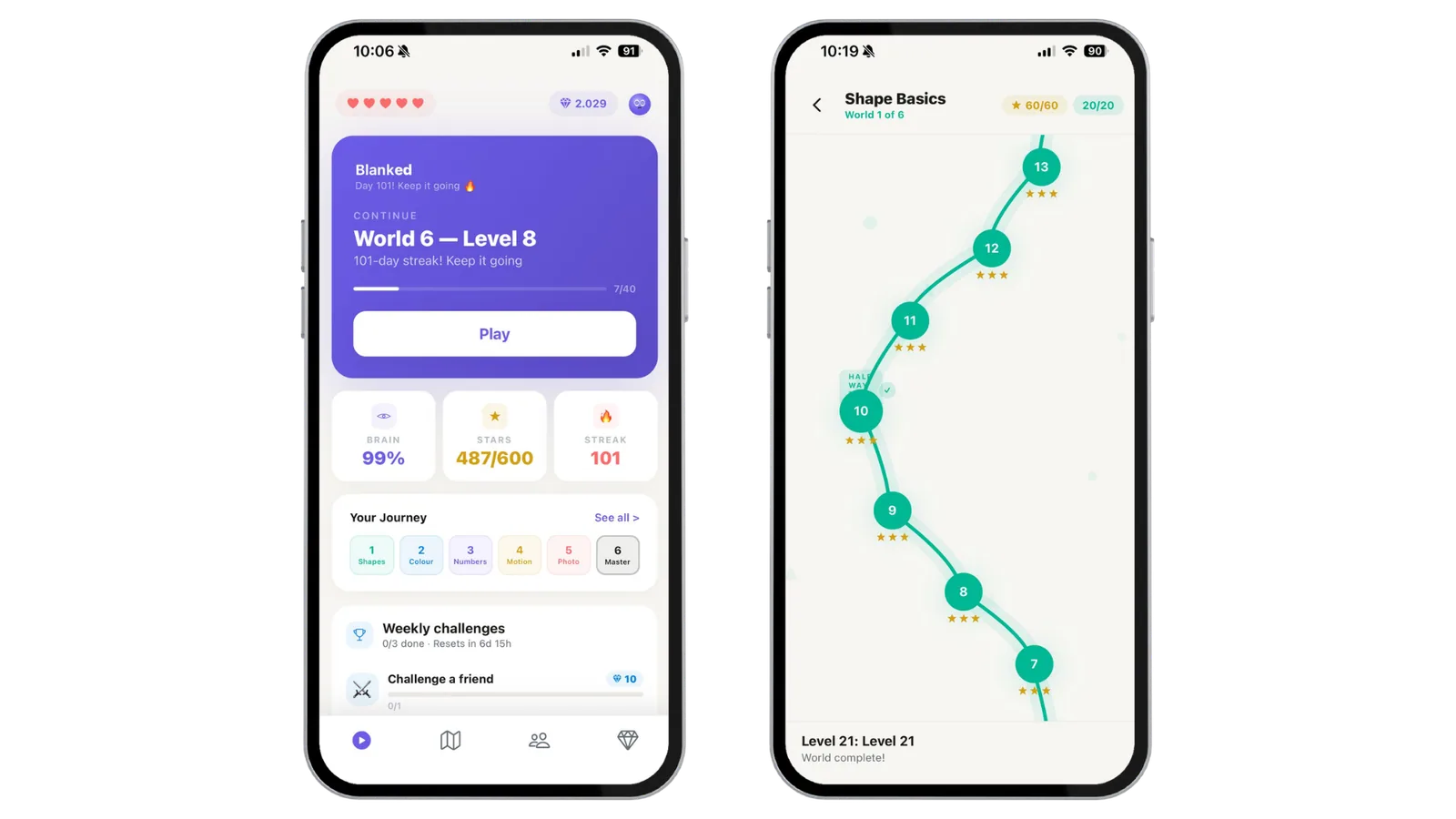
The app features 6 distinct game modes, 380+ levels spread across multiple worlds, a mascot called Blink who will absolutely guilt-trip you about your streak, and a session length of about 2 minutes. It’s designed to be something you do every day without thinking twice about the time commitment.
Blanked isn’t trying to be Lumosity or Elevate. It’s not a broad cognitive training platform. It’s a focused visual memory workout disguised as a game you actually want to play. (For how it compares to other brain training apps, check out our best brain training apps 2026 roundup.)
The Core Mechanic: See It, Lose It, Recall It
Every mode in Blanked follows the same three-step loop:
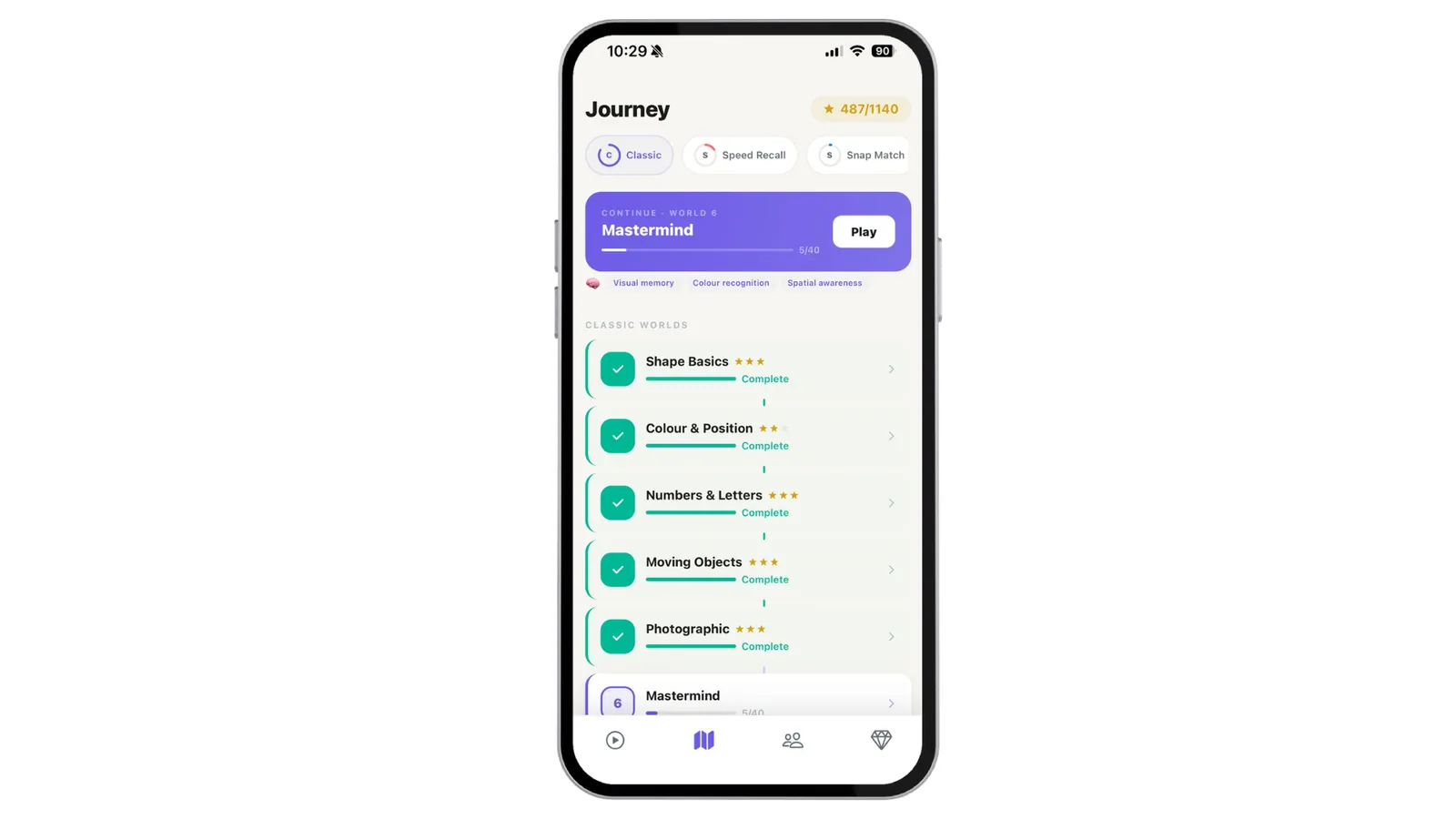
1. Study the scene. You’re shown a screen filled with colourful shapes, positions, numbers, or patterns. You have a limited time to take it all in.
2. Go Blank. The scene vanishes completely. This is the moment that separates Blanked from typical matching games. There’s nothing left on screen to reference. Your memory is the only tool you have.
3. Answer from memory. You’re asked questions about what you just saw. What colour was the shape in the top right? How many circles were there? Which pattern appeared first? Get it right, progress. Get it wrong, learn.
This loop is specifically designed to trigger active recall, which is one of the strongest memory-building mechanisms identified in cognitive science. Unlike recognition tasks (where you pick the right answer from options that jog your memory), Blanked forces you to retrieve information from scratch. That’s harder, and that’s why it trains your brain more effectively.
The 6 Game Modes Explained
Each mode targets a slightly different aspect of visual memory. Here’s what they are and what they train.
Classic
The foundational mode. You study a scene of colourful shapes arranged on a grid, the scene goes blank, and you answer multiple-choice questions about what you saw. Shapes, colours, positions, quantities. Classic is where most players start, and it’s where you build the core skill: encoding a complex visual scene quickly and accurately.
What it trains: General visual memory, spatial awareness, colour recognition, detail encoding.
Speed Recall
Same concept as Classic, but with shorter study times and a ticking clock on your answers. Speed Recall pushes you to encode faster and retrieve more efficiently. The time pressure forces your brain to prioritise the most important visual details rather than trying to memorise everything.
What it trains: Processing speed, rapid encoding, working memory under pressure.
Snap Match
You’re shown a scene, it disappears, and then you’re shown a second scene. Your job is to identify whether the second scene is identical or if something has changed. This mode trains your ability to hold a complete visual image in working memory and compare it against new input.
What it trains: Visual comparison, change detection, sustained attention to detail.
Sequence
Shapes appear one at a time in a specific order. After the sequence finishes, you have to recall the order they appeared. This mode targets visual sequential memory, the ability to remember not just what you saw but when you saw it relative to other things.
What it trains: Sequential memory, temporal ordering, pattern recognition.
Counting Blitz
A scene flashes on screen briefly and you need to count specific elements: how many blue circles? How many triangles? This mode trains your ability to rapidly scan and quantify visual information, a skill you use constantly in real life without realising it.
What it trains: Rapid visual scanning, numerical estimation, selective attention.
Colour Chain
You’re shown a sequence of colours and must reproduce the chain from memory. As levels progress, the chains get longer and the colours get closer in shade, making discrimination harder. Colour Chain isolates a very specific part of visual memory: the ability to encode and recall colour information accurately.
What it trains: Colour discrimination, sequential recall, visual precision.
Each mode has its own world map with multiple worlds and dozens of levels per world. Difficulty increases gradually as you progress, which keeps you training at the edge of your ability rather than coasting through easy rounds. This adaptive difficulty is important because, as the research shows, your brain only builds new neural pathways when it’s genuinely challenged.
Meet Blink: Your Purple, Judgmental Mascot
Every memorable app has a character. Duolingo has its owl. Blanked has Blink.
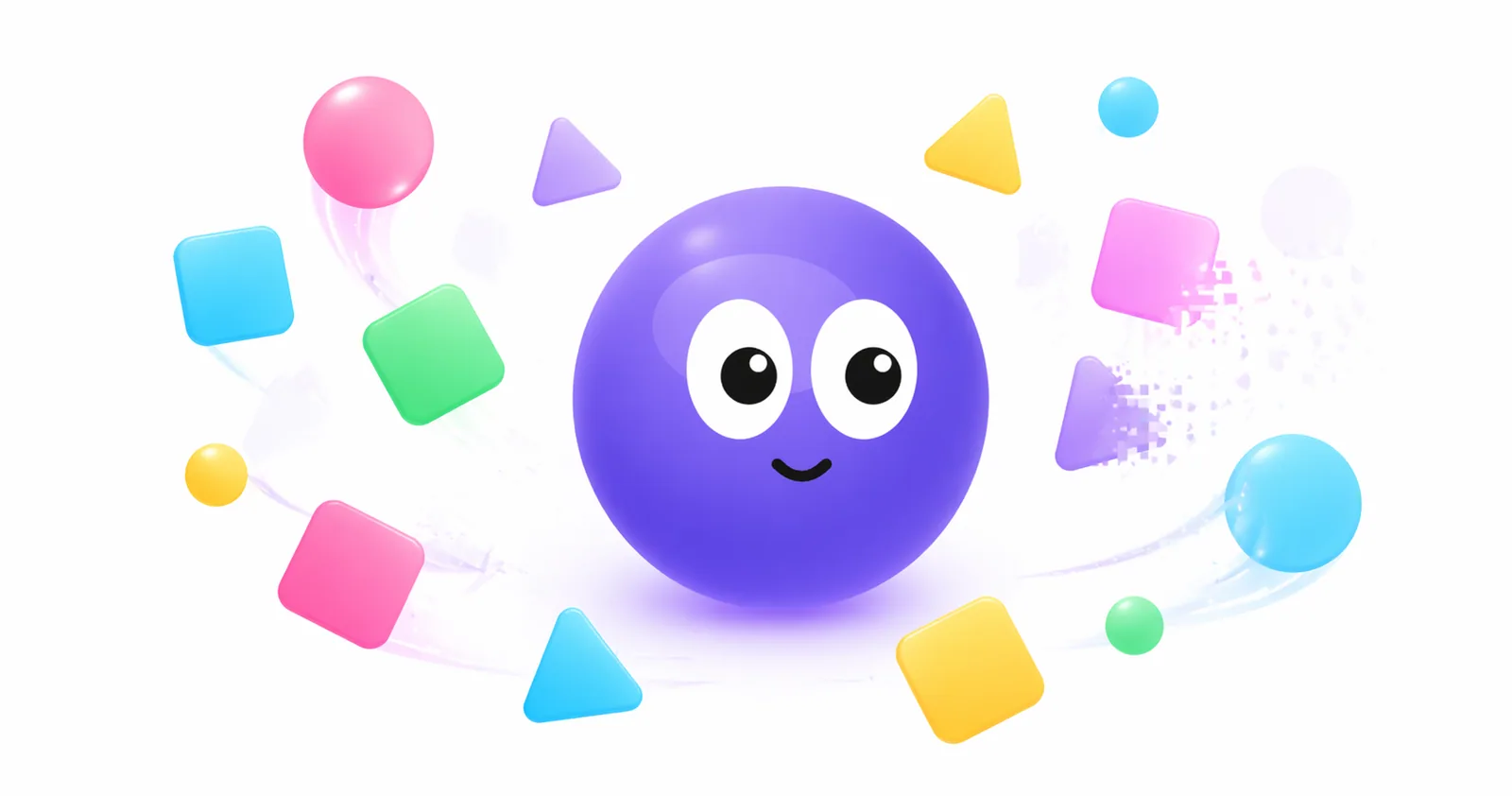
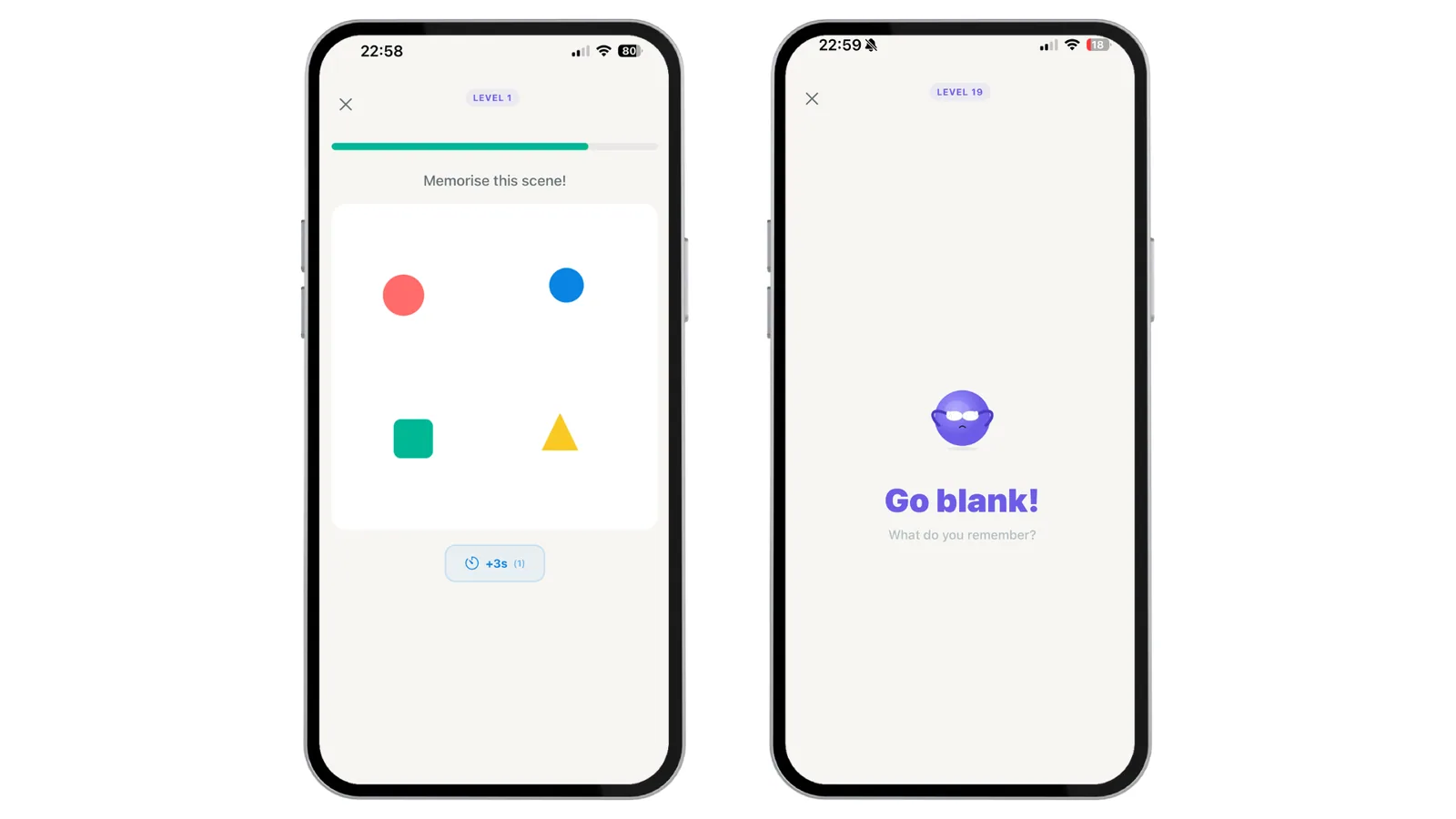
Blink is a purple blob with big, expressive eyes and a surprising amount of personality for something without arms or legs. Blink celebrates your wins, gives you side-eye when you get answers wrong, and absolutely will not let you forget that you’re about to break your streak.
It sounds like a small detail, but it’s not. Research on habit formation shows that emotional attachment to an app significantly increases daily return rates. Blink isn’t just decoration. Blink is your accountability partner, your cheerleader, and occasionally your disappointed parent. You can customise Blink’s appearance with expressions, frames, and banners from the in-app cosmetics shop, which gives you something to work toward beyond just levelling up.
Streaks, Lives, and Power-Ups
Daily Streaks
Play at least one session per day and your streak counter goes up. Miss a day and it resets to zero. Streak shields are available (earned through play or included with Blanked+) that protect your streak if you miss a day.
Why streaks matter for training: the neuroscience is clear that consistency beats intensity when it comes to memory improvement. A 2-minute daily session is more effective than a 30-minute weekly one. The streak system is designed to nudge you toward the pattern that produces actual results.
Lives
You start with a set number of lives. Get an answer wrong and you lose one. Run out and you wait for them to regenerate (or use a Blanked+ subscription for unlimited lives). This might feel frustrating at first, but it serves a purpose: it makes you care about each answer. When there’s a cost to getting it wrong, your brain pays more attention during the study phase, which directly strengthens encoding.
Power-Ups
Three power-ups are available for when you need a boost:
- Peek: Get a brief second glance at the scene after it’s disappeared. Useful when a level feels just beyond your current ability.
- 50/50: Removes two incorrect answers from a multiple-choice question. Narrows your odds when you’re genuinely stuck.
- Skip: Jump past a question entirely. Best saved for those moments when you drew a complete blank (no pun intended).
Power-ups are earned through gameplay, rewarded at streak milestones, or available through the Blanked+ subscription.
Blanked+: What You Get With the Subscription
Blanked is free to play. You can download it, play every game mode, and progress through levels without paying anything. The free experience includes ads and limited lives.
Blanked+ is the premium subscription. Here’s what it adds:
- Unlimited lives. No more waiting for regeneration. Play as many sessions as you want.
- 100 gems per month. Gems are used for power-ups and cosmetics in the shop.
- Daily power-up. One free power-up every day.
- No ads. Clean, uninterrupted experience.
- Memory Analytics. Detailed tracking of your visual memory performance over time, broken down by game mode and skill type.
The Memory Analytics feature is worth highlighting. It doesn’t just tell you your score. It shows you trends in your encoding speed, recall accuracy, and which types of visual information you struggle with most. If you’re treating visual memory training seriously, this is where you see whether it’s actually working.
Beginner Tips: How to Get Better Fast
If you’re just starting out, here are seven tips that will accelerate your progress:
1. Start with Classic mode. It builds the foundational skills that every other mode relies on. Get comfortable with Classic before branching out.
2. Don’t try to memorise everything. In the early levels, focus on 2 to 3 key details per scene rather than trying to absorb the entire grid. As your visual memory capacity grows, you’ll naturally hold more.
3. Use chunking. Group shapes by colour, position, or pattern rather than trying to remember individual items. “Three red shapes on the left, two blue on the right” is much easier to hold than six separate items. (More on this in our guide to improving your visual memory.)
4. Narrate what you see. Silently describing the scene in your head (“yellow triangle top-left, blue circle centre, green square bottom-right”) engages both visual and verbal encoding, which creates a stronger memory trace.
5. Play daily, not in binges. Two minutes every day beats twenty minutes once a week. Your brain consolidates learning during sleep, so consistent daily exposure with overnight consolidation is the fastest path to improvement.
6. Protect your streak. It sounds gamified and trivial, but the streak mechanic works because it creates a tiny commitment loop. Once you’re on day 15, you won’t want to break it. And that consistency is exactly what produces results.
7. Don’t stress about wrong answers. Getting things wrong is part of the training. Each mistake teaches your brain what it missed, which sharpens encoding on the next round. If you’re getting everything right, the difficulty probably isn’t high enough to be training you effectively.
Ready to try it? Download Blanked free from the App Store and see how your visual memory stacks up. The first few levels are gentle. After that, Blink starts raising the bar. Good luck.
Frequently asked questions
Is Blanked free to play?
How long does a Blanked session take?
Is Blanked available on Android?
What age group is Blanked designed for?
Does Blanked actually improve memory?
Train your memory. Play Blanked free.
A free visual memory game built around how memory actually works. 6 game modes, 400+ levels.
Download on the App Store