Memory Training for Students: Remember What You Study


On this page (7)
You’ve been at your desk for three hours. You’ve read the chapter twice, highlighted the important bits, and made colour-coded notes. You feel prepared. Then you close the textbook, and within twenty minutes, half of it has already started to dissolve.
Sound familiar? You’re not alone. Research shows that students who use passive study methods like rereading and highlighting retain only about 34% of material after a week. Students who use active recall techniques retain over 80%.
That’s not a small difference. That’s the difference between scraping through and actually knowing your subject. The good news is that remembering what you study isn’t about studying harder or longer. It’s about studying in a way that works with your brain instead of against it.
Why You Forget What You Study (It’s Not Your Fault)
Before we talk about what works, it helps to understand why the default approach fails.
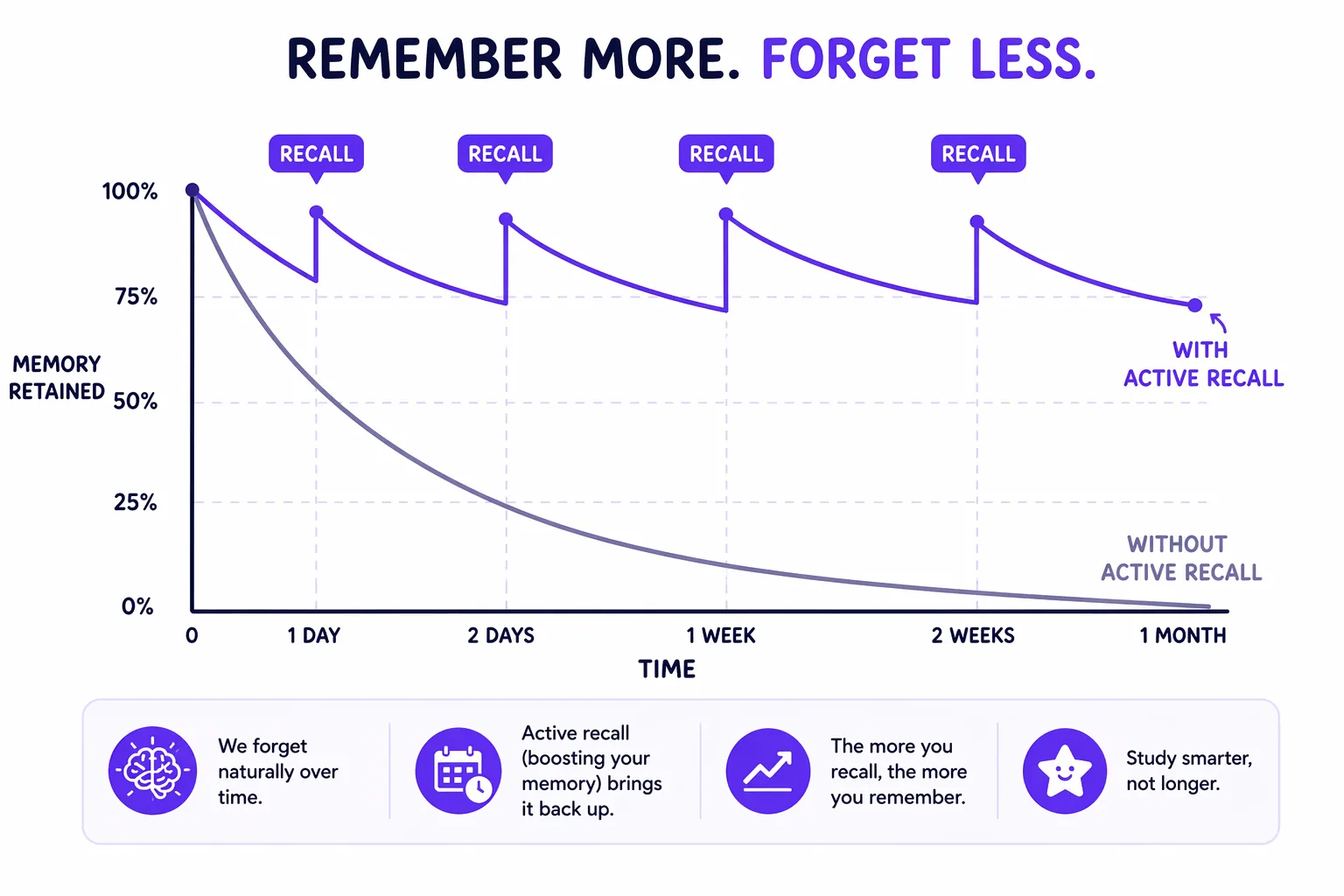
In the 1880s, psychologist Hermann Ebbinghaus discovered the forgetting curve: within 20 minutes of learning something, you’ve already lost around 40% of it. After a day, roughly 70% is gone. After a week, you’re down to about 10 to 20%. (We cover this in more detail in our post on why you forget things so quickly.)
The forgetting curve isn’t a flaw in your brain. It’s a feature. Your brain is constantly deciding what to keep and what to discard, and its default assumption is that most new information isn’t important enough to store permanently. Your job as a student is to convince your brain otherwise.
The way you do that is through how you interact with the information, not how many times you look at it. Rereading your notes feels productive, but it’s mostly passive. Your brain processes the words without deeply encoding them. It’s like driving the same route every day but never actually learning the street names.
Active Recall: The Single Most Effective Study Technique
If you take one thing from this entire article, make it this: active recall is the single most powerful study technique backed by cognitive science. It beats rereading, highlighting, summarising, and re-watching lectures.
Active recall means forcing yourself to retrieve information from memory without looking at your notes. Instead of reading a chapter and thinking “yeah, I know this,” you close the book and ask yourself: “What were the three main causes of the French Revolution?” Then you try to answer from memory. The struggle to remember is the training.
Research from Washington University found that students who used retrieval practice remembered 80% of material a week later, compared to 34% for students who simply reread their notes. The act of pulling information out of your memory strengthens the neural pathways involved, making future retrieval faster and more reliable.
Here’s how to build active recall into your study sessions:
- The blank page method. After reading a section, close everything and write down everything you can remember on a blank page. Then check what you missed. The gaps show you exactly what needs more work.
- Self-testing. Write questions as you take notes, then test yourself on them later without looking at the answers. Flashcard apps like Anki automate this process.
- The Feynman Technique. Explain the concept out loud as if teaching a 12-year-old. If you can’t explain it simply, you don’t understand it well enough.
The key insight is that difficulty is productive. When it feels hard to remember something, that’s your brain building a stronger connection. Easy recall means weak encoding. Effortful recall means lasting memory.
Spaced Repetition: Stop Cramming, Start Spacing
Cramming the night before an exam works for passing the test. It fails spectacularly for actually retaining what you’ve learned. If you’re studying a subject you’ll need to build on later (medicine, law, engineering, languages), cramming is actively counterproductive.
Spaced repetition is the antidote. Instead of reviewing material once in a marathon session, you review it at increasing intervals: after one day, then three days, then a week, then two weeks. Each review session reactivates the memory trace just before it fades, which strengthens it and extends the time before the next review is needed.
A 2009 study at the University of California found that 90% of students performed better when learning was spaced out over time compared to massing it into a single session. The effect is consistent across subjects, age groups, and types of material.
A practical spaced repetition schedule for exam prep might look like this:
- Day 1: Learn the material. Take notes using active recall.
- Day 2: Review and self-test on yesterday’s material.
- Day 4: Review again. Focus on what you got wrong.
- Day 7: Full self-test. Identify remaining gaps.
- Day 14: Final review. By now, most material should feel solid.
This means starting your revision earlier than you normally would. But the trade-off is that you’ll actually remember what you studied, rather than watching it evaporate twenty minutes after the exam ends.
The Visual Memory Advantage Most Students Ignore
Here’s something most study guides don’t tell you: a huge portion of academic material is visual, and most students never train their visual memory specifically.
Think about what you’re actually asked to remember in exams. Diagrams in biology. Charts in economics. Maps in geography. Anatomical structures in medicine. Chemical compound structures. Historical timelines. Circuit diagrams in physics. All of these rely heavily on your ability to encode, store, and recall visual information.
Visual memory is processed through different neural pathways than verbal memory. The occipital and parietal lobes handle spatial and visual information, while verbal information is processed primarily through the temporal lobe. This means that even if your verbal recall is strong, your visual recall might be weak, and vice versa. (For the full neuroscience breakdown, see our post on what happens to your brain when you play memory games.)
How do you strengthen visual memory for studying?
- Draw from memory. After studying a diagram, close your book and redraw it. This forces active recall of visual information specifically. It doesn’t matter if your drawing is messy. The act of reconstructing it is what builds the memory.
- Use colour coding deliberately. Colour isn’t just decoration. Assigning specific colours to categories of information creates additional encoding pathways. Your brain can recall “the red section” faster than “the third paragraph on page 47.”
- Visualise abstract concepts. Turn abstract information into mental images. If you need to remember that inflation reduces purchasing power, imagine a balloon getting bigger while a shopping basket gets smaller. The more vivid and absurd the image, the more memorable it becomes.
The Memory Palace: Ancient Technique, Modern Results
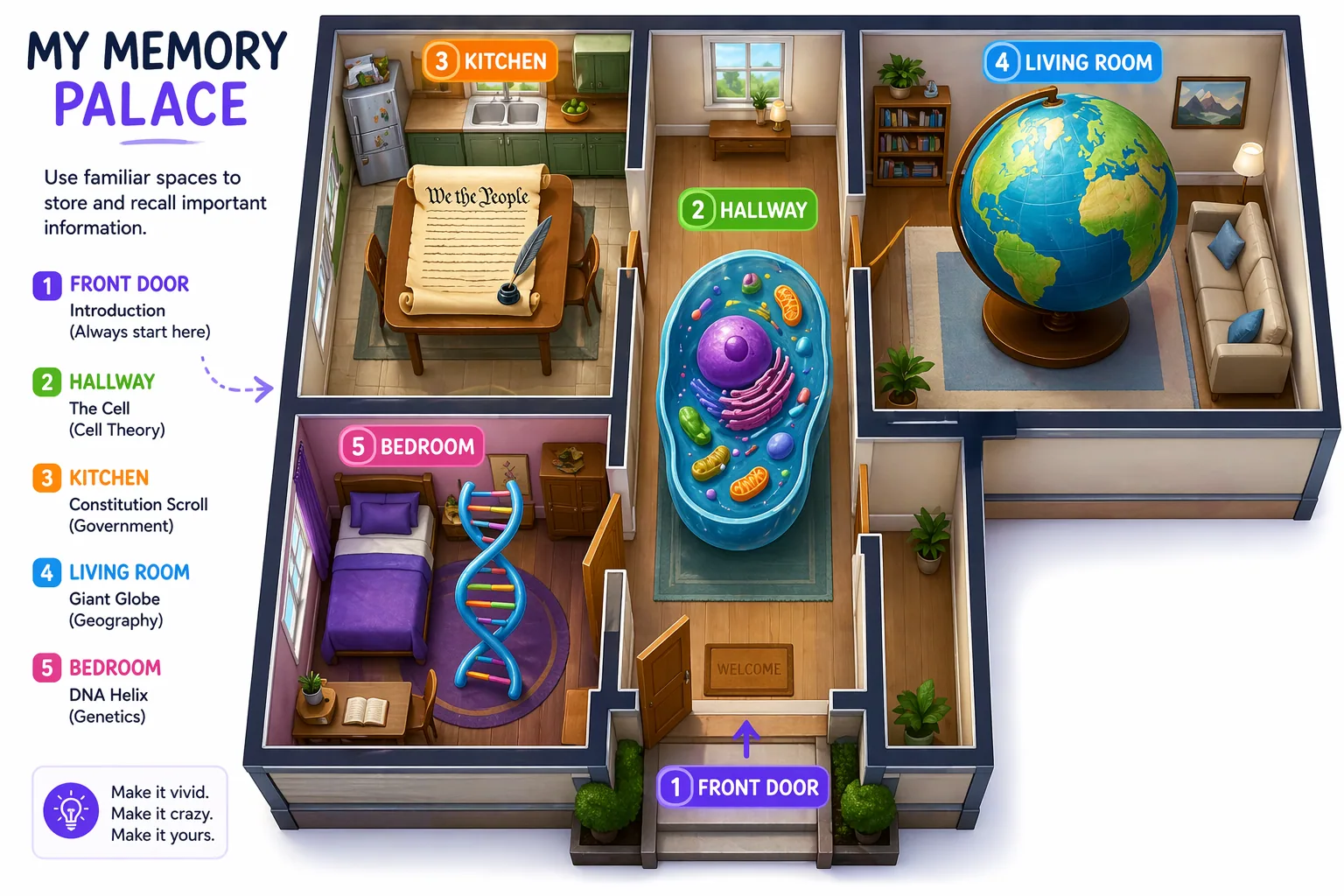
The Memory Palace technique (also called the method of loci) has been used since ancient Greece, and modern research confirms it’s still one of the most effective methods available. A study published in the journal Neuron found that participants using this technique recalled up to 95% of a 40-word list a week after learning it.
The concept: you mentally place items you need to remember at specific locations within a building you know well, like your house. To recall them, you mentally walk through the space and “see” each item where you left it.
For students, this is particularly powerful for sequential information:
- History: place key events from a timeline at locations through your house in chronological order.
- Biology: walk through the stages of cell division room by room.
- Law: place each element of a legal test at a different spot in your kitchen.
- Languages: associate new vocabulary with vivid images at specific locations.
The technique works because it converts abstract information into spatial and visual memory, which your brain processes more naturally and retains more durably. You’re essentially hijacking a system your brain is already excellent at (remembering places) and using it to store information your brain would otherwise forget. (More on this technique in our guide to improving your visual memory.)
The Study Stack: Putting It All Together
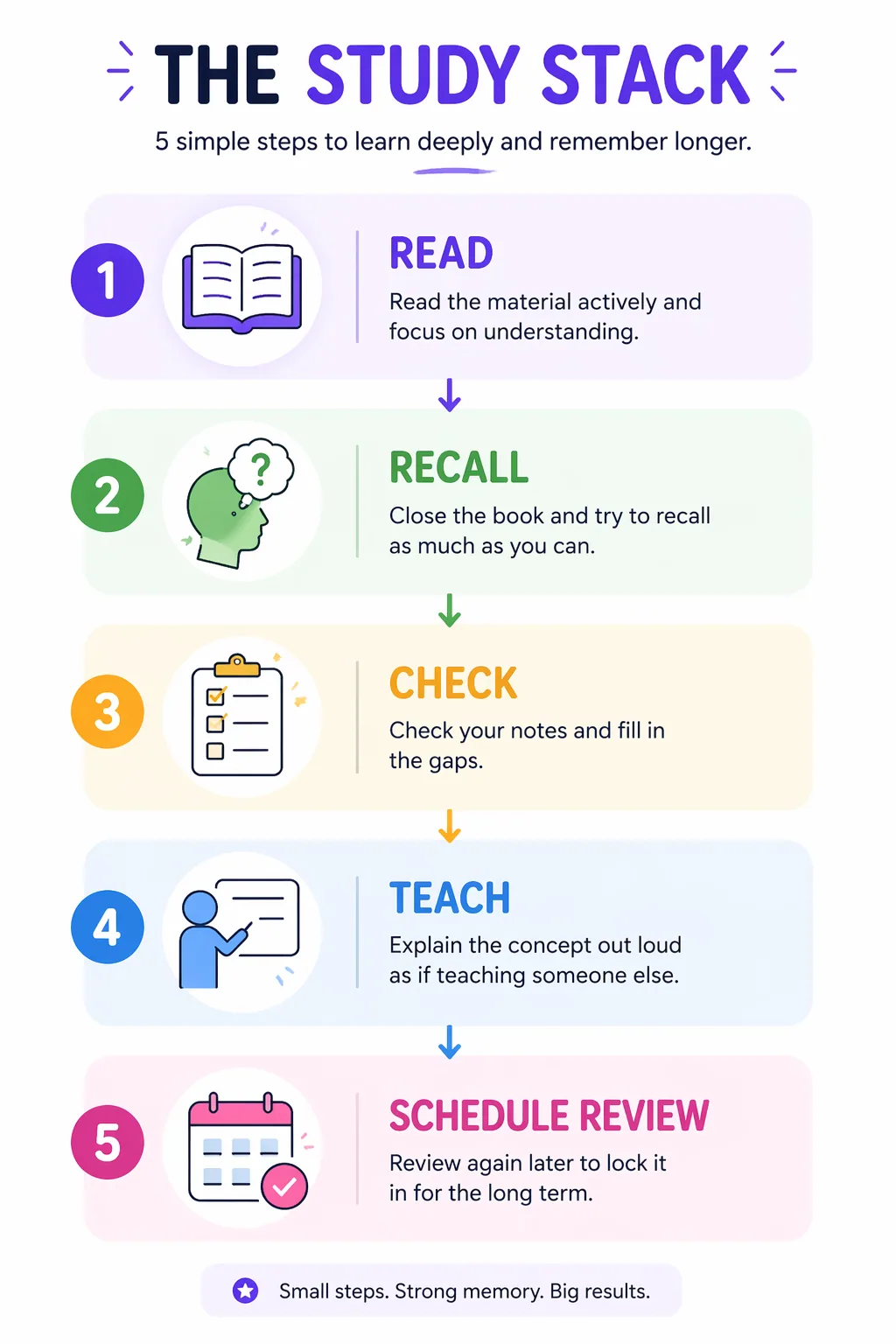
You don’t need to use every technique every time you study. But combining a few of them into a consistent routine creates a powerful system. Here’s a practical study stack that takes about 30 to 45 minutes per session:
Step 1: Read and take notes (15 minutes). Read the material once, actively. Don’t highlight. Instead, write questions in the margin or on a separate sheet as you go.
Step 2: Close everything and recall (10 minutes). On a blank page, write down everything you can remember. For visual material, sketch diagrams from memory. Don’t peek.
Step 3: Check and fill gaps (5 minutes). Open your notes, identify what you missed, and focus your attention on those specific gaps.
Step 4: Teach it (5 minutes). Explain the key concepts out loud as if teaching someone. Use your own words. If you stumble, that’s a gap that needs more work.
Step 5: Schedule your next review. Put a reminder in your calendar to review this material in 1 to 3 days. When you review, go straight to active recall. Don’t reread.
This approach takes roughly the same amount of time as a typical study session, but produces dramatically better retention because every step involves active engagement rather than passive consumption.
What About Brain Training Apps?
Brain training apps aren’t a substitute for studying. No app will magically help you pass organic chemistry. But they can serve a specific supporting role: strengthening the underlying cognitive skills that make studying more effective.
Think of it like warming up before a workout. You wouldn’t expect stretching to win you a race, but it makes your muscles more ready to perform. Similarly, a daily brain training session can prime your working memory, visual recall, and processing speed for the study session that follows.
If visual memory is relevant to your subject (and for most subjects, it is), training it specifically can make a real difference. Blanked is built entirely around visual memory training: you study a scene, it disappears, and you answer from memory. It takes 2 minutes, which means you can do it as a warm-up before opening your textbooks.
The broader research supports this idea. Studies show that targeted cognitive training can improve working memory capacity and processing speed, both of which directly affect how efficiently you encode and retrieve study material. The key word is “targeted.” Generic puzzle games don’t have the same effect as apps specifically designed to train memory. (For a detailed comparison, see our best brain training apps 2026 guide.)
The biggest shift you can make as a student isn’t studying more. It’s studying differently. Active recall, spaced repetition, visual memory training, and the Memory Palace technique aren’t hacks or shortcuts. They’re how your brain is designed to learn. Every hour you spend fighting your brain’s natural systems with passive rereading is an hour wasted. Every hour you spend working with those systems is an hour invested.
Start with one technique. Add another next week. Build a routine that sticks. And if you want to give your visual memory a 2-minute daily boost before you study, try Blanked for free. Your hippocampus will thank you.
Frequently asked questions
What is the most effective study technique for memory?
How do I stop forgetting what I study overnight?
Does visual memory matter for studying?
Can brain training apps help students study better?
How long should a study session be for best retention?
Train your memory. Play Blanked free.
A free visual memory game built around how memory actually works. 6 game modes, 400+ levels.
Download on the App Store