Why You Forget Things 5 Minutes After Seeing Them


On this page (10)
You glance at a phone number on a screen. Five seconds later, it’s gone. You meet someone at a party, repeat their name in your head, and by the time you’ve walked to the bar, it has completely evaporated. You park your car, walk twenty metres, and genuinely cannot remember which bay you chose.
If any of that sounds familiar, relax. You’re not losing your mind. You’re experiencing something that every single human brain does, and does constantly. The question isn’t whether you forget. It’s why your brain throws out information so aggressively, and what you can do to make the important stuff stick.
Your Brain Isn’t Broken. It’s Filtering.
Here’s the thing most people don’t realise about memory: forgetting isn’t a malfunction. It’s a feature.
Your brain processes an extraordinary amount of sensory information every second. The colour of every car you pass. The hum of the air conditioning. The pattern on the wallpaper in the waiting room. If your brain held on to all of that with equal intensity, you’d be overwhelmed within minutes. Forgetting is your brain’s way of deciding what matters and what doesn’t.
The problem is that this filtering system doesn’t always get it right. Sometimes it discards something you actually needed. You intended to remember the phone number, the name, the parking bay. But your brain, running its usual triage, classified it as disposable. And just like that, it was gone.
Understanding why this happens is the first step toward doing something about it. Because once you know where the process breaks down, you can intervene at exactly the right moment.
The Forgetting Curve: You Lose Half in 20 Minutes
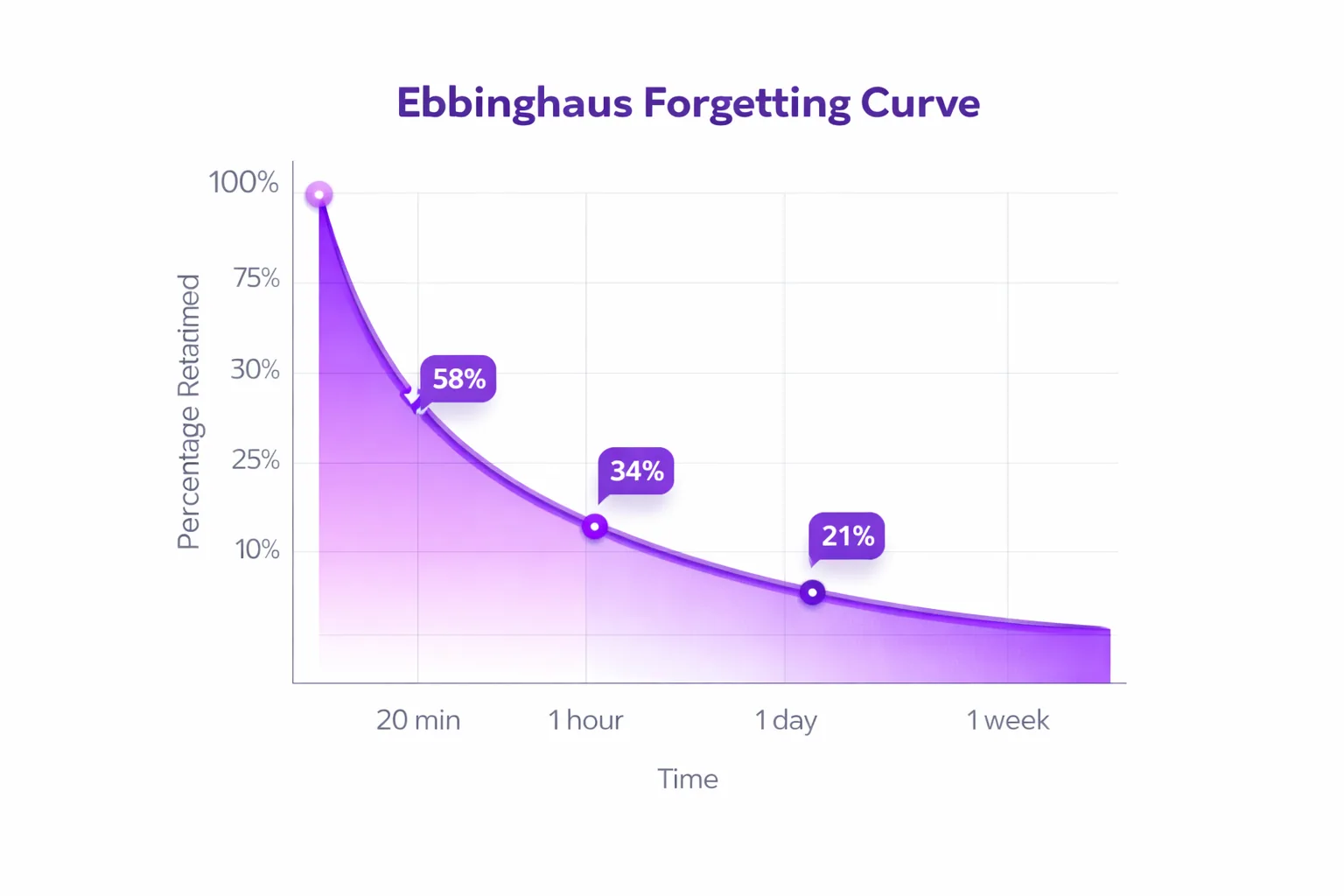
In the 1880s, a German psychologist named Hermann Ebbinghaus ran one of the most important experiments in the history of memory research. He memorised lists of nonsense syllables (meaningless letter combinations like WID and ZOF) and then tested himself at various intervals to see how much he retained.
The results were stark. Within 20 minutes, he’d already forgotten roughly 40% of what he’d learned. After an hour, it was around 50%. After a day, about 70% was gone. After a week, he could barely recall 10%.
This pattern, now called the Ebbinghaus forgetting curve, has been replicated hundreds of times over the past 140 years. The core finding holds: memory loss is fastest immediately after learning, then gradually levels off. The steepest drop happens in the first 20 to 60 minutes.
This is why you can read a fascinating article, feel completely engaged, and struggle to recall the main points by lunchtime. Your brain isn’t defective. It’s doing exactly what Ebbinghaus predicted in 1885.
The 4 Real Reasons You Forget Things So Quickly
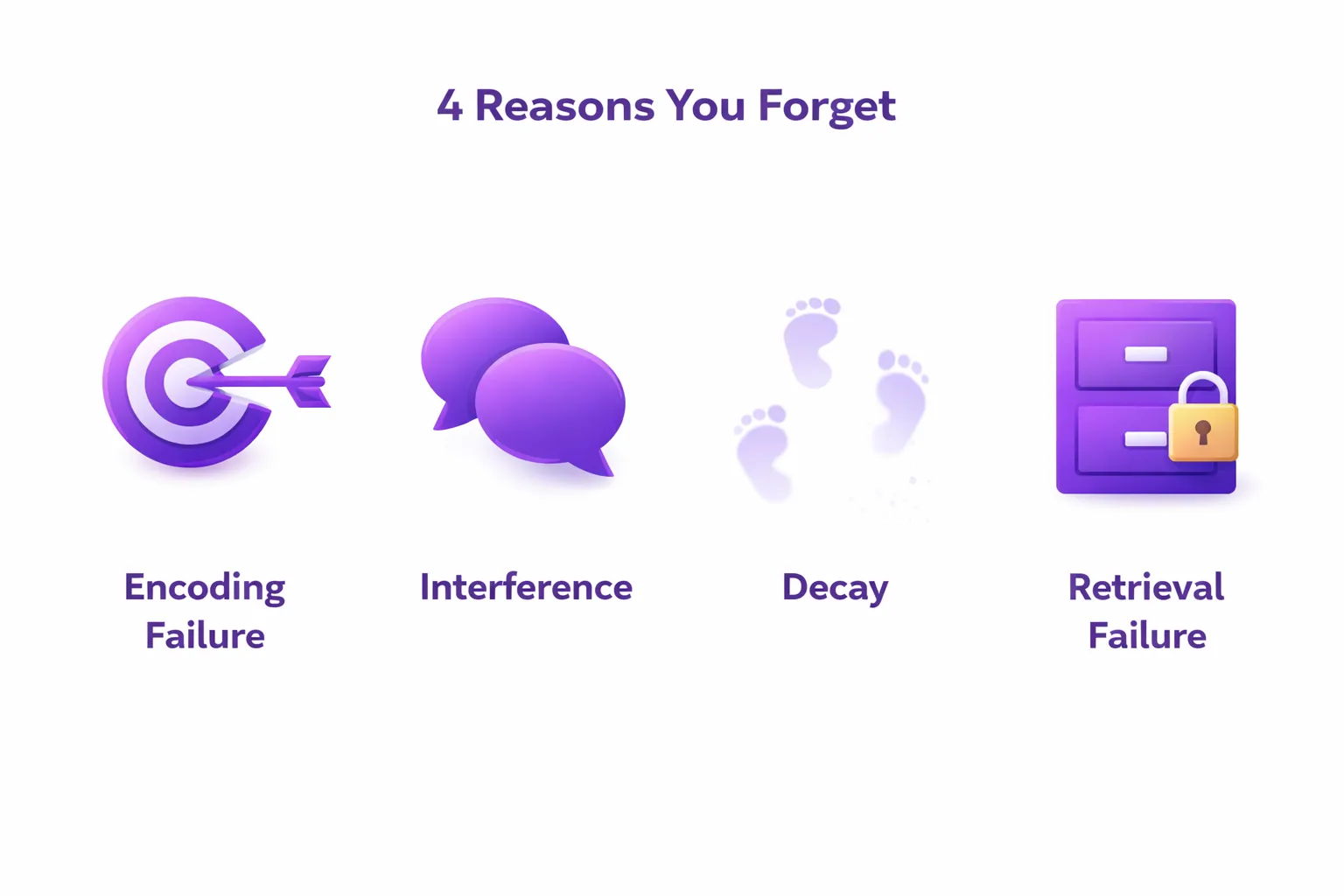
The forgetting curve describes what happens, but it doesn’t fully explain why. There are four main mechanisms behind everyday forgetting, and most of the time, more than one is involved.
1. Encoding Failure: You Never Actually Stored It
This is the biggest culprit, and it’s not really forgetting at all. You can’t forget something you never remembered in the first place.
Encoding failure happens when your brain doesn’t properly process incoming information. Maybe you were distracted, thinking about something else, or simply not paying attention. The data hit your sensory registers (you saw the number, you heard the name) but it never made the jump from perception into short-term memory.
Here’s a classic test: without looking, can you describe which direction the Queen faces on a pound coin? Most people can’t, despite having seen hundreds of them. The information was perceived but never encoded. Your brain saw it but didn’t bother to file it.
This is the reason you “forget” where you put your keys. You didn’t forget. You never recorded the location in the first place because your attention was elsewhere when you set them down.
2. Interference: New Information Pushes Out the Old
Your working memory has a very limited capacity. Research suggests it can hold roughly 3 to 4 items at a time (the old estimate of 7 has been revised downward). When new information comes in, it competes with whatever’s already there.
This happens in two directions. Retroactive interference is when new information disrupts your recall of older information (you learn a new phone number and suddenly can’t remember the old one). Proactive interference is the reverse, when old memories make it harder to learn new ones (you keep typing your old password because the muscle memory is too strong).
Interference explains why you can remember the name of the first person you met at a party but not the fifth. Each new name competes with and partially overwrites the ones before it.
3. Decay: The Memory Trace Fades
Even when you successfully encode information, the memory trace (the physical neural pattern created in your brain) weakens over time if it’s not reinforced. Think of it like a footprint in sand. Fresh and clear at first, then gradually smoothed away unless you retrace it.
Decay is what the forgetting curve primarily measures. The neural connections formed during learning become weaker the longer they go without being reactivated. This is why spaced repetition (revisiting information at increasing intervals) is so effective. Each review retraces the footprint before it disappears completely.
4. Retrieval Failure: It’s in There, You Just Can’t Access It
Sometimes the memory is stored perfectly well, but you can’t find it. This is the “tip of the tongue” phenomenon. You know you know it. You can feel the shape of the answer. But the retrieval pathway is blocked or too weak to follow.
Retrieval failure often happens because of missing context cues. Your brain stored the memory alongside certain environmental details (the room you were in, the song that was playing, the mood you were in), and without those cues, the pathway back to the memory is harder to navigate. This is why revisiting a place you haven’t been to in years can suddenly flood you with memories you thought were long gone.
The Doorway Effect (Yes, It’s a Real Thing)
You stand up from your desk, walk to the kitchen, and the moment you cross the threshold, you’ve completely forgotten why you went there. Sound familiar?
Researchers at the University of Notre Dame studied this in 2011 and gave it a proper name: the doorway effect. Their experiments showed that walking through a doorway genuinely impairs your ability to recall what you were just thinking about. The theory is that your brain treats doorways as “event boundaries.” Crossing one signals the end of one mental chapter and the beginning of another, which causes your brain to partially clear its working memory to make room for new information.
It’s not a sign of cognitive decline. It’s your brain’s filing system doing a page break at an inconvenient time. If it makes you feel better, this happens to people of all ages, not just when you get older.
Why Visual Memories Fade Faster Than You’d Think
Visual information is processed and discarded particularly quickly. Your iconic memory (the initial visual snapshot your brain takes) lasts only about 200 to 400 milliseconds. After that, the information either moves into short-term visual memory or it’s gone forever.
Short-term visual memory holds about 3 to 4 items for a few seconds. And this is where most visual forgetting happens. You glance at a scene, your brain captures a few details, and within seconds, most of the information has decayed. Unless you actively engaged with what you saw (paid attention, noticed patterns, created a mental narrative), the trace fades almost immediately.
This is relevant because a huge amount of modern life is visual. Faces, directions, documents, presentations, dashboards, maps, product designs. If your visual memory isn’t well-trained, you’re constantly re-checking, re-reading, and re-looking because the information didn’t stick the first time.
The good news is that visual memory responds particularly well to targeted training. Research from the University of Michigan found that adults who practised pattern recognition tasks showed improved visual processing speed and working memory after just two weeks. The neural pathways responsible for visual recall strengthen with use, just like any other skill. (For a deeper look at the science, see our post on what happens to your brain when you play memory games.)
How to Actually Hold On to What You See
Now for the useful part. Understanding why you forget is interesting. Doing something about it is better. Here are five practical strategies that directly target the mechanisms above.
1. Fix encoding by paying attention on purpose. The number one reason for everyday forgetting is that you never encoded the information properly. The fix is deceptively simple: when you want to remember something, look at it deliberately for 3 to 5 seconds and narrate what you see in your head. “I’m parking on level 3, row B, near the yellow pillar.” That conscious narration forces your brain to encode it rather than let it pass through.
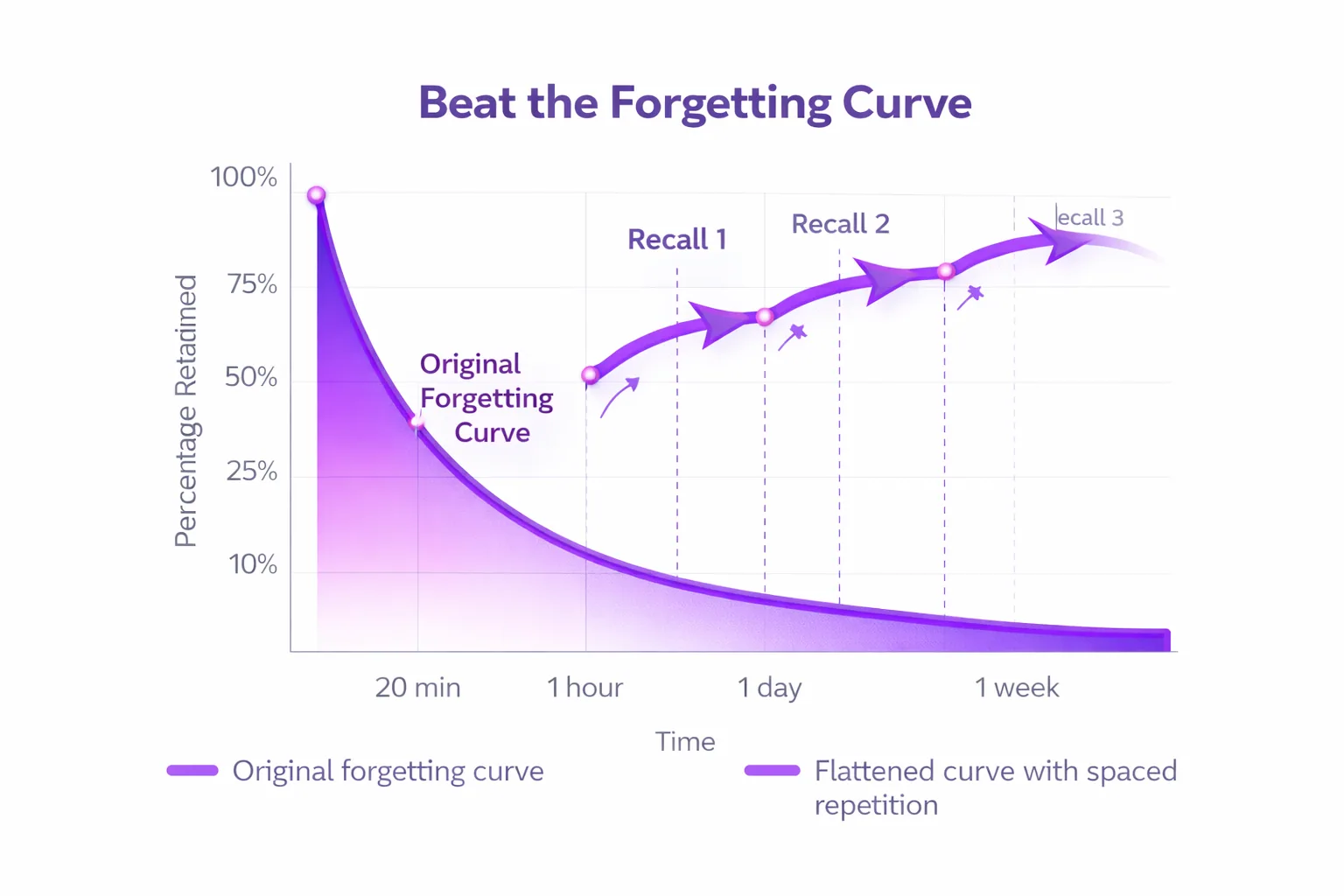
2. Beat the curve with active recall. The forgetting curve’s steepest drop happens in the first hour. If you can actively recall information within that window (without looking at it again), you dramatically flatten the curve. After a meeting, spend 60 seconds recalling the key points without checking your notes. After meeting someone, replay their name and face in your mind before the conversation ends.
3. Use spaced repetition. Ebbinghaus himself discovered that revisiting information at increasing intervals (after one hour, then one day, then three days, then a week) dramatically improved retention. Each recall session strengthens the memory trace and extends the time before the next review is needed. This is the principle behind flashcard apps, but it applies to any type of information.
4. Reduce interference by single-tasking. If new information pushes out old information, then doing fewer things simultaneously protects what’s already in your working memory. When you need to remember something, resist the urge to immediately switch to another task. Give your brain a few seconds of quiet to consolidate. Multitasking is the enemy of memory formation.
5. Train your visual memory specifically. If visual forgetting is the problem (and for most people it is), then training your visual memory directly is the most efficient fix. Games that ask you to memorise visual scenes and then recall details from memory are specifically designed to strengthen the encode-store-retrieve pipeline that visual information passes through. This is the core mechanic of Blanked: study a scene, it vanishes, answer from memory. Two minutes a day, and you’re directly training the exact process that breaks down when you “forget” what you just saw. (For more methods, check out our guide to how to improve your visual memory.)
The truth about forgetting is both humbling and encouraging. Humbling because your brain genuinely discards most of what it encounters, and there’s no way around that biological reality. Encouraging because the mechanisms behind forgetting are well understood, which means you can work with your brain’s system instead of fighting it.
You don’t need a perfect memory. You need a trained one. And training starts with understanding that forgetting isn’t the problem. Failing to encode, failing to rehearse, and failing to retrieve are the problems. Fix those, and you’ll be amazed at what you can hold on to.
Frequently asked questions
Is it normal to forget things within minutes?
Why do I forget what I was doing when I walk into another room?
How can I stop forgetting things so quickly?
Does forgetting get worse with age?
Can brain training apps help with forgetfulness?
Train your memory. Play Blanked free.
A free visual memory game built around how memory actually works. 6 game modes, 400+ levels.
Download on the App Store