Screen Time Is Wrecking Your Memory: The Research (2026)


On this page (9)
The average adult spends over 10 hours a day looking at a screen. For teens, it’s roughly 8 to 9 hours. Before the COVID-19 pandemic, adult screen time was already high. During lockdowns, it spiked to an average of 16 hours a day. And it never fully came back down.
Most of that screen time is passive. Scrolling through social media. Watching videos on autoplay. Flicking between tabs without absorbing anything. Your eyes are active, but your brain is coasting. And a growing body of research suggests that this kind of screen usage is doing something measurable to your memory.
This isn’t a pearl-clutching “phones are evil” article. Screens aren’t inherently bad. But the way most people use them is, and the science is starting to show exactly why.
The Number That Should Worry You
A large-scale study published in 2023 analysed over 462,000 participants and found that more than 4 hours of daily screen time was associated with an increased risk of vascular dementia, Alzheimer’s disease, and all-cause dementia. Higher daily screen time was also linked to physical changes in specific brain regions.
A 2026 study from Nanjing Normal University used functional near-infrared spectroscopy (brain imaging) to examine college students’ cognitive performance relative to their smartphone usage. Students with excessive screen time showed measurably impaired working memory, the kind of memory you use to hold and manipulate information in real time.
And a 2025 scoping review from Penn State, covering 17 studies on adults aged 40 and over, found a consistent pattern: passive screen time (scrolling, watching TV, binge-watching) was associated with declines in verbal memory and global cognition. The decline wasn’t subtle.
These aren’t fringe studies or scare tactics. They’re published in peer-reviewed journals and they’re painting a consistent picture: how you use your screen matters enormously for your cognitive health.
Passive vs Active: Not All Screen Time Is Equal
This is the most important distinction in the research, and the one that most articles about screen time completely miss.
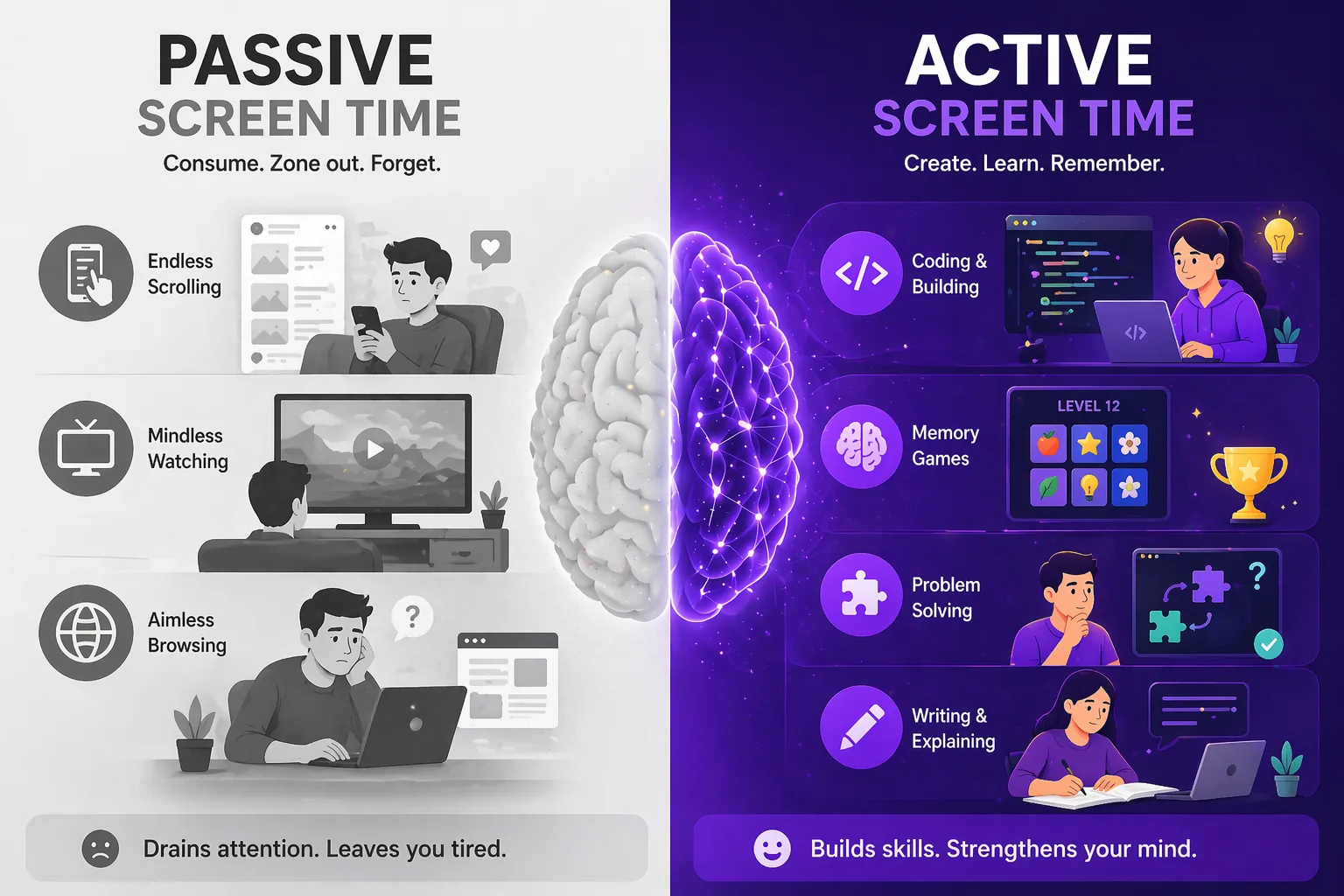
Passive screen time is when you’re consuming content without actively engaging your brain. Scrolling through Instagram. Watching TikTok on autoplay. Having Netflix on in the background. Your brain is receiving information but not processing it deeply, not encoding it, not working to retrieve anything. It’s the cognitive equivalent of sitting on a sofa all day.
Active screen time is when you’re using a screen in a way that demands cognitive effort. Writing code. Playing a strategy game. Solving problems. Using a memory training app. Your brain is encoding, processing, and retrieving information. It’s working.
The Penn State scoping review made this distinction explicit: active screen use was generally associated with better cognitive outcomes, particularly in memory, executive function, and attention. Passive screen use showed the opposite pattern.
This means the problem isn’t screens themselves. It’s what you do with them. An hour of focused problem-solving on a screen is cognitively beneficial. An hour of passive scrolling is cognitively draining. And most people’s screen time is overwhelmingly the latter.
What Passive Scrolling Does to Your Brain
So why is passive screen time specifically harmful? The research points to three main mechanisms.
1. It Trains Your Brain to Skim, Not Encode
When you scroll through a social media feed, your brain processes dozens of posts per minute. It sees images, reads headlines, registers snippets. But it encodes almost none of it into memory. You’re training your brain to process information at surface level and discard it immediately.
Over time, this becomes a habit. Your brain defaults to shallow processing even when you want to focus deeply. Reading a textbook feels harder. Remembering details from a meeting becomes unreliable. You’ve essentially trained your encoding system to be lazy. (For more on why encoding failures cause forgetting, see our post on why you forget things so quickly.)
2. It Fragments Your Attention
The average person checks their phone 96 times a day. Each check is an attention interruption. And research on task switching shows that every interruption costs you cognitive resources. Your working memory has to dump what it was holding, process the new input, and then try to reload what it was doing before.
Over a day, those interruptions add up. Your working memory spends more time loading and unloading than actually working. The result is that you feel scattered, forgetful, and mentally tired, even though you haven’t done anything cognitively demanding.
3. It Replaces Activities That Build Memory
Every hour spent passively scrolling is an hour not spent on activities that actively strengthen your brain. Reading a book. Having a face-to-face conversation. Playing a game that challenges your memory. Going for a walk (physical exercise boosts BDNF, a protein critical for memory formation). The harm from passive screen time isn’t just what it does. It’s what it replaces.
The Sleep Problem Nobody Talks About
Screen time doesn’t just affect your brain while you’re using the screen. It follows you to bed.
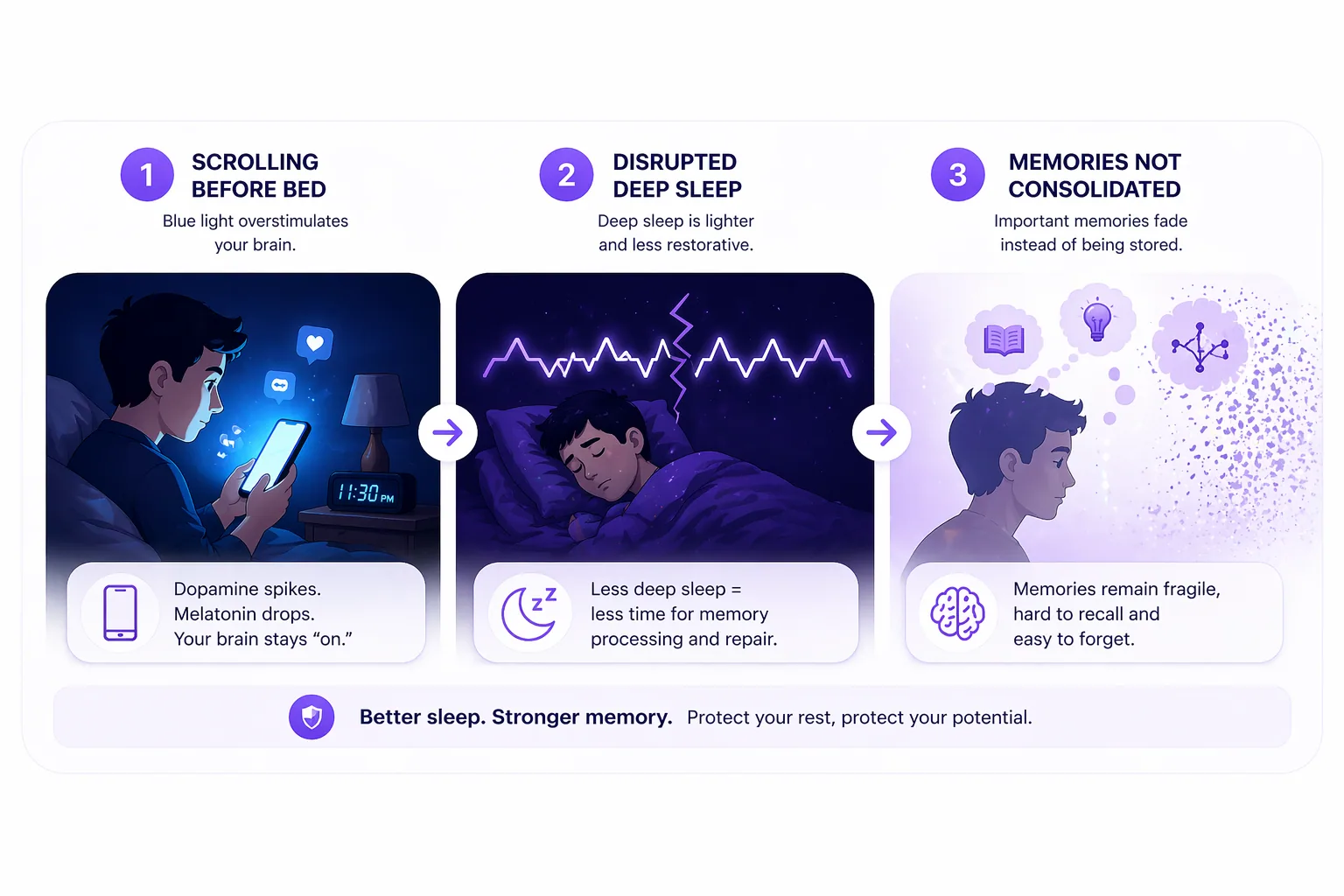
Blue light from screens suppresses melatonin production, the hormone that regulates your sleep cycle. But the sleep damage goes beyond blue light. A 2025 study on university students found that excessive screen time before bed was associated with reduced sleep quality, shorter attention spans, and impaired memory retention the following day.
This matters for memory specifically because sleep is when your brain consolidates memories. During deep sleep, your hippocampus replays the day’s experiences and transfers important information from short-term to long-term storage. Disrupt that process, and the memories from your day simply don’t get filed properly. (We cover this in detail in our guide to how to improve your visual memory.)
The practical implication is clear: scrolling through your phone in bed isn’t just a bad sleep habit. It’s actively sabotaging the memory consolidation process that was supposed to happen while you slept.
Digital Dementia: Real Concern or Media Panic?
The term “digital dementia” was coined by German neuroscientist Manfred Spitzer in 2012. It describes cognitive decline associated with technology overuse, and it’s been picked up enthusiastically by media outlets ever since.
So is it a real thing? The honest answer: the label is dramatic, but the underlying concern has merit.
Digital dementia is not a clinical diagnosis. You won’t find it in any medical handbook. But the cognitive effects it describes (reduced memory capacity, shortened attention span, difficulty with deep processing) are well-documented in the research. The 462,000-participant study linking 4+ hours of daily screen time to increased dementia risk is real. The brain imaging studies showing impaired working memory in heavy phone users are real.
What’s misleading about the term is that it implies inevitability. Your phone isn’t going to give you dementia. But if your daily routine involves 6 to 10 hours of passive screen consumption, minimal physical exercise, poor sleep, and no cognitively demanding activities, you are creating conditions that are genuinely unfavourable for your brain’s long-term health.
The good news is that these effects appear to be reversible, especially with targeted intervention.
How to Fight Back Without Going Off-Grid
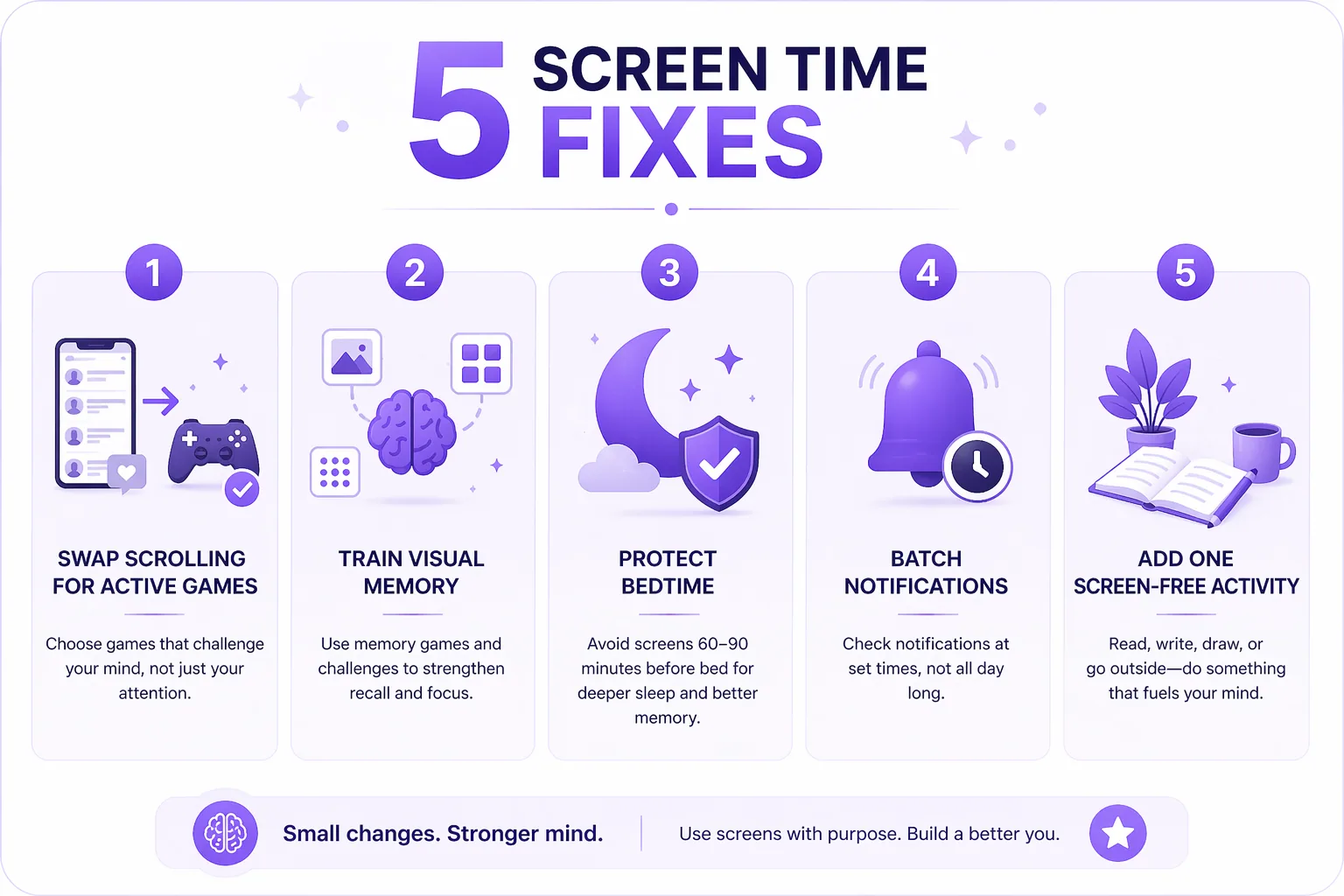
Nobody is going to throw their phone in a river. And you don’t need to. The research doesn’t say “screens are bad.” It says “passive screen time is bad.” That’s a solvable problem. Here are five practical ways to shift the balance.
1. Replace passive scrolling with active screen time. Swap 10 minutes of social media for 10 minutes of something that challenges your brain. A puzzle game. A language app. A memory training session. You’re still using a screen, but you’re switching from consumption to engagement. Your brain can tell the difference.
2. Train your visual memory specifically. If passive scrolling trains your brain to skim and discard, visual memory training does the opposite. It trains you to encode, store, and recall what you’ve seen. Blanked is built around this exact process: study a scene, it disappears, recall it from memory. Two minutes a day is enough to counterbalance a significant chunk of passive screen damage. (For the science behind why this works, see our post on what happens to your brain when you play memory games.)
3. Protect the last hour before sleep. This is the highest-impact change you can make. Put your phone in another room for the last 60 minutes before bed. Read a physical book, have a conversation, or simply let your brain wind down. Your sleep quality will improve, and with it, your memory consolidation.
4. Batch your notifications. Every notification is an attention interruption, and every interruption costs your working memory. Turn off non-essential notifications and check your phone at set intervals (every 30 or 60 minutes) rather than reactively. Your working memory will thank you.
5. Add one daily activity that doesn’t involve a screen. A 20-minute walk. A conversation with a friend. Cooking a meal from a physical recipe. Reading a chapter of a book. These activities use your brain in ways that screens don’t, and they build the neural connections that passive screen time is weakening.
The research on screen time and memory isn’t saying you need to become a Luddite. It’s saying you need to be intentional. Your brain adapts to whatever you repeatedly do. If you repeatedly skim, scroll, and discard, your brain gets efficient at skimming, scrolling, and discarding. If you repeatedly encode, hold, and recall, your brain gets efficient at that instead.
The choice isn’t between screens and no screens. It’s between using your screen in a way that weakens your memory and using it in a way that strengthens it. Two minutes of visual memory training won’t undo 8 hours of passive scrolling. But it’s a start. And Blanked is free to try.
Train your memory. Play Blanked free.
A free visual memory game built around how memory actually works. 6 game modes, 400+ levels.
Download on the App Store