What Is Aphantasia? Life Without a Mind's Eye (2026)

On this page (6)
In 2010, a 65-year-old retired surveyor walked into a neurology clinic in Exeter with a complaint nobody had a name for. After a minor heart procedure, he had lost the ability to picture things in his mind. He could remember his wife's face perfectly well, describe it, recognise it instantly. He just could not see it any more when he closed his eyes. His mind's eye had gone dark.
The neurologist, Adam Zeman, published the case, and something unexpected happened. Letters started arriving from people saying some version of the same thing: that is me, except I have been like this my whole life. They had never lost anything. They had simply never had it, and most of them had spent decades assuming that "picture it in your mind" was a figure of speech everyone else was also pretending about.
In 2015, Zeman and his colleagues gave the condition a name: aphantasia, the absence of a functioning mind's eye. A decade on, it is one of the fastest-growing areas of memory and imagination research, and if you are reading this because you just discovered that other people literally see images in their heads, you are in good company.
The Apple Test
Here is the moment most people discover which side of this line they are on.
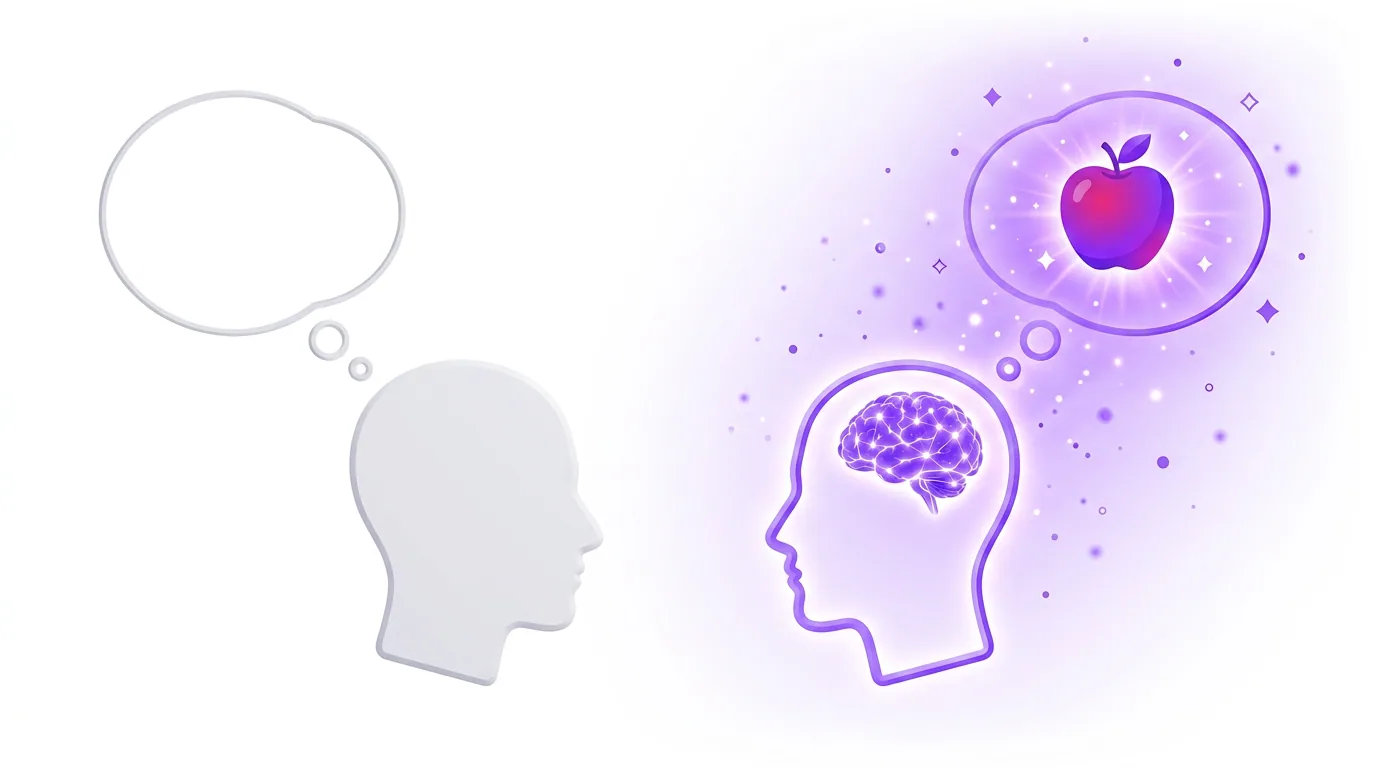
Close your eyes and imagine an apple. Now ask yourself what you actually experienced. Some people report a vivid, almost photographic apple: red, glossy, with a stem and a leaf and a particular way the light falls on it. Others get something dimmer, a vague appleish impression that comes and goes. And somewhere between 1 and 4 people in every 100 get nothing at all. No image, no shape, no colour. They know what an apple is, they can list its properties, they can draw one. There is just nothing to look at.
That last group is aphantasic. The scientific instrument behind this informal test is the Vividness of Visual Imagery Questionnaire (VVIQ), a 16-item scale developed in 1973 that asks you to rate the vividness of imagined scenes, from "perfectly clear and as vivid as normal vision" down to "no image at all, you only know that you are thinking of the object". Score at the very bottom of the scale and you meet the research definition of aphantasia. Zeman's work puts complete aphantasia at roughly 0.7 percent of the population, with broader imagery weakness at around 3 to 4 percent. At the other end of the same spectrum sits hyperphantasia, imagery so vivid it approaches actual seeing, in roughly 3 percent of people.
The remarkable part is how late in life most aphantasics find out. Because the condition is lifelong and invisible, and because language about imagery is ambiguous, people routinely reach their 30s, 40s or 60s before a conversation or an article like this one reveals that "counting sheep" was never a metaphor.
How Scientists Proved It Is Real
An obvious objection hangs over all of this: how do you know aphantasics are not just describing the same experience differently? Maybe everyone has similar imagery and some people simply rate it more modestly.
Two experiments closed that door.
The first used binocular rivalry, a lab technique where each eye is shown a different image (say, red stripes to one eye and green stripes to the other) and the brain flips between them, consciously seeing one at a time. In people with typical imagery, merely imagining one of the images beforehand primes the brain to see that image first when the rivalry begins. It is an objective, involuntary fingerprint of mental imagery. In 2018, researchers Rebecca Keogh and Joel Pearson found that self-described aphantasics show no priming effect at all. Their reports of a blank mind's eye matched what their visual systems were actually doing.
The second experiment is even more elegant. Your pupils constrict when you look at something bright, and it turns out they also constrict, slightly, when you merely imagine something bright. In 2022, the same lab showed that aphantasic participants produce no pupillary response to imagined brightness, while typical imagers do. You cannot fake your pupils. Aphantasia is not a difference in vocabulary. It is a measurable difference in how the brain simulates visual experience.
What Aphantasia Is Not
Aphantasia is not a disorder, and researchers who have evaluated it against clinical criteria have concluded it does not qualify as one. It is better understood as a variation in human experience, like being left-handed. Most aphantasics live entire successful lives without noticing anything is different.
It is not a failure of knowledge or intelligence. Aphantasics know what things look like. Asked whether grass is darker than an avocado skin, they answer correctly. The information is stored; it just is not rendered as a picture.
It is not blindness of the whole imagination. Many aphantasics report vivid imagination in other senses (inner speech, imagined music, imagined touch), and a striking number still experience visual imagery in dreams, which suggests the deliberate, voluntary generation of images is what is missing, not the machinery of visual experience itself.
And it is emphatically not a creativity block. Ed Catmull, the co-founder of Pixar, is aphantasic. So is Glen Keane, the Disney animator who drew Ariel in The Little Mermaid. Blake Ross, co-creator of Firefox, wrote one of the most widely shared personal accounts of the condition. People who cannot see images in their heads have spent careers putting unforgettable images in everyone else's.
Aphantasia and Memory: What Actually Changes
This is where the condition gets genuinely interesting for anyone who cares about how memory works, because aphantasia splits visual memory into its component parts and shows which ones depend on imagery and which do not.
In a 2021 study in the journal Cortex, researcher Wilma Bainbridge and colleagues asked 61 aphantasics and matched controls to study photographs of rooms, then draw them from memory. The aphantasics drew significantly fewer objects, and they leaned on words, often labelling a rectangle "window" rather than drawing the window. But here is the twist: what they did draw was placed with the same spatial accuracy as the controls, and they made fewer false memory errors, almost never inserting an object that had not been there.
The pattern is a clean dissociation. Object imagery (what things looked like) was impaired. Spatial memory (where things were) was completely intact. Aphantasics seem to navigate the world on layout, structure and verbal description rather than pictures, and for many tasks that works just as well. It may even protect against the false memories that vivid imaginations are prone to inventing.
There is one area where the difference cuts deeper. Aphantasia frequently travels together with a pattern called severely deficient autobiographical memory (SDAM), in which people cannot mentally relive their own past. They know the facts of their lives, but there is no first-person replay, no stepping back into the summer holiday and seeing it. For people with both, the past is a well-organised database rather than a photo album. Many describe it neutrally; some describe it as the one part of aphantasia that carries real loss.
If you want to feel the difference between these memory systems yourself, our free visual memory test is a two-minute way to measure recall of positions and sequences, the spatial side of the system that aphantasia leaves untouched.
Can Aphantasia Be Trained Away?
The honest answer: there is currently no evidence that lifelong aphantasia can be converted into typical imagery, and anyone selling a cure is ahead of the science. Congenital aphantasia appears stable across life. A small number of acquired cases (like Zeman's original patient) follow injury, surgery or psychological events, and those sometimes evolve, but that is a different phenomenon.
What can change is strategy. Aphantasics already demonstrate this daily: they memorise through verbal description, spatial structure, logic and repetition, and the Bainbridge results show those routes can equal picture-based memory on accuracy. Memory techniques usually described in visual language also survive translation. The memory palace, the most famous "visualisation" technique of all, works for many aphantasics when they swap vivid pictures for spatial positions and verbal tags, because the technique's real engine is spatial structure, not image quality.
The same goes for training the recognition side of visual memory. Noticing, encoding and recalling what you have actually seen (which grid cell just flashed, which pattern appeared where) does not require generating internal pictures at all, which is why aphantasics can perform normally on recognition and location-based memory tasks. A few minutes of daily practice with a visual memory game exercises exactly that machinery: perception, attention and spatial recall, no mind's eye required.
How to Find Out Where You Sit
Start with the apple, but do not stop there, because single-item tests mislead. Run through a few VVIQ-style prompts: the face of someone you see daily, the front of your home, a sunrise. For each one, ask not "do I know this?" but "am I visually experiencing this?" Knowing is memory. Seeing is imagery. Aphantasia is having the first without the second.
If the answer is consistently "nothing to look at", you have learned something real about your own cognition, and the appropriate response is curiosity rather than concern. You have been running on this architecture your whole life. It got you here. The research of the last decade suggests your memory is not worse than anyone else's; it is organised differently, trading pictures for structure, and in some situations that trade works in your favour.
The mind's eye, it turns out, is optional equipment. What is not optional is memory itself, and that can be understood, measured and trained whatever your brain draws, or does not draw, behind closed eyes.
Frequently asked questions
How do I know if I have aphantasia?
Is aphantasia a disability or disorder?
Do people with aphantasia have worse memory?
Can aphantasia be cured or trained away?
Do people with aphantasia dream in images?
Train your memory. Play Blanked free.
A free visual memory game built around how memory actually works. 6 game modes, 400+ levels.
Download on the App Store