How to Build a Memory Palace: Beginner's Guide (2026)

On this page (7)
Close your eyes and picture your childhood home. The front door. The hallway. The kitchen. The route to your bedroom. You can walk through the whole thing room by room, even if you have not set foot in it for twenty years.
You never studied that layout. You never made flashcards for it. Your brain absorbed it automatically, and it will hold that map for the rest of your life.
The memory palace technique works by hijacking that system. Instead of trying to force your brain to store the things it is bad at remembering (lists, numbers, names, speeches), you attach them to the thing it is astonishingly good at remembering: places. It is the oldest memory technique in recorded history, it is the method used by nearly every competitive memory athlete on the planet, and you can build your first one in about 15 minutes.
What Is a Memory Palace?
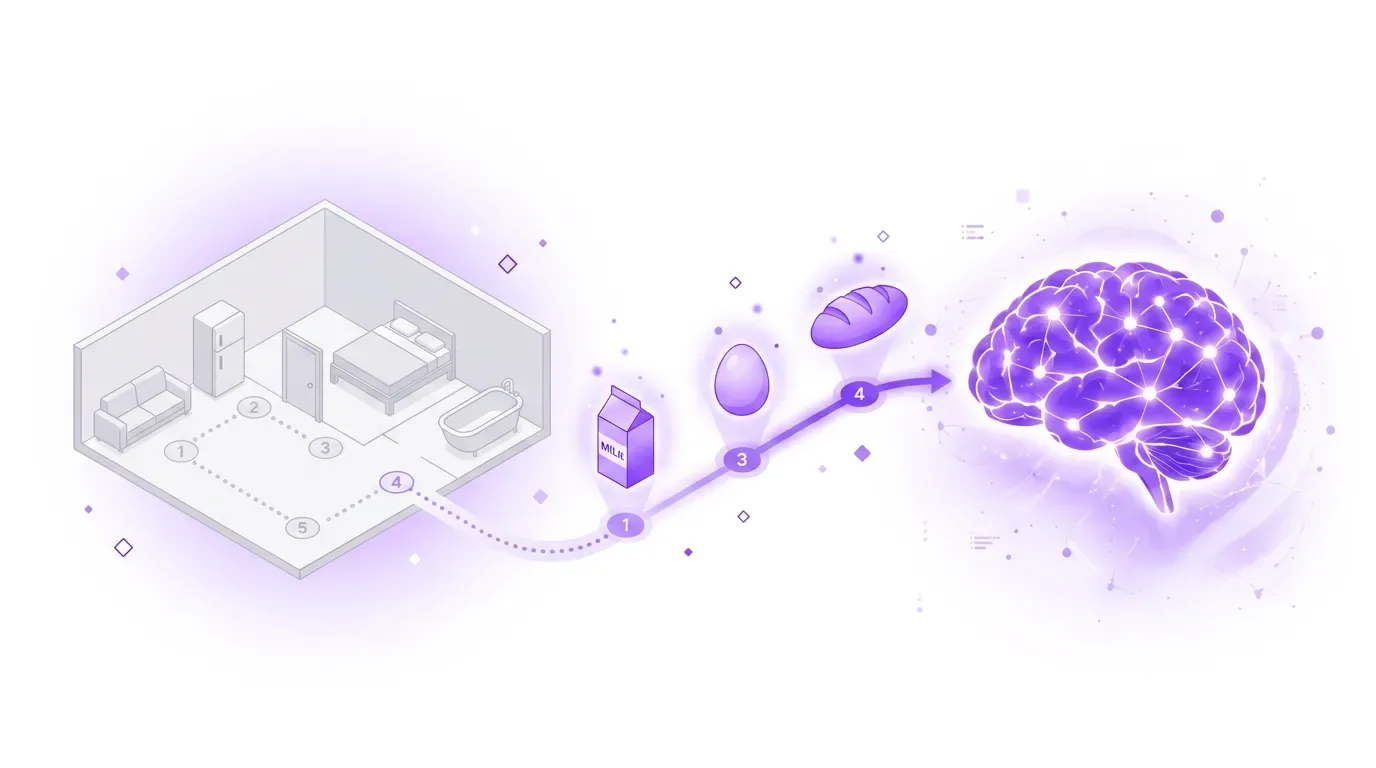
A memory palace (also called the method of loci, from the Latin word for places) is a mental version of a real location you know well. To memorise a list of items, you convert each item into a vivid mental image and place those images at specific spots along a fixed route through the location: one image by the front door, the next on the sofa, the next on the kitchen counter. To recall the list, you mentally walk the route and collect the images in order.
The technique is ancient. The Greek poet Simonides of Ceos is credited with discovering it around 500 BCE, after he stepped out of a banquet hall moments before the roof collapsed. The bodies inside were crushed beyond recognition, but Simonides found he could identify every victim by remembering where each person had been sitting. Location, he realised, was the index his memory had been using all along.
Roman orators used the same method to deliver hours-long speeches without notes, which is where the phrase "in the first place, in the second place" comes from. Each "place" was literally a locus in the speaker's memory palace.
Why Places Stick When Facts Do Not
Your brain did not evolve to remember shopping lists. It evolved to remember environments: where food was, where danger was, how to get back to shelter. Hundreds of thousands of years of survival pressure built a spatial memory system that is automatic, high-capacity, and durable.
Abstract information gets none of that hardware by default. A list of errands has no location, no imagery, no route. It is stored, if at all, by fragile verbal rehearsal in short-term memory, which is why it evaporates within minutes.
The memory palace bridges the gap. By converting abstract items into visual images and pinning them to locations, you move the information out of the weak verbal system and into the strong spatial one. The list of errands becomes a route through your house, and your brain files it the same way it files real geography.
The research on this is unusually strong for a memory technique. In 2003, neuroscientist Eleanor Maguire and her colleagues studied competitors from the World Memory Championships, expecting to find structural brain differences or exceptional IQs. They found neither. What they found was that during memorisation, the athletes showed elevated activity in brain regions associated with spatial navigation, and nearly all of them reported using the method of loci. Their memories were not different hardware. They were ordinary brains running a better strategy.
A 2017 study published in Neuron by Martin Dresler and colleagues went further. Researchers took people who had never used the technique and gave them six weeks of memory palace training, around 30 minutes a day. Their recall roughly doubled (from an average of 26 words out of 72 to more than 60), and brain scans showed their neural activity patterns had shifted to resemble those of the world-class memory athletes. Four months later, without continued training, the gains were still largely intact.
How to Build Your First Memory Palace (5 Steps)
You do not need a palace. A one-bedroom flat works fine. Here is the full process.
Step 1: Choose a place you know deeply. Your current home is the standard first choice. Your childhood home, your commute, your office, or your local supermarket all work too. The only requirement is that you can walk through it in your mind without effort. If you have to think about what comes after the kitchen, the location is doing work that should be free.
Step 2: Fix a route with 10 stations. Pick a starting point (the front door is traditional) and walk one consistent path through the space: door, hallway, coat hooks, sofa, TV, window, kitchen counter, fridge, cooker, bedroom door. Each stop is a station (a locus). Always travel the route in the same direction. The fixed order is what preserves the sequence of whatever you store.
Step 3: Convert each item into a vivid image. This is the step beginners underdo. Suppose the first item on your shopping list is milk. Do not picture a carton of milk. Picture the front door blasted off its hinges by a flood of milk pouring out of the letterbox. Exaggerated, absurd, in motion, slightly ridiculous: that is what your brain flags as worth keeping. Boring images fade. Weird ones stick.
Step 4: Place one image at each station. Mentally stand at the station and watch the scene happen there for a second or two. The sofa is not near the giant eggs; the sofa is cracking under a mound of giant eggs. Interaction between the image and the location is what welds them together.
Step 5: Walk the route to recall. Start at the front door and move station by station. At each stop, the image will be waiting. Milk exploding through the door. Eggs crushing the sofa. Read each image back into the original item as you go. To make the memory last days instead of hours, walk the route again after an hour, then again the next morning. (This is ordinary spaced repetition, and it works on palaces as well as it works on flashcards.)
That is the whole technique. Ten stations, ten images, one walk.
A Worked Example: 10 Items in 2 Minutes
Shopping list: milk, eggs, bread, coffee, apples, chicken, rice, honey, cheese, tomatoes.
- Front door: milk floods through the letterbox and blows the door open.
- Hallway: you wade through ankle-deep cracked eggs, shells crunching.
- Coat hooks: baguettes hang from every hook like umbrellas.
- Sofa: a giant cafetiere sits on the cushions, steaming, staining everything.
- TV: apples bounce off the screen one by one, thrown from somewhere off-camera.
- Window: a chicken pecks furiously at the glass, demanding to be let in.
- Kitchen counter: rice pours from the ceiling like sand, burying the counter.
- Fridge: honey oozes out of the door seals and pools on the floor.
- Cooker: a wheel of cheese is melting over all four rings at once.
- Bedroom door: tomatoes splatter against it as if a crowd is booing your bedroom.
Read that list twice, close your eyes, and walk the route. Most people get 9 or 10 out of 10 on the first attempt, in order, forwards or backwards. Try doing that with plain rehearsal.
The Mistakes That Make Beginners Quit
Making the images too polite. A carton of milk on the counter is forgettable because it is plausible. Scale it up, set it in motion, make it collide with the location. The embarrassing images are the ones you keep.
Skipping stations or wandering the route. If you sometimes go sofa-then-TV and sometimes TV-then-sofa, the order of your list dissolves. The route is the backbone of the technique. Walk it the same way every time.
Cramming multiple items into one station. One image per station is the beginner rule. Once you are comfortable, you can combine items into compound scenes, but stacking three separate images in one spot is the fastest way to lose two of them.
Reusing one palace for everything at once. A palace can absolutely be reused, but if you load tonight's shopping list into the same rooms that are still holding yesterday's to-do list, the images interfere. Either let the old images fade for a day or two before reloading, or build separate palaces for separate purposes: one for shopping, one for work, one for study.
Expecting it to memorise itself. The palace is not passive storage. Placing the images takes deliberate attention, and the route needs an occasional refresher walk. It is dramatically more efficient than rote repetition, not effort-free.
What to Use It For (And What Not To)
Memory palaces are built for ordered, discrete information. They are the tool of choice for speeches and presentations (one station per talking point, which is exactly how the Romans used them), shopping and to-do lists, exam material that comes in lists and sequences, and remembering names at an event when you attach each face to a seat or a spot in the room.
Students get particular value from them. Anatomy, history dates, legal cases, foreign vocabulary: anything that must be recalled in structure benefits from a palace, and it pairs naturally with the retrieval practice techniques covered in our guide to memory training for students.
They are the wrong tool for skills and understanding. A palace will hold the twelve steps of a process, but it will not teach you to actually perform the process, and it cannot substitute for understanding why a concept works. It stores what you give it. Comprehension has to come first.
Your First Week With the Technique
Day one, build a single 10-station palace in your home and load the worked example above. Day two, walk it once in the morning, then load your own list into the same stations in the evening and notice the interference. That lesson is worth experiencing once. Day three, map a second route (your commute or workplace) so your palaces stop competing. For the rest of the week, put one real thing into a palace daily: the day's errands, the points you want to raise in a meeting, the names of people you met.
The skill underneath every step is the same one: generating a sharp mental image and holding it in place. That is visual memory, and like the spatial system it feeds into, it strengthens with use. Daily visual exercises, whether that is deliberate imagery practice or a few rounds of a visual memory game, keep the image-generation muscle warm so that when you need a flood of milk to blow a door off its hinges, it arrives instantly and in detail.
Twenty-five centuries after Simonides walked out of that banquet hall, the method of loci is still the most reliable memory technique anyone has found. Not because it is clever, but because it stops fighting your brain and starts borrowing from it. The map of your home is already in your head, permanent and free. The palace just puts it to work.
Frequently asked questions
Does the memory palace technique actually work?
How long does it take to build a memory palace?
Can you reuse a memory palace?
How many items can a memory palace hold?
What is the difference between a memory palace and the method of loci?
Train your memory. Play Blanked free.
A free visual memory game built around how memory actually works. 6 game modes, 400+ levels.
Download on the App Store