Why Do I Cringe at Old Memories? The Science (2026)


On this page (6)
You are lying in bed, almost asleep, thinking about nothing in particular. And then, without warning, your brain serves up that thing you said in 2014. The pause. The wrong name. The joke that landed in total silence. Your whole body tenses, you make a noise into the pillow, and you are wide awake again, cringing at a moment nobody else on Earth remembers.
Almost everyone does this. The involuntary replay of old embarrassing moments, sometimes called a cringe attack, is one of the most common and least discussed quirks of human memory. It feels like your brain is bullying you for no reason. It is not. There is a clear explanation for why these particular memories are so vivid, why they ambush you unbidden, and why the whole thing hurts far more than it should. And once you understand the mechanism, it loses a lot of its power.
Why the Embarrassing Ones Stick So Hard
Start with the strangest part: of all the millions of moments in your life, why do the mortifying ones get preserved in such sharp, punishing detail?
The answer is that your brain deliberately prioritises emotional memories, and it does not distinguish between good emotion and bad. A small structure called the amygdala tags experiences with emotional significance, and when something carries a strong emotional charge, the amygdala effectively flags it as important and tells the memory system to encode it more deeply. Emotionally charged events are laid down more strongly and remembered more vividly than neutral ones, sometimes several times over.
An embarrassing moment is an emotional spike, a jolt of social fear and self-consciousness, so your brain files it under "important, remember this." The very intensity that makes the moment awful is what guarantees it a front-row seat in your memory. Your dull, pleasant Tuesdays fade. The time you waved back at someone who was waving at the person behind you is preserved in high definition, because your amygdala decided it mattered.
Why They Pop Up Uninvited
The second mystery is the timing. You are not trying to remember these moments. You would pay to forget them. So why do they surface on their own, usually when your mind is idle?
These are what psychologists call involuntary autobiographical memories: recollections that arrive without you deliberately retrieving them. They are extremely common, and they surface most when your mind is unoccupied, drifting, or about to sleep, exactly the low-demand moments when the brain's default background activity takes over and starts wandering through stored experiences.
Normally, the prefrontal cortex (the brain's control centre) helps keep intrusive thoughts in check. But when you are relaxed, tired, or unfocused, that inhibition loosens, and a strongly-encoded emotional memory can push its way into awareness on its own. The memory was flagged as important and stored with a hair trigger, so a stray cue (a similar situation, a word, a feeling) is enough to fire it off. This is the same reconstructive memory system that runs all your recall, just surfacing something you never asked for.
Why It Hurts More Than It Should: Two Distortions
Here is the part that should genuinely change how you feel about your cringe memories. The pain they cause is based on two errors your brain is making.
The spotlight effect. Psychologists have shown, repeatedly, that we dramatically overestimate how much other people notice and remember about us. In the classic experiment, people made to wear an embarrassing t-shirt were convinced everyone in the room had clocked it; in reality, only a fraction had, and fewer still remembered. You are the permanent centre of your own experience, so it feels like your blunder was a spotlight moment for everyone present. It was not. For them it was a blip, if they registered it at all, and it was gone from their memory within hours. You are the only person still holding it.
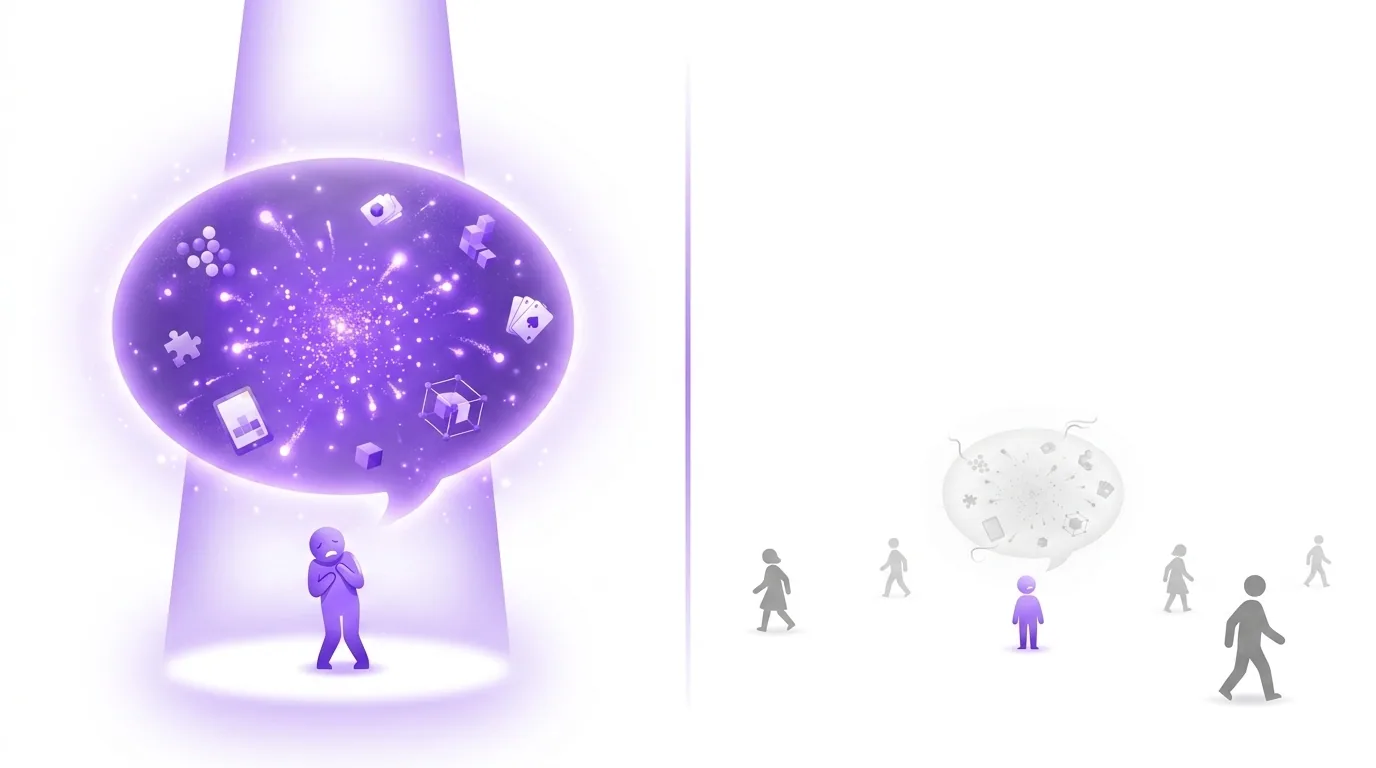
Memory distortion. Because memory is reconstructive rather than a recording, each time you replay the moment you re-edit it, and cringe memories tend to get edited in the cruellest direction. The pause you remember as excruciating and endless probably lasted a second. The reaction you remember as universal mockery was probably a couple of people who have long forgotten. You are not cringing at what happened. You are cringing at a worst-case reconstruction your brain has rehearsed into something far sharper than the original event.
Put those together and the cringe attack is exposed for what it is: an intensely vivid, involuntary replay of a distorted memory of an event that almost nobody else remembers. The feeling is real. The threat it is reacting to is not.
Why Your Brain Bothers Doing This
If cringe attacks are so painful and so disproportionate, why did evolution build them in? Because for most of human history, social standing was survival. Being embarrassed, rejected, or shamed in front of your group was genuinely dangerous, so we developed self-conscious emotions (embarrassment, shame, guilt) as an internal alarm system for social missteps.
Remembering those missteps vividly served a purpose: it helped you not repeat the behaviour that threatened your place in the group. The cringe is that ancient system doing its job, over-cautiously, in a modern world where saying the wrong thing at a party is not actually a threat to your survival. Your brain is running social-danger software on hardware that has not updated in fifty thousand years. It flags the memory hard so you will "learn the lesson", even when there is no lesson left to learn.
Seen that way, a cringe attack is not your mind attacking you. It is a clumsy, outdated act of self-protection.
How to Take the Sting Out
You cannot delete these memories, and trying to suppress them tends to make them rebound stronger. But you can defuse them, and the science points to a few genuinely effective moves.
Remember the spotlight effect on purpose. In the moment of cringing, actively remind yourself that no one else remembers this. It is almost certainly true, and naming it interrupts the false assumption the cringe is built on.
Reappraise instead of reliving. Each time you recall a memory it becomes briefly editable before it is stored again, a process called reconsolidation. If you revisit the moment with a calmer, kinder framing ("everyone does this", "it was a second, not an era") rather than re-feeling the horror, you gradually update the memory with less emotional charge attached. Reliving it in full cringe does the opposite, filing it back down even harder.
Treat yourself like a friend. Self-compassion, talking to yourself the way you would reassure a friend who did the same thing, measurably reduces the distress of these memories. You would never tell a friend their decade-old awkward comment defines them. Extend the same courtesy inward.
Give a wandering mind something to do. Because these memories surface most when your brain is idle, an under-occupied mind is fertile ground for them. A small amount of engaging mental activity, something that actually holds your attention, leaves less room for the involuntary replay to take over.
The Reassuring Part
A cringe attack is not a sign that something is wrong with you. It is a sign that your memory system is working exactly as designed: prioritising emotional events, storing them vividly, and occasionally surfacing them when your guard is down. The same machinery that ambushes you with a ten-year-old blunder is the machinery that lets you hold on to everything that matters.
And that machinery is not fixed. How well you can hold, direct, and control your attention and memory responds to practice, which is the whole point of training it deliberately. If your own memory just handed you a cringe you did not ask for and left you curious about how it actually works, our free memory test takes about two minutes, and a few focused minutes a day with a memory game trains the attention and control your memory runs on.
The next time your brain plays that clip from 2014, you will know the truth of it: a vivid, involuntary, exaggerated replay of a moment the rest of the world forgot the same day. You are the only one still in the audience. You are allowed to leave.
Frequently asked questions
Why do I cringe at old memories?
What is a cringe attack?
Why do embarrassing memories feel so much worse than they were?
How do I stop cringing at old memories?
Are cringe attacks a sign of a mental health problem?
Train your memory. Play Blanked free.
A free visual memory game built around how memory actually works. 6 game modes, 400+ levels.
Download on the App Store