Why Do Songs Get Stuck in Your Head? The Science (2026)

On this page (7)
It is 3pm. You have not heard the song in weeks. And yet there it is, the same four seconds of chorus, playing on a loop behind your eyes, and the harder you try to shake it, the louder it gets. By dinner you would pay money to make it stop.
You are not going mad, and you are not alone. About 90 percent of people get a song stuck in their head at least once a week. Scientists have a name for it, a fairly good idea of what causes it, and, usefully, some evidence-based tricks for switching it off. Here is why your brain does this, and how to make it stop.
What an Earworm Actually Is
The scientific name is involuntary musical imagery, or INMI. An earworm is a short fragment of music, usually the hook or chorus rather than the whole song, that plays in your mind on repeat without your permission and often against your will.
Two features define it. It is involuntary: you did not choose to start it, and you cannot simply choose to stop it. And it is a loop: it is almost always a short section, a few seconds long, that repeats rather than the full song playing through. That looping quality is the clue to the whole phenomenon, because it points straight at the part of your memory system responsible.
The Loop in Your Head Is a Real Mechanism
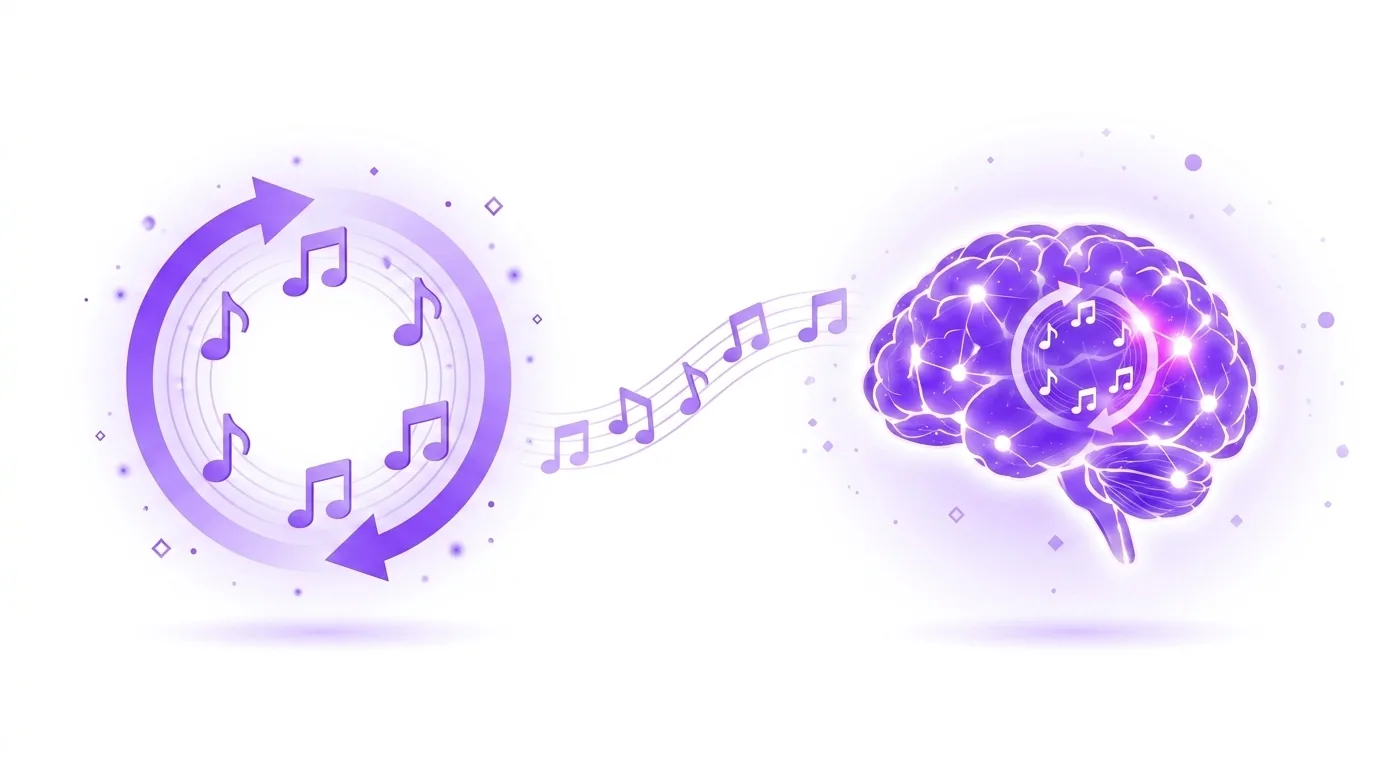
Your working memory, the system that holds information in mind for short stretches, includes a component that psychologists call the phonological loop. Its job is to hold sound, spoken words, a phone number you are repeating, a snatch of melody, by silently rehearsing it on a kind of short mental tape that records a few seconds of audio and plays it back.
Normally this loop is helpful and quiet. You use it to keep a number in mind while you dial, and then you let it go. An earworm is what happens when a catchy fragment of music gets caught in that loop and the release mechanism fails. The tape reaches the end of its few seconds, loops back to the start, and plays again, and again, because the brain keeps rehearsing the fragment instead of letting it fade.
This is why earworms are always short and always repetitive. They are limited to what fits on that mental tape, a few seconds of sound, and they repeat because looping is exactly what the phonological loop does. You are not hallucinating a song. You are stuck rehearsing a tiny piece of one.

Why Some Songs Get Stuck and Others Do Not
Not all music is equally sticky. Researchers who study earworms, including James Kellaris, who coined the phrase "cognitive itch", and Kelly Jakubowski, who analysed the musical features of hundreds of reported earworms, have found that the songs most likely to lodge in your head share a recognisable profile.
They tend to be repetitive and simple, with a melody easy enough to rehearse without effort. They often have a fast, upbeat tempo, the kind of thing you could move to. Their melodies frequently follow a common, easy contour (the overall up-and-down shape of the notes) but contain one or two unexpected leaps or intervals that make them distinctive. That combination, mostly predictable with a surprising twist, seems to be exactly what snags attention and refuses to let go.
On top of the music itself, a few triggers make any song more likely to catch:
- Recent or repeated exposure. The song you just heard, or have heard many times, is primed and ready to loop.
- A memory or emotional association. Songs tied to a strong memory or feeling resurface more easily, which is part of why a track from years ago can ambush you.
- A wandering, under-occupied mind. Earworms strike most when your brain has spare capacity: in the shower, on a walk, doing something automatic. An idle phonological loop goes looking for something to rehearse.
- Stress and tiredness. Both make intrusive, repetitive thoughts of all kinds, earworms included, more frequent and harder to dismiss.
The Zeigarnik Twist: Why Incomplete Is Worse
Here is a strange and well-supported detail. Hearing only part of a song is more likely to give you an earworm than hearing the whole thing.
This fits a broader quirk of memory called the Zeigarnik effect, the tendency of the mind to hold on to unfinished tasks far more insistently than completed ones. An interrupted song is an unfinished task. Your brain, disliking the loose end, keeps replaying the fragment as if trying to push through to a resolution it never reaches. The loop is, in a sense, your mind repeatedly asking "and then how does it go?" and never getting to play the answer.
This single idea also hands you one of the most effective cures, which we will get to now.
How to Get Rid of an Earworm (Evidence-Based)
Most folk remedies for earworms do not work, but a handful of strategies have genuine research behind them. They all share one logic: the earworm survives by occupying your phonological loop, so you get rid of it by giving that loop something else to do, or by resolving the loose end that feeds it.
Chew gum. This is the one that surprises people, and it is backed by actual experiments. Chewing engages some of the same motor machinery your brain uses for the silent inner rehearsal that keeps a song looping. Occupy that machinery with chewing and the loop struggles to keep replaying the tune. It is simple, and it genuinely reduces both how often the song returns and how vivid it feels.
Do an absorbing verbal task. Anything that demands your inner voice competes for the same resource the earworm is using. Reading something and following it closely, doing a crossword or a word puzzle, or having a real conversation can crowd the song out. The task has to be engaging enough to actually occupy you; idle scrolling will not do it.
Play the song all the way through. Because incomplete songs loop harder (the Zeigarnik effect), deliberately listening to the full track from start to finish can give your brain the resolution it was missing and close the loop. Counterintuitive, but it often works better than trying to avoid the song.
Have a go-to "cure tune". Some people can reliably displace an earworm with a different, less sticky song. It is a small trade, the new song might linger briefly, but a bland replacement is easier to shake than the original catchy one.
Stop fighting it. Trying hard to suppress a thought tends to make it rebound stronger, a well-documented effect. Letting the song play out in the background without struggling against it often lets it fade faster than a direct battle would.
Should You Worry About Earworms?
For the overwhelming majority of people, no. Earworms are a normal, near-universal quirk of a healthy memory system, not a symptom of anything wrong. They are your working memory being a little too good at its job of holding on to sound.
The one caveat worth mentioning: if musical imagery becomes constant, deeply distressing, or is accompanied by other intrusive symptoms, it is reasonable to mention it to a doctor, since persistent intrusive thoughts can occasionally relate to conditions worth discussing. But the ordinary chorus that hijacks your afternoon and fades by evening is simply what a normal brain does.
The Bigger Picture: Your Memory Is Always Running
There is something quietly reassuring in the earworm. It is proof that your memory system is active even when you are not using it on purpose, holding, rehearsing, and replaying information beneath conscious awareness. The same phonological loop that traps a chorus is what lets you hold a sentence in mind while you read it, follow spoken directions, or keep a new name in your head long enough to use it.
That system is not fixed. The capacity and control of working memory, how much you can hold and how well you can direct it, respond to practice, which is the whole idea behind deliberate memory training. If a song looping in your head made you curious about how your own working memory performs, our free memory test takes about two minutes, and a few focused minutes a day with a memory game trains the attention and control that the phonological loop relies on.
So the next time four seconds of a song you do not even like moves into your head rent-free, you will at least know what is happening: a catchy fragment caught in a real mental loop, waiting for you to chew some gum, finish the song, or simply let it spin itself out.
Frequently asked questions
Why do songs get stuck in your head?
What is an earworm?
How do you get rid of a song stuck in your head?
What makes a song more likely to become an earworm?
Are earworms a sign of a problem?
Train your memory. Play Blanked free.
A free visual memory game built around how memory actually works. 6 game modes, 400+ levels.
Download on the App Store