Why Your Brain Remembers Faces But Forgets Names

On this page (6)
You’re at a friend’s birthday party. Someone walks toward you with a big smile and says hello. You recognise them immediately. You know you’ve met them before. You can picture where you met, roughly when it was, even what they were wearing. But their name? Completely gone. Evaporated. Your brain is giving you everything except the one piece of information you actually need.
This isn’t a sign that your memory is failing. It’s a sign that your brain handles faces and names through completely different systems, and those systems aren’t equally powerful. The neuroscience behind this quirk is genuinely fascinating, and understanding it reveals something important about how visual and verbal memory work, why they’re so different, and what you can do about it.
Your Brain Has a Face Department (But No Name Department)
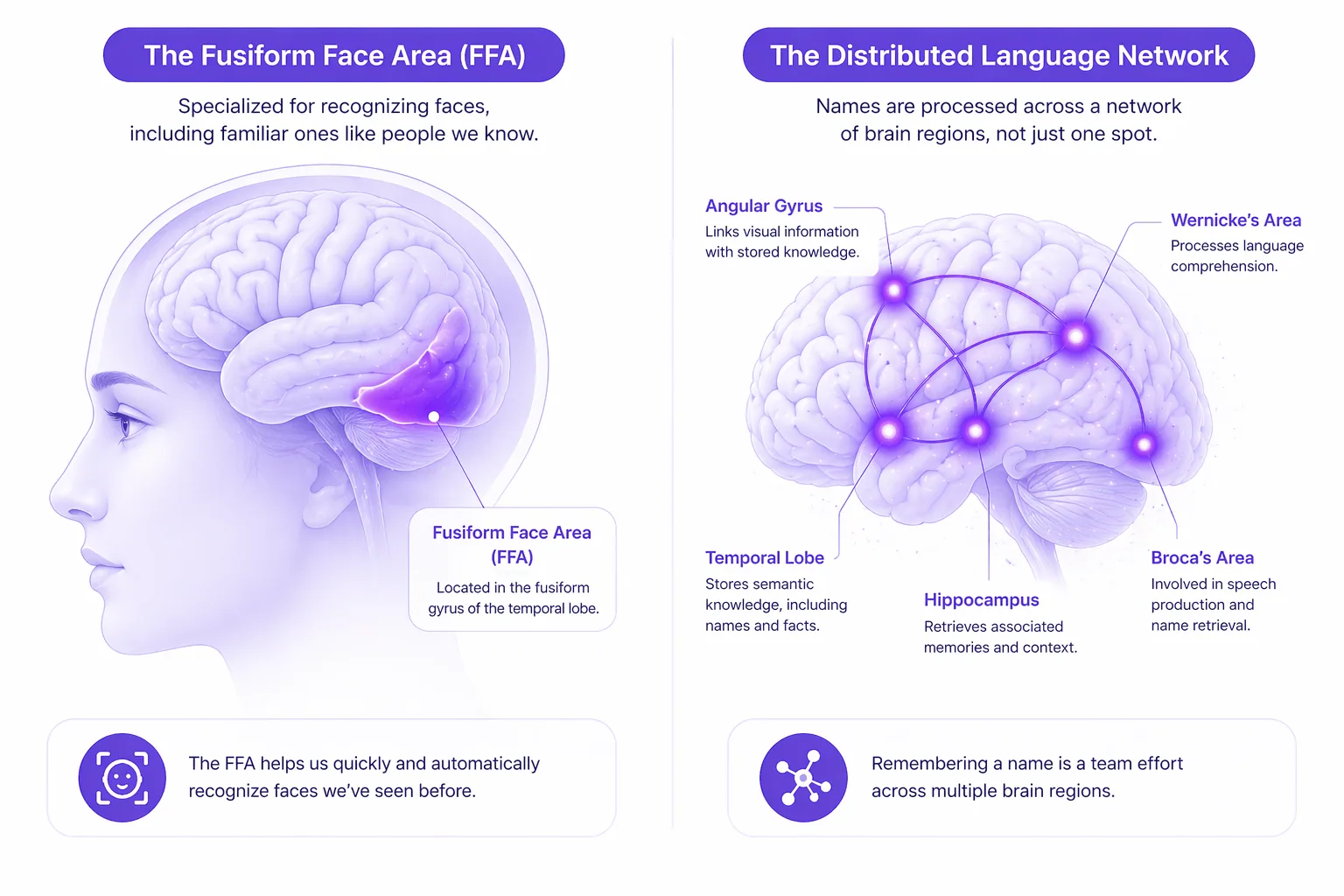
Deep in the temporal lobe of your brain, on a structure called the fusiform gyrus, sits a specialised region that neuroscientists call the fusiform face area (FFA). This region is dedicated almost exclusively to processing faces. Not objects, not words, not landscapes. Faces.
The FFA is remarkably good at its job. It can distinguish between thousands of individual faces, detect subtle differences in expression, estimate age, read emotional state, and determine whether a face is familiar or unfamiliar, all within milliseconds. Damage to this area causes a condition called prosopagnosia (face blindness), where people can recognise objects perfectly well but cannot recognise faces, including those of close family members or even their own reflection.
Your brain dedicates an entire specialised region to face processing because, from an evolutionary perspective, faces are critical. Our primate ancestors needed to quickly identify who was friend, foe, or family. Long before language existed, faces were the primary social identification tool. Your brain evolved to prioritise them.
Names, on the other hand, get no such VIP treatment. There is no “fusiform name area.” Names are processed through the same general language networks that handle all words. They’re stored alongside vocabulary, retrieved through the same pathways as any other verbal information (which is why a name so often ends up on the tip of your tongue), and compete for space with every other word your brain has ever learned.
In simple terms: faces get a dedicated express lane. Names are stuck in general traffic.
Recognition vs Recall: Two Very Different Jobs
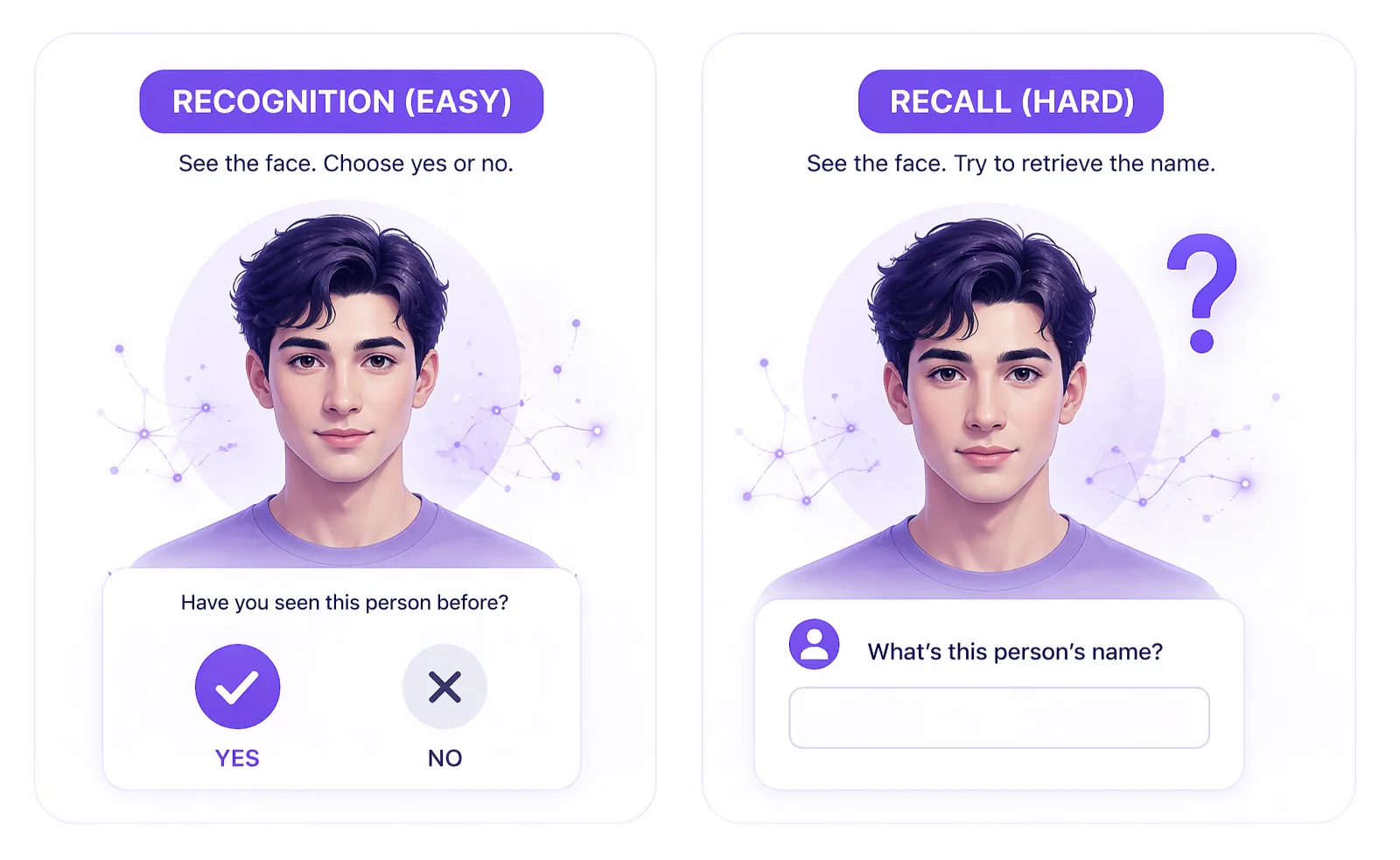
There’s a crucial distinction that explains most of the face/name gap: recognising something and recalling something are fundamentally different cognitive tasks.
Recognition is a yes-or-no process. When someone walks up to you, your brain simply asks: “Have I seen this face before?” The face itself is the cue. It’s right there in front of you, presenting all the visual information your brain needs to make a match. This is a relatively easy task for your brain. The answer is binary, and the stimulus provides its own context.
Recall is a retrieval process. To remember someone’s name, your brain has to navigate through its verbal memory stores, find the specific label attached to this specific face, and retrieve it without any external cue. Nobody is holding up a prompt card. You have to pull the name out of storage using only the face as a trigger. That’s a much harder job.
This is why the experience feels so lopsided. Recognising the face is easy because it’s a recognition task. Retrieving the name is hard because it’s a recall task. You’re not comparing like with like. Your brain isn’t worse at names. It’s doing a harder type of memory work when it tries to retrieve one. (For more on how recall and recognition differ, see our post on why you forget things so quickly.)
Why Names Are Uniquely Forgettable
Beyond the recognition vs recall issue, names have several properties that make them particularly slippery for your memory:
Names are arbitrary. The word “apple” connects to a real object with colour, texture, taste, and visual form. The name “Sarah” connects to nothing inherent about the person. It’s a random label. Your brain struggles to anchor arbitrary labels because there’s no meaningful association to hook them to.
Names have no synonyms. If you forget the word “enormous,” you can say “huge” or “massive.” If you forget someone’s name, there’s no alternative. It’s the only word that works. This makes names uniquely vulnerable to tip-of-the-tongue failures.
Names are low-frequency words. You hear common words thousands of times. You might hear someone’s name once, at the moment of introduction, and then not again until the next meeting. Low-frequency exposure means weak encoding, which means fragile storage.
Introductions are terrible encoding environments. When you meet someone new, your brain is processing their face, body language, tone of voice, the social context, and what you’re going to say next, all simultaneously. The name gets lost in the noise. It’s classic encoding failure: your brain was too busy processing everything else to properly store the name. (This is the same mechanism we described in our post on why you forget things 5 minutes after seeing them.)
The York Study That Flips Everything
Here’s where it gets interesting. Researchers at the University of York designed an experiment to test face and name memory on a level playing field. Instead of comparing face recognition (easy) against name recall (hard), they tested both using the same framework: recognition only.
Participants were shown a set of unfamiliar faces and a set of unfamiliar names, then tested on which ones they could recognise from a lineup. The result? People were actually better at recognising names than faces.
The finding was consistent across three separate experiments. When the task was made fair, the supposed superiority of face memory vanished. Dr Rob Jenkins, who led the study, put it directly: “Our study suggests that, while many people may be bad at remembering names, they are likely to be even worse at remembering faces.”
So why does it feel like the opposite? Because in real life, you only notice the mismatch in one direction. When you see someone’s face and can’t recall their name, it’s embarrassing and memorable. When you hear someone’s name but wouldn’t recognise their face if they walked past you on the street, you never find out. The failures are invisible.
This reframe matters because it means the problem isn’t that names are uniquely hard to remember. The problem is that the situation (see face, retrieve name) creates an unfair comparison. And that means both face memory and name memory can be improved with the right kind of training.
How to Actually Remember Names Better
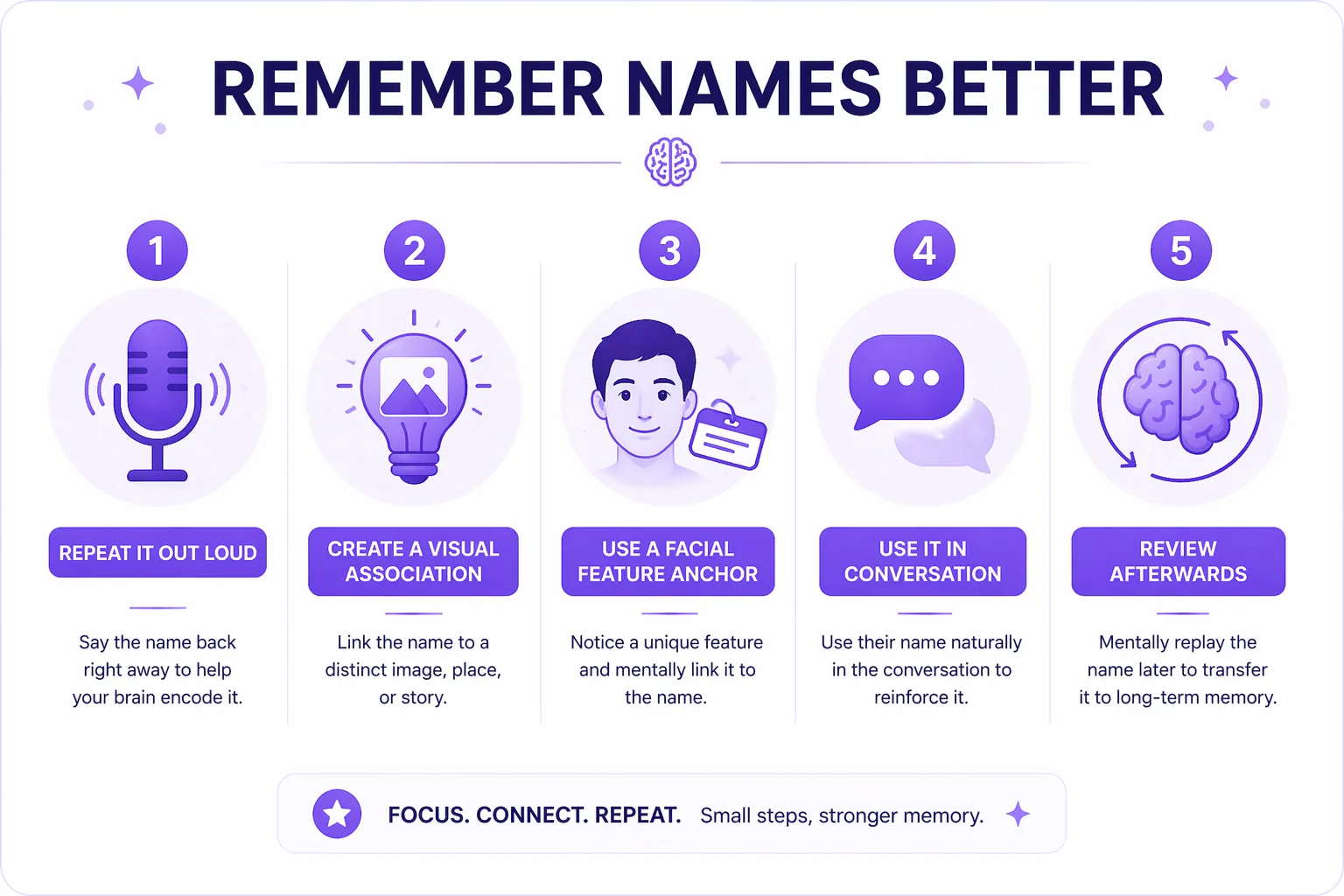
Now that you understand why names are hard, here are five techniques that directly address the underlying mechanisms:
1. Repeat the name immediately. “Nice to meet you, Sarah.” This forces your brain to encode the name consciously rather than letting it get drowned out by everything else happening during the introduction. One repetition within the first 10 seconds significantly increases your chance of retaining it.
2. Create a visual association. Link the name to a vivid mental image. If you meet someone called Cliff, picture them standing on a cliff edge. If you meet a Marina, imagine a harbour behind them. The more absurd the image, the more memorable it becomes. This works because you’re converting an arbitrary verbal label into visual information, which your brain handles far more naturally.
3. Attach the name to a facial feature. Pick one distinctive feature of the person’s face (strong eyebrows, kind eyes, wide smile) and mentally weld the name to it. “Sarah with the dimples.” You’re creating a bridge between your visual memory system (which is strong) and the verbal label (which is weak).
4. Use the name during the conversation. Most people hear a name once and never say it again until they’ve already forgotten it. Using the name two or three times during the conversation (“That’s interesting, Sarah”) creates additional encoding opportunities through spaced repetition within the interaction itself.
5. Review mentally afterwards. After leaving a social event, spend 60 seconds mentally reviewing the people you met. Picture each face and recall their name. This is active recall, the most powerful memory technique available, applied to names. Do it before the forgetting curve kicks in and you’ll retain significantly more. (For more on active recall, see our memory training for students guide.)
The Visual Memory Connection
The face/name gap reveals something fundamental about how your brain works: visual memory and verbal memory are processed through different neural pathways, and for most people, the visual pathway is significantly stronger.
Your brain dedicates more cortical real estate to visual processing than to any other sense. As cognitive neuroscientist E. Clea Warburton from the University of Bristol puts it, we are visual creatures. Our brains have more cortex devoted to processing visual information than information from any other sense. We are programmed to encode and retrieve visual information more naturally than auditory or verbal information.
This has a practical implication that goes far beyond remembering names. If your visual memory system is your brain’s strongest suit, then training it makes sense. Not just so you can remember faces better (though it helps), but because visual memory underpins navigation, spatial awareness, reading comprehension, detail recall, and dozens of daily tasks you barely think about. (For the full breakdown, see our guide to how to improve your visual memory.)
This is also why the name-remembering techniques above work so well. Techniques 2 and 3 (visual association and facial feature anchoring) work by converting the weak verbal signal into a strong visual one. You’re essentially routing the name through your brain’s most powerful processing system.
And if you want to strengthen that visual system directly, that’s what Blanked is designed for. Studying a scene, letting it disappear, and recalling details from memory is the exact encode-store-retrieve loop that strengthens the visual pathways your brain relies on most. Two minutes a day, and you’re building the foundation that makes every other memory technique more effective.
The next time you recognise someone’s face but blank on their name, don’t beat yourself up. Your brain isn’t malfunctioning. It’s just better at the task it evolved for (recognising faces) than the task civilisation added later (attaching arbitrary labels to those faces). The good news is that both skills are trainable. And now you know exactly how to start.
Frequently asked questions
Why is it easier to remember faces than names?
Is face memory or name memory actually better?
What is the fusiform face area?
How can I get better at remembering names?
Can training visual memory help with remembering faces?
Train your memory. Play Blanked free.
A free visual memory game built around how memory actually works. 6 game modes, 400+ levels.
Download on the App Store