8 Brain Exercises for Adults That Actually Work (2026)

On this page (12)
When most people hear “brain exercises,” they picture a retired person doing crosswords in an armchair. That image is outdated by about two decades. The research on cognitive training has exploded in recent years, and the findings are clear: your brain responds to targeted exercise at any age, not just in retirement.
A 2026 randomised trial published in Neuropsychologia found that mnemonic strategy training produced measurable increases in brain activation and functional connectivity in cognitively intact older adults. The ACTIVE Trial’s 20-year follow-up showed that speed-of-processing training reduced dementia risk by 25%. And the McGill University study demonstrated biochemical changes in the brain after just 10 weeks of targeted training.
The science is no longer debating whether brain exercises work. It’s refining which ones work best, for whom, and why. Here are eight exercises backed by research that you can start using today, whether you’re 25 or 75.
Why Your Brain Needs Exercise (Even If You’re Not 70)
Your brain begins a gradual decline in processing speed from around age 30. Working memory capacity starts narrowing. The prefrontal cortex, which manages attention and decision-making, slowly loses volume. None of this is dramatic at first. You probably won’t notice anything until your 40s or 50s. But the decline is happening.
The encouraging part is that neuroplasticity, your brain’s ability to form new neural connections and strengthen existing ones, continues throughout life. The brain regions responsible for memory, attention, and processing speed respond to targeted stimulation just like muscles respond to resistance training. Challenge them regularly, and they stay strong. Leave them unchallenged, and they gradually weaken. (For a detailed look at what changes with age and what doesn’t, see our post on memory and ageing.)
The key insight from the research is that not all mental activity counts as brain exercise. Passive activities like watching television, scrolling social media, or reading content you’re already familiar with don’t provide enough challenge to stimulate neuroplastic change. Your brain needs novel, effortful, targeted tasks. That’s what the following eight exercises provide.
8 Brain Exercises That Actually Work
1. Visual Memory Training
Visual memory is one of the most practical cognitive skills you use daily: remembering faces, navigating environments, recalling where you put things, processing diagrams and written information. It’s also one of the skills most responsive to targeted training.
Research from the University of Michigan found that adults who practised pattern recognition tasks showed improved visual processing speed and working memory after just two weeks of consistent daily practice. The training effect was specific: visual exercises improved visual recall, not verbal recall, which is why targeted training matters.
The most effective visual memory exercises involve encoding a visual scene and then recalling it from memory without any reference. This forces your brain through the full encode-store-retrieve cycle, which is the process that strengthens the underlying neural pathways. Blanked is built around exactly this mechanic: study a scene of colourful shapes, the scene vanishes, then answer questions from memory. Six game modes target different facets of visual memory, and sessions take about 2 minutes.
How to start: Play a dedicated visual memory game daily, or practise without an app by studying a room for 30 seconds, closing your eyes, and listing as many details as you can remember. Do this once a day. (Full guide in our post on how to improve your visual memory.)
2. Active Recall Practice
Active recall is the practice of retrieving information from memory without looking at your notes or references. It’s the single most effective learning technique identified in cognitive science, and it doubles as a powerful brain exercise.
Research from Washington University found that students who used retrieval practice retained 80% of material a week later, compared to 34% for those who reread their notes. The effortful retrieval process strengthens synaptic connections through long-term potentiation, the same mechanism that underlies all memory formation.
How to start: After reading an article, watching a presentation, or finishing a meeting, close everything and spend 60 seconds writing down everything you can remember. Don’t check until you’ve exhausted your recall. The gaps reveal exactly what your brain didn’t encode properly. This takes one minute and produces dramatic improvements when done consistently.
3. Learn a New Skill
Learning something genuinely new, not refining an existing skill, is one of the most potent brain exercises available. A 2014 study found that older adults who learned a new, cognitively demanding skill (such as digital photography or quilting) showed significant memory improvements compared to those who engaged in familiar, less demanding activities.
The key word is “cognitively demanding.” Learning something that feels challenging and unfamiliar forces your brain to build entirely new neural pathways rather than relying on established ones. A musical instrument, a new language, a coding language, a craft, a sport with complex rules. The more unfamiliar and complex the skill, the more your brain has to work.
How to start: Pick one skill you’ve been curious about and commit to 15 to 30 minutes of practice three times a week. The choice matters less than the novelty. Your brain doesn’t care whether you’re learning Japanese or pottery. It cares that the task is new, challenging, and sustained.
4. The Memory Palace Technique
The Memory Palace (method of loci) is a spatial memory technique used since ancient Greece. You mentally place items you want to remember at specific locations within a building you know well, then recall them by mentally walking through the space.
A study published in the journal Neuron found that participants using this technique recalled up to 95% of a 40-word list a week after learning it. The technique works because it converts abstract information into spatial and visual memory, which your brain processes more naturally and retains more durably.
How to start: Choose your house. Mentally walk through 5 to 10 specific spots in order (front door, hallway, kitchen counter). Practise placing vivid, exaggerated objects at each spot. Once the technique feels natural, use it for shopping lists, presentation points, or any information you need to remember in sequence.
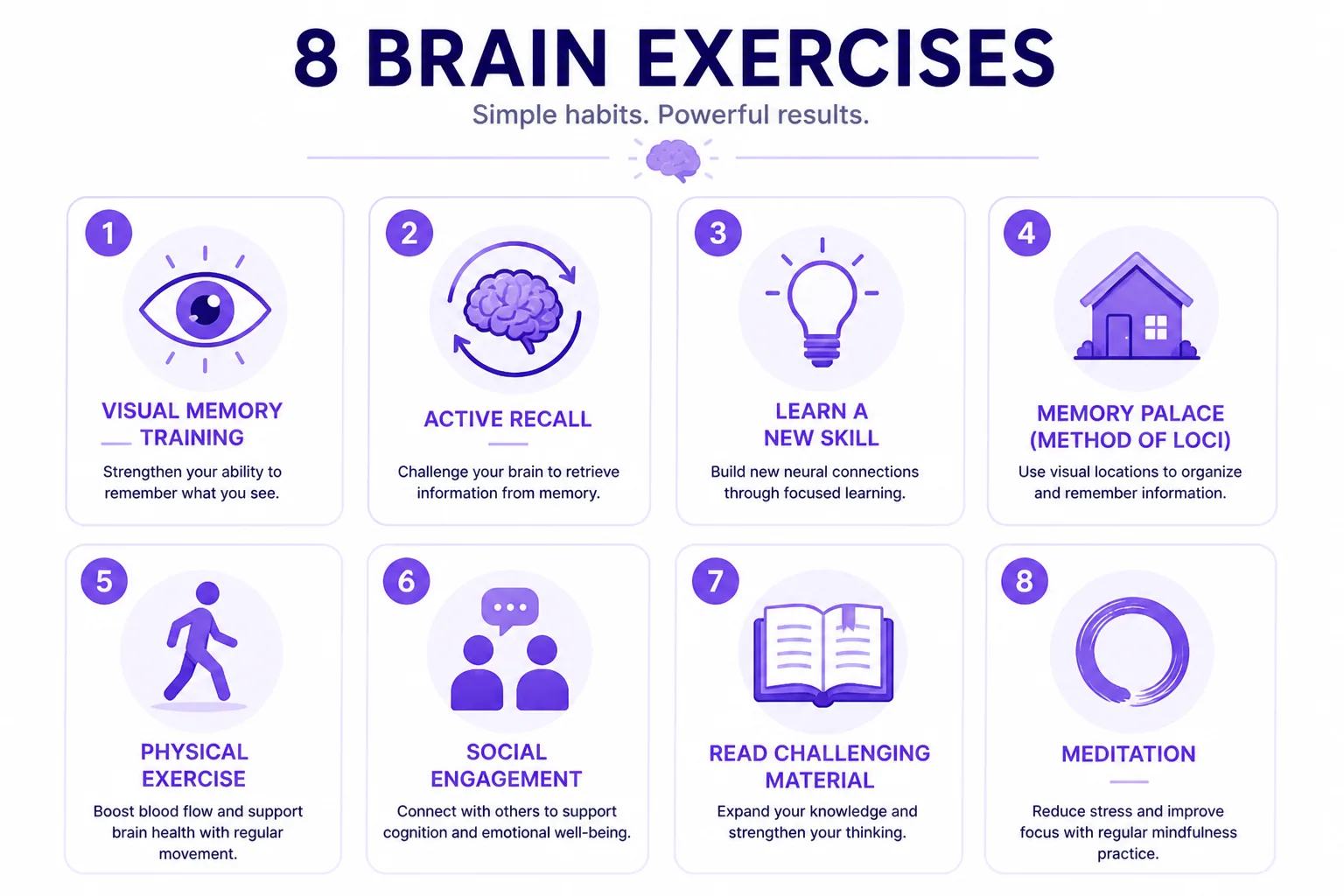
5. Physical Exercise
This might seem like it doesn’t belong on a list of brain exercises, but the evidence is overwhelming. Physical exercise increases production of brain-derived neurotrophic factor (BDNF), a protein essential for neuron growth, survival, and plasticity. BDNF is particularly active in the hippocampus, your brain’s memory formation centre.
A 2023 meta-analysis found that regular moderate-intensity aerobic exercise and resistance training improved cognitive function in older adults. The Lancet Commission identified physical exercise as one of the most effective lifestyle interventions for cognitive health. And crucially, cognitive training combined with physical exercise produces stronger results than either approach alone.
How to start: Twenty to thirty minutes of brisk walking, cycling, or swimming, three to five times a week. You don’t need to train for a marathon. The cognitive benefits appear at moderate intensity. If you’re combining physical exercise with brain training, exercising in the morning and doing cognitive training later in the day appears to be optimal based on the research.
6. Social Engagement
Face-to-face social interaction is a full-brain workout. It simultaneously engages language processing, emotional regulation, attention, working memory, facial recognition, and real-time decision-making. No app or puzzle exercises that many cognitive systems at once.
A 2023 review found that developing social connections was linked to a lower risk of cognitive decline, while a lack of social engagement was associated with a higher risk of Alzheimer’s disease. A 2019 study found that people with more frequent social contact were less likely to experience cognitive decline and dementia.
How to start: Prioritise one in-person social interaction per day. It doesn’t need to be a dinner party. A conversation with a colleague, a phone call with a friend, or even chatting with a barista counts. If you work remotely or live alone, this requires deliberate effort, but the cognitive payoff is substantial.
7. Read Challenging Material
Reading is only a brain exercise if the material challenges you. Rereading a familiar genre or scrolling through articles you already agree with doesn’t provide enough cognitive demand to stimulate neuroplastic change. Challenging material does.
A 2007 review found that expanding vocabulary through reading led to increased grey matter density, a structural brain change associated with improved cognitive function. But the benefits come from engagement with unfamiliar ideas, complex arguments, and new vocabulary. Your brain has to work to process it. That effort is the exercise.
How to start: Read one article or book chapter per week that’s outside your usual domain. If you typically read fiction, try a popular science book. If you read business content, try philosophy or history. The unfamiliarity is what makes it effective. Bonus: after reading, close the book and practise active recall of the key points.
8. Meditation and Mindfulness
Meditation might seem passive, but the neuroscience tells a different story. Research has shown that regular mindfulness meditation increases cortical thickness in the prefrontal cortex (attention and decision-making) and the hippocampus (memory formation). It also reduces cortisol levels, which is significant because chronic stress physically damages the hippocampus.
A 2011 Harvard study found that 8 weeks of mindfulness meditation produced measurable increases in grey matter concentration in brain regions involved in learning, memory, self-awareness, compassion, and introspection. Participants meditated for an average of 27 minutes per day.
How to start: Ten minutes of guided meditation per day using a free app like Insight Timer or the timer on your phone. Focus on breath awareness. When your mind wanders (it will), notice it and return to the breath. That noticing and returning is the exercise. It’s attention training in its purest form.
How to Build a Brain Exercise Routine That Sticks
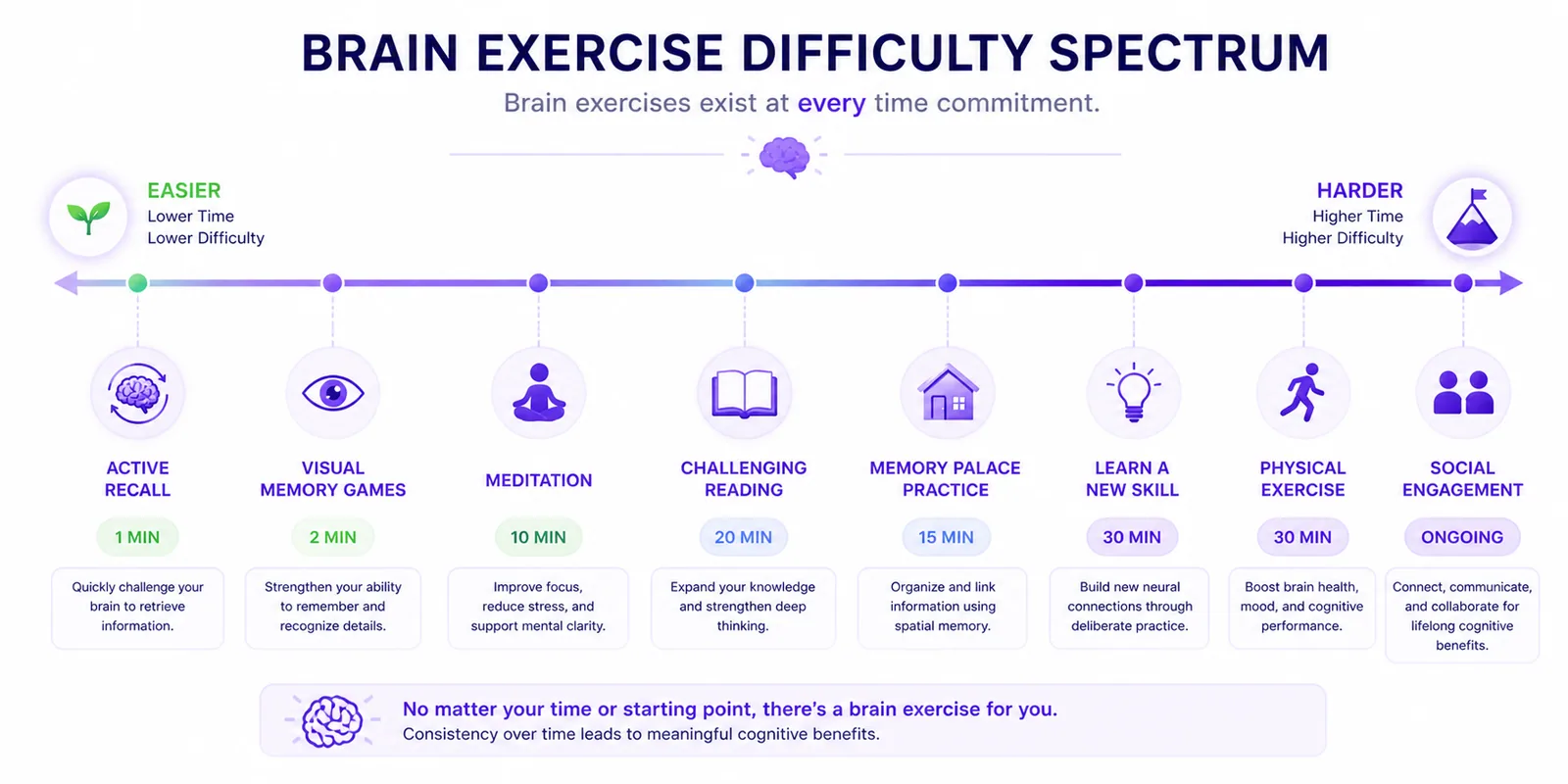
You don’t need to do all eight exercises every day. That would take hours and you’d burn out within a week. The research consistently shows that consistency with a few exercises beats occasional variety across many.
Here are three realistic routines based on how much time you have:
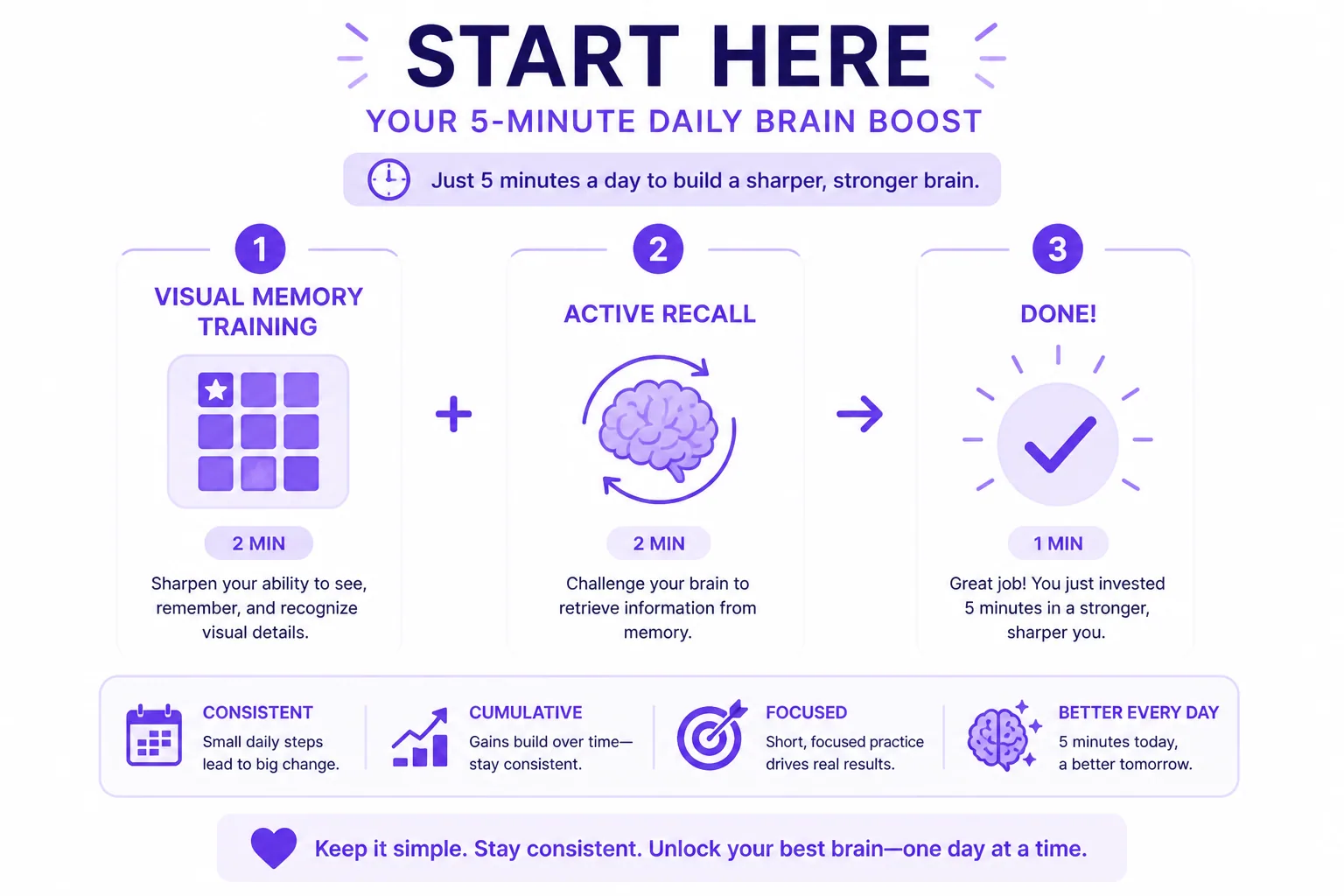
The 5-Minute Daily (minimal commitment): One visual memory training session (2 minutes) + one active recall exercise after reading or a meeting (1 to 2 minutes). This takes less time than checking social media and covers the two exercises with the strongest evidence for targeted cognitive improvement.
The 20-Minute Daily (standard commitment): Visual memory training (2 minutes) + active recall (2 minutes) + meditation (10 minutes) + challenging reading (5 to 10 minutes). This covers memory, attention, and exposure to novel information. Combine with your existing exercise routine on workout days.
The Full Stack (comprehensive): All of the above, plus learning a new skill 3 times per week, prioritising daily social interaction, and combining cognitive training with regular physical exercise. This is the approach the research suggests produces the strongest overall results, but only if you can sustain it. Start with the 5-minute routine and build up.
The single most important factor is showing up daily. A 2-minute visual memory session done every day for three months will produce measurably better results than a 30-minute brain workout done sporadically. Your brain responds to frequency, not intensity. (For the full timeline of when you’ll see results, see our post on how long it takes to improve your memory.)
What Brain Exercises Can and Can’t Do
Brain exercises can strengthen specific cognitive skills when practised consistently. The evidence supports improvements in processing speed, working memory, visual memory, and attention with targeted training. The ACTIVE Trial shows that some forms of training can even reduce dementia risk over decades. (For the full evidence breakdown, see our post on whether brain training actually works.)
What brain exercises cannot do is raise your general intelligence, cure or prevent dementia with certainty, or replace healthy lifestyle fundamentals like sleep, nutrition, and physical activity. They work best as one component of a broader brain health strategy, not as a standalone solution.
The good news is that starting is simple. If you do nothing else from this list, open Blanked for 2 minutes tomorrow morning and practise one active recall exercise after your next meeting. That’s 3 minutes of targeted brain exercise. It’s more than most people do, and the research says it’s enough to start producing measurable changes within weeks.
Frequently asked questions
What is the best brain exercise for adults?
How often should you do brain exercises?
Do crossword puzzles count as brain exercise?
At what age should adults start brain exercises?
Can brain exercises replace physical exercise for brain health?
Train your memory. Play Blanked free.
A free visual memory game built around how memory actually works. 6 game modes, 400+ levels.
Download on the App Store