Does Brain Training Work? What Science Says (2026)

On this page (9)
Type “does brain training work” into Google and you’ll get a mess of contradictions. One article says it’s scientifically proven. The next says it’s snake oil. A third says it depends. A fourth is trying to sell you a supplement.
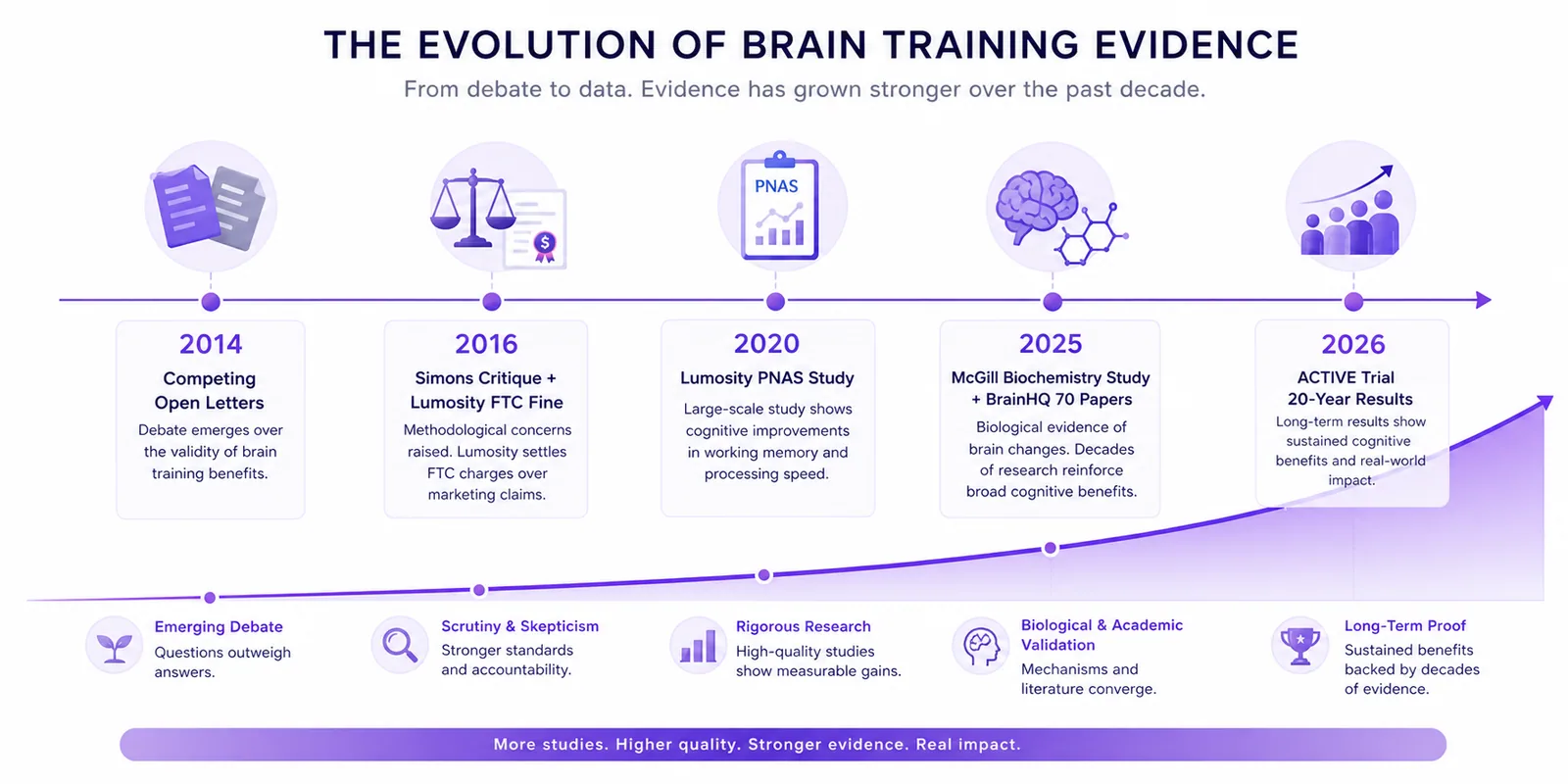
The confusion is understandable. For a decade, the research on brain training was genuinely divided. Two groups of scientists published competing open letters: one signed by 70 researchers saying brain games have no proven benefit, another signed by 133 researchers saying they do. Same evidence, opposite conclusions.
But the evidence landscape has shifted dramatically since then. Between 2024 and 2026, a wave of large-scale, long-term studies changed the conversation. This post gives you the honest, current picture: what works, what doesn’t, what’s still uncertain, and how to make sense of it all.
The Sceptics Had a Point (in 2016)
The most influential critique of brain training came from Daniel Simons and colleagues in 2016. Their review, published in Psychological Science in the Public Interest, examined the studies cited by brain training companies and concluded that while people got better at the trained tasks, there was little evidence those improvements transferred to untrained tasks or real-world cognitive abilities.
In plain language: playing a memory game makes you better at that memory game. It doesn’t necessarily make you better at remembering where you parked your car.
This was a legitimate finding. In 2016, much of the brain training research was based on small sample sizes, short training periods, and measures that only tested performance on tasks similar to the training. The industry had also overpromised. Lumosity was fined $2 million by the FTC in 2016 for claims that weren’t adequately supported by evidence.
So the sceptics weren’t wrong. They were responding to a real problem: an industry making big claims with limited proof. But the science didn’t stop in 2016.
What Changed Between 2016 and 2026
Three things shifted the evidence base significantly:
1. The ACTIVE Trial Hit 20 Years
The Advanced Cognitive Training for Independent and Vital Elderly (ACTIVE) Trial is the largest and longest study of cognitive training ever conducted. Over 2,800 adults aged 65 and older were randomised to receive training in memory, reasoning, or speed of processing, then followed for two decades.
In February 2026, Johns Hopkins published the 20-year follow-up results. Participants who received speed-of-processing training with booster sessions had a 25% lower risk of dementia diagnosis compared to those who received no training. This was the only cognitive intervention in the trial to show a lasting protective effect over 20 years. That’s not a small finding. That’s a major public health result.
2. Brain Imaging Showed Physical Changes
Earlier studies relied primarily on test scores. Recent research has gone further, using brain imaging to show actual physical changes. The 2025 McGill University study used PET scans to demonstrate that 10 weeks of brain training increased acetylcholine production (a neurotransmitter critical for memory) and effectively reversed 10 years of brain ageing in the cholinergic system. A 2026 NYU study found measurable changes in white matter structure after computerised cognitive exercises. (We covered both studies in our post on what happens to your brain when you play memory games.)
These aren’t test score improvements. They’re biochemical and structural changes visible on brain scans.
3. The Volume of Research Exploded
BrainHQ alone had 70 peer-reviewed publications in 2025, bringing its total to over 300 studies. But the research isn’t limited to one company. Independent studies from universities across the world have examined cognitive training using diverse methodologies, populations, and training types. A Lancet Commission report identified cognitive training as the single most effective lifestyle intervention for improving cognition in older adults.
The evidence in 2026 is not the same evidence the sceptics were responding to in 2016. It’s deeper, longer-term, and includes biological markers that go beyond self-reported improvements.
The Strongest Evidence: What We Now Know
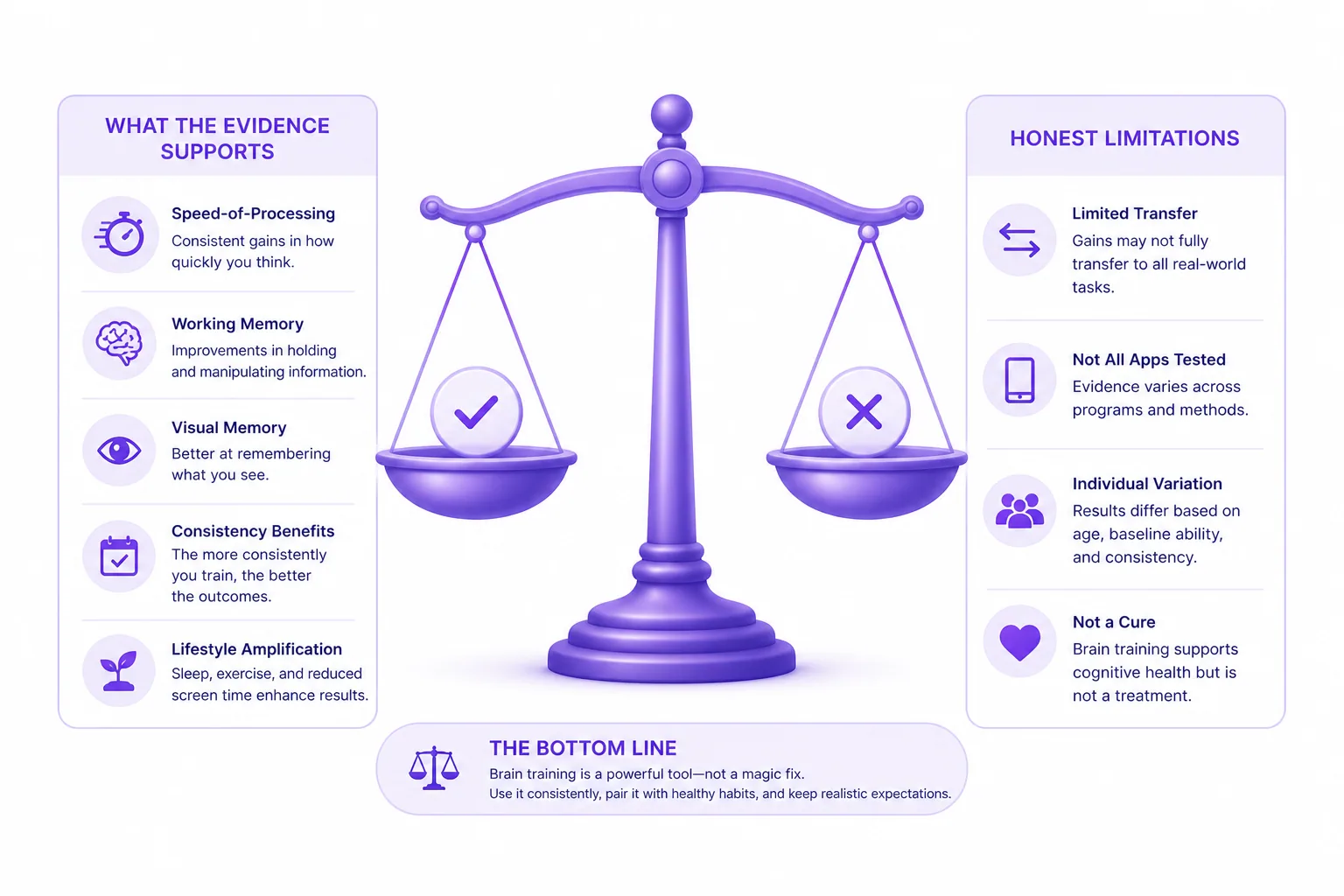
Based on the current research, here’s what the science supports:
Speed-of-processing training works. This is the most robustly supported form of cognitive training. The ACTIVE Trial’s 20-year data, combined with hundreds of supporting studies, provides strong evidence that speed-of-processing exercises improve processing speed, attention, and daily functioning, and reduce dementia risk. BrainHQ is the primary app delivering this type of training.
Working memory training improves working memory. Multiple studies show that targeted working memory exercises improve performance on working memory tasks. A randomised controlled trial found improvements in executive functions, working memory, and processing speed in young adults after brain training. The debate is about whether these gains transfer beyond the trained tasks.
Visual memory training improves visual memory. Research from the University of Michigan and others shows that visual pattern recognition and memory exercises improve visual processing speed and working memory within 2 to 4 weeks of consistent daily practice. The training is most effective when it targets a specific visual skill and uses adaptive difficulty. (For the full breakdown, see our guide to how to improve your visual memory.)
Consistency matters more than intensity. A six-year study of over 1,000 adults found that sustained weekly training significantly outperformed intensive short-term training. The ACTIVE Trial’s booster sessions showed the same pattern. Short, frequent sessions beat long, sporadic ones. (More on timelines in our post on how long it takes to improve your memory.)
Brain training combined with lifestyle factors produces stronger results. The Lancet meta-analysis found that cognitive training combined with physical exercise produced greater improvements than either alone. Sleep quality, social engagement, and reduced passive screen time all amplify training effects.
The Honest Limitations (They Still Exist)
The evidence has improved enormously, but it’s not a blank cheque. Here are the limitations the research is still clear about:
Transfer effects remain limited. The Simons critique from 2016 still holds for many types of training: improvements on trained tasks don’t automatically transfer to unrelated cognitive abilities. Getting brilliant at a pattern-matching game doesn’t make you better at learning French. The strongest transfer evidence comes from speed-of-processing training, which has shown real-world benefits like safer driving and better daily functioning. Other types of training show more limited transfer.
Not all apps have evidence. BrainHQ has 300+ studies. Most brain training apps have zero. Scientific American noted that most consumer apps have not undergone scientific validation at all. The existence of strong evidence for one programme doesn’t mean all programmes work equally. Choosing an app that uses evidence-backed training principles matters. (See our best brain training apps 2026 roundup for how to evaluate them.)
Individual results vary significantly. Age, baseline cognitive ability, genetics, sleep quality, stress, and lifestyle all affect outcomes. The Scientific American review noted that brain training may benefit some people more than others, particularly those with existing cognitive weaknesses in the trained domain.
Brain training is not a cure or preventative for dementia. The ACTIVE Trial showed a 25% reduction in dementia risk, not elimination. Brain training should be part of a broader brain health strategy that includes exercise, sleep, nutrition, and social connection. If you’re concerned about cognitive decline, speak with a healthcare professional. (See our post on memory and ageing for guidance on what’s normal and what warrants attention.)
What “Works” Actually Means
Part of the confusion around brain training comes from people meaning different things by “works.”
If “works” means “makes you generally smarter,” the evidence doesn’t support that. No brain training app has been shown to raise general intelligence.
If “works” means “improves the specific cognitive skill it targets with consistent use,” the evidence strongly supports that. Speed-of-processing training improves processing speed. Working memory training improves working memory. Visual memory training improves visual memory.
If “works” means “produces measurable physical changes in the brain,” recent imaging studies confirm that too.
If “works” means “reduces dementia risk,” one specific type of training (speed-of-processing) has 20-year evidence supporting a 25% risk reduction.
The most accurate summary in 2026 is this: brain training works within its scope. It improves the skills it trains, especially with consistent daily practice. It doesn’t transform your intelligence. It doesn’t replace healthy lifestyle habits. But as one component of a broader brain health routine, the evidence is now substantially stronger than it was a decade ago.
How to Choose Training That’s Worth Your Time
If you’re going to invest time in brain training, here’s how to make sure it counts:
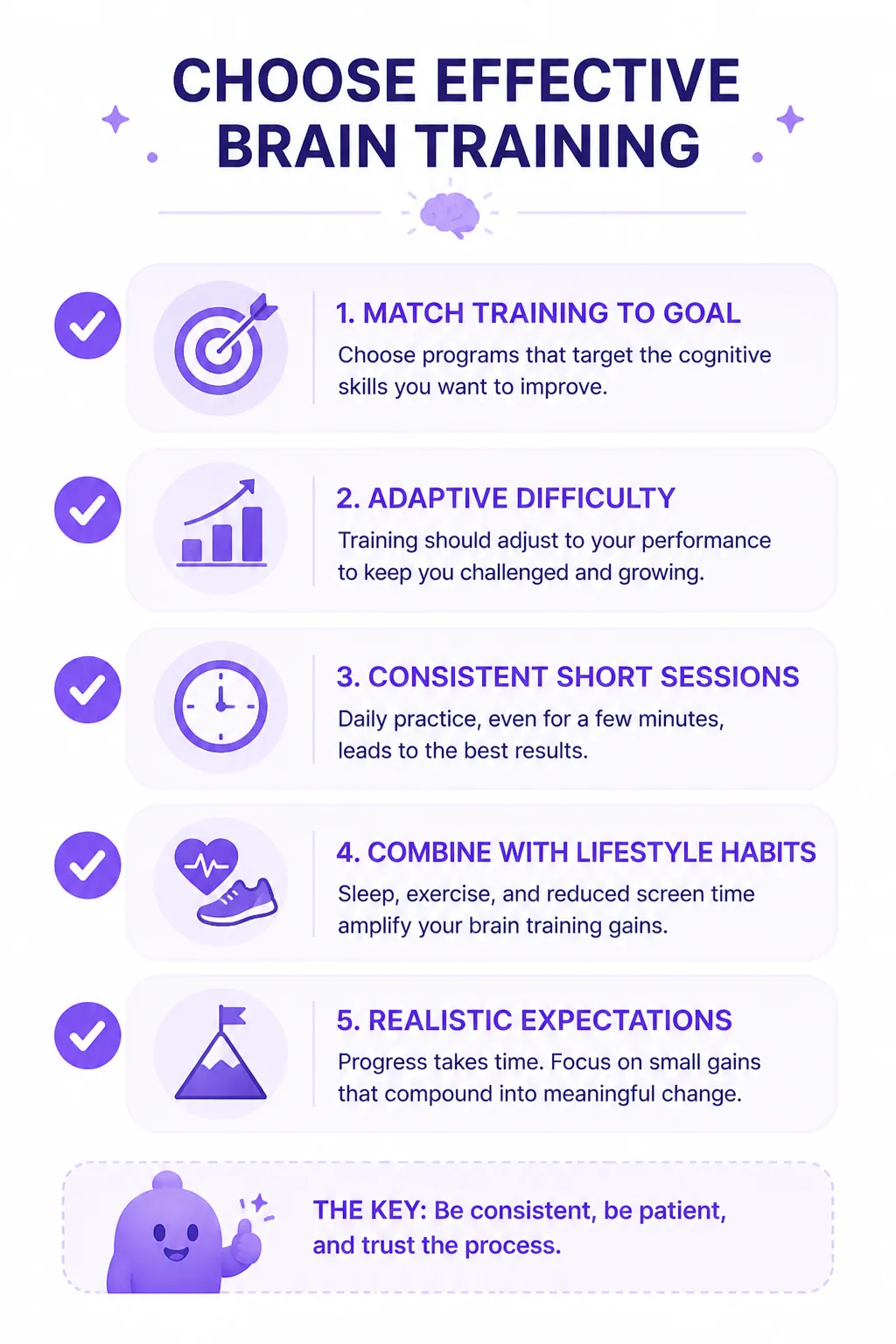
1. Match the training to your goal. Want to improve visual memory (faces, places, details)? Choose an app that specifically trains visual memory. Want broader cognitive fitness? Choose an app that covers multiple domains. The specificity of your training should match the specificity of your goal.
2. Look for adaptive difficulty. If the app doesn’t get harder as you improve, it’s not training. It’s entertainment. Adaptive difficulty keeps you at the edge of your ability, which is where neural pathways actually strengthen.
3. Prioritise consistency over session length. Two minutes daily beats thirty minutes weekly. Choose an app with a session length you’ll realistically commit to every day. (This is why Blanked is designed around 2-minute sessions. The research says consistency wins, so we removed every barrier to daily play.)
4. Combine with lifestyle factors. Brain training alone is good. Brain training plus quality sleep, regular exercise, and reduced passive screen time is significantly better. The combination effect is well-documented. (See our posts on how sleep affects memory and screen time and memory.)
5. Set realistic expectations. Brain training will sharpen the specific skills you train. It will not make you a genius, cure dementia, or replace medical advice. If your expectations are realistic, the results will meet or exceed them.
The brain training debate isn’t over. Science never truly settles. But the conversation in 2026 is fundamentally different from where it was in 2016. The evidence is stronger, the studies are larger and longer, and the biological mechanisms are better understood. Brain training isn’t a miracle. But it’s not snake oil either. It’s a tool. And like any tool, its value depends on choosing the right one and using it consistently.
If you want to start with something focused, fast, and free, give Blanked a try. Two minutes a day of targeted visual memory training, backed by the principles the research supports most strongly: active recall, adaptive difficulty, and daily consistency.
Frequently asked questions
Is there scientific proof that brain training works?
Why do some scientists say brain training doesn’t work?
Do brain training apps prevent dementia?
How long do I need to use brain training before it works?
Are all brain training apps equally effective?
Train your memory. Play Blanked free.
A free visual memory game built around how memory actually works. 6 game modes, 400+ levels.
Download on the App Store