Memory and Ageing: What Declines and What Doesn’t (2026)

On this page (10)
If you’re over 40, you’ve probably noticed it. A name that used to come instantly now takes a few seconds. A word that was right on the tip of your tongue yesterday now hovers frustratingly out of reach. You walk into a room and forget why you went there, then spend the next five minutes wondering whether this is a normal Tuesday or the beginning of something worse. (You have probably also noticed the years themselves feel faster now; here is the memory science behind that.)
Here’s what the research actually says: some types of memory do decline with age. That’s real, and pretending otherwise would be dishonest. But the decline is more selective and more gradual than most people fear. And several important cognitive abilities don’t decline at all. Some actually improve.
This post separates the science from the anxiety. What changes, what doesn’t, when to worry, and what you can actually do about it.
The Good News Nobody Tells You
The narrative around ageing and memory is overwhelmingly negative. Media headlines focus on decline, dementia risk, and cognitive deterioration. What they rarely mention is that most people in their 60s, 70s, and even 80s retain the majority of their cognitive abilities.
According to UCSF’s Memory and Aging Centre, normal age-related cognitive changes are subtle and mostly affect thinking speed and attentional capacity. They are not the dramatic memory loss people fear. And a 2025 study published in Clinical Interventions in Aging confirmed that while cognitive decline accompanies ageing, the rate and severity vary enormously between individuals. Genetics, lifestyle, education, and ongoing cognitive engagement all play significant roles in how quickly (or slowly) your brain ages.
The most important takeaway from the research? Age-related memory changes are not inevitable at a fixed rate. They’re influenced heavily by what you do. And that’s the part most articles leave out.
What Actually Declines With Age
Let’s be specific about what changes. Not everything labelled “memory” is affected equally.
Processing Speed
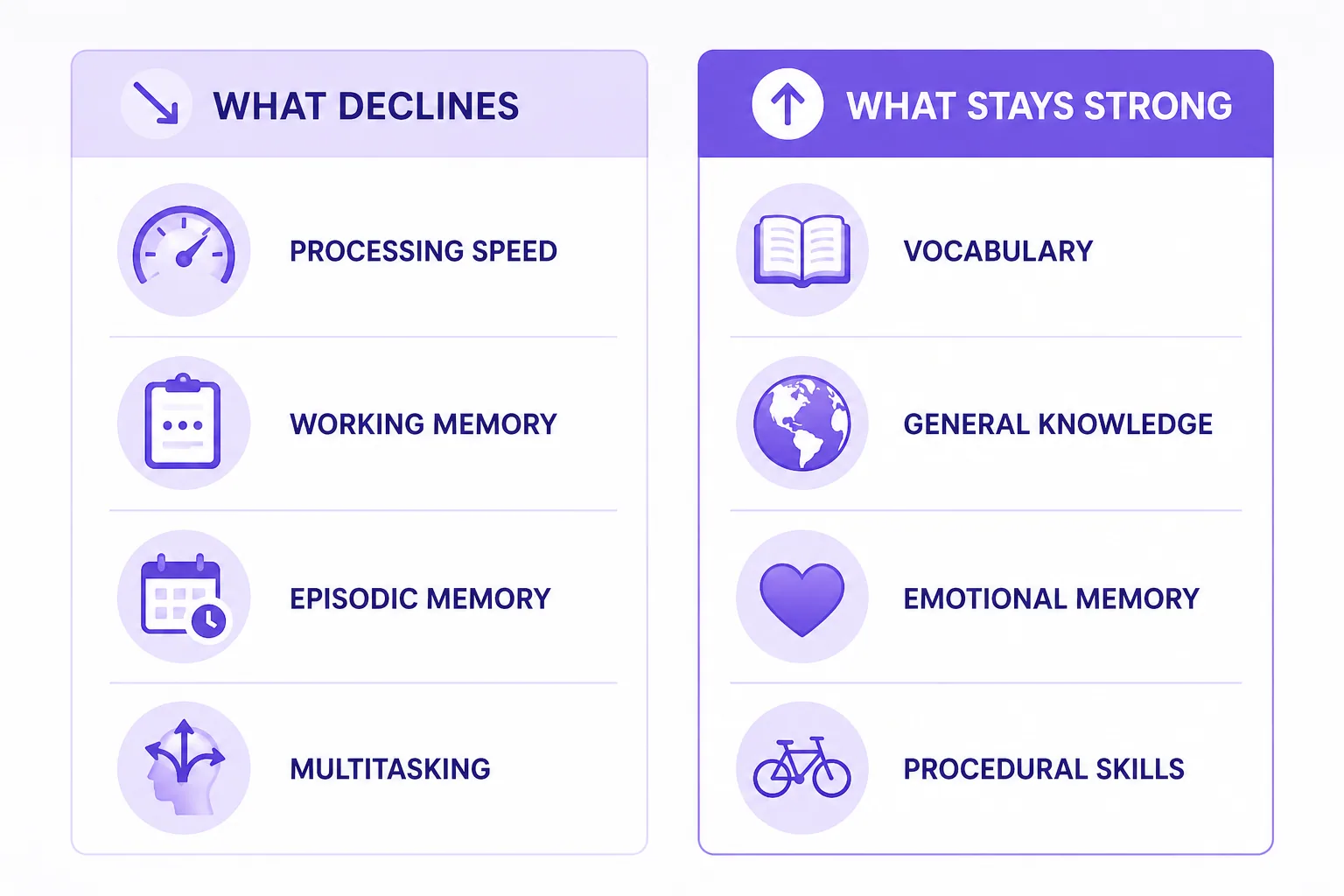
This is typically the first thing to slow down, and it’s often the change people notice most. Your brain takes slightly longer to process new information, react to stimuli, and switch between tasks. A peer-reviewed review in Frontiers in Aging Neuroscience confirmed that processing speed is one of the cognitive functions most sensitive to age-related decline. This doesn’t mean you process information less accurately. It means you process it less quickly.
Working Memory
Working memory, your ability to hold and manipulate information in real time (like doing mental arithmetic or following a complex set of directions), typically declines from your 30s onward. The prefrontal cortex, which manages working memory, is particularly sensitive to age-related structural changes. A 2025 mega-analysis published in Nature Communications confirmed that hippocampal and frontal lobe volume reductions are key drivers of episodic memory decline in ageing.
Episodic Memory
Episodic memory, the ability to recall specific events and experiences, shows gradual decline with age. You might find it harder to remember what you had for dinner three days ago, or the details of a conversation from last week. This type of memory relies heavily on the hippocampus, which loses approximately 1 to 2% of its volume annually after age 60.
Multitasking and Divided Attention
The ability to do multiple things simultaneously becomes harder with age, partly because of slower processing speed and partly because the prefrontal cortex’s capacity to manage competing demands reduces. This isn’t really memory loss. It’s attention management becoming less efficient, which then affects how well you encode new information.
What Stays Strong (or Gets Better)
This is the section that most ageing articles bury at the bottom, if they include it at all. Several cognitive abilities remain stable or actually improve with age:
Vocabulary and verbal knowledge. Your word bank grows throughout your life. Older adults consistently outperform younger adults on vocabulary tests. UCSF’s research confirms that vocabulary, reading comprehension, and verbal reasoning remain unchanged or even improve with age.
Crystallised intelligence. This refers to accumulated knowledge, wisdom, and expertise. The facts you’ve learned, the patterns you’ve recognised over decades, the judgment you’ve built through experience. Crystallised intelligence continues to grow well into your 70s for most people.
Emotional regulation and social cognition. Older adults are generally better at reading social situations, managing emotional responses, and making nuanced judgments about people. The brain regions involved in emotional processing remain relatively preserved with age.
Procedural memory. Skills you’ve learned through practice (driving, playing an instrument, typing, cooking) are stored differently from factual memories and are remarkably resistant to age-related decline. You don’t forget how to ride a bicycle at 70.
Semantic memory. Your general knowledge about the world (facts, concepts, meanings) remains stable well into old age. You might struggle to remember what happened last Tuesday, but you’ll have no trouble explaining how photosynthesis works if you learned it decades ago.
The pattern is clear: your brain’s ability to process new information quickly gets slower, but your accumulated knowledge and well-practised skills remain largely intact. The common fear of “losing your mind” as you age is, for most people, a significant overreaction to what is actually a selective and gradual change.
Normal Ageing vs Something More Serious
This is the question that keeps many people up at night: “Is what I’m experiencing normal, or is it the start of dementia?”
The clinical distinction is important:
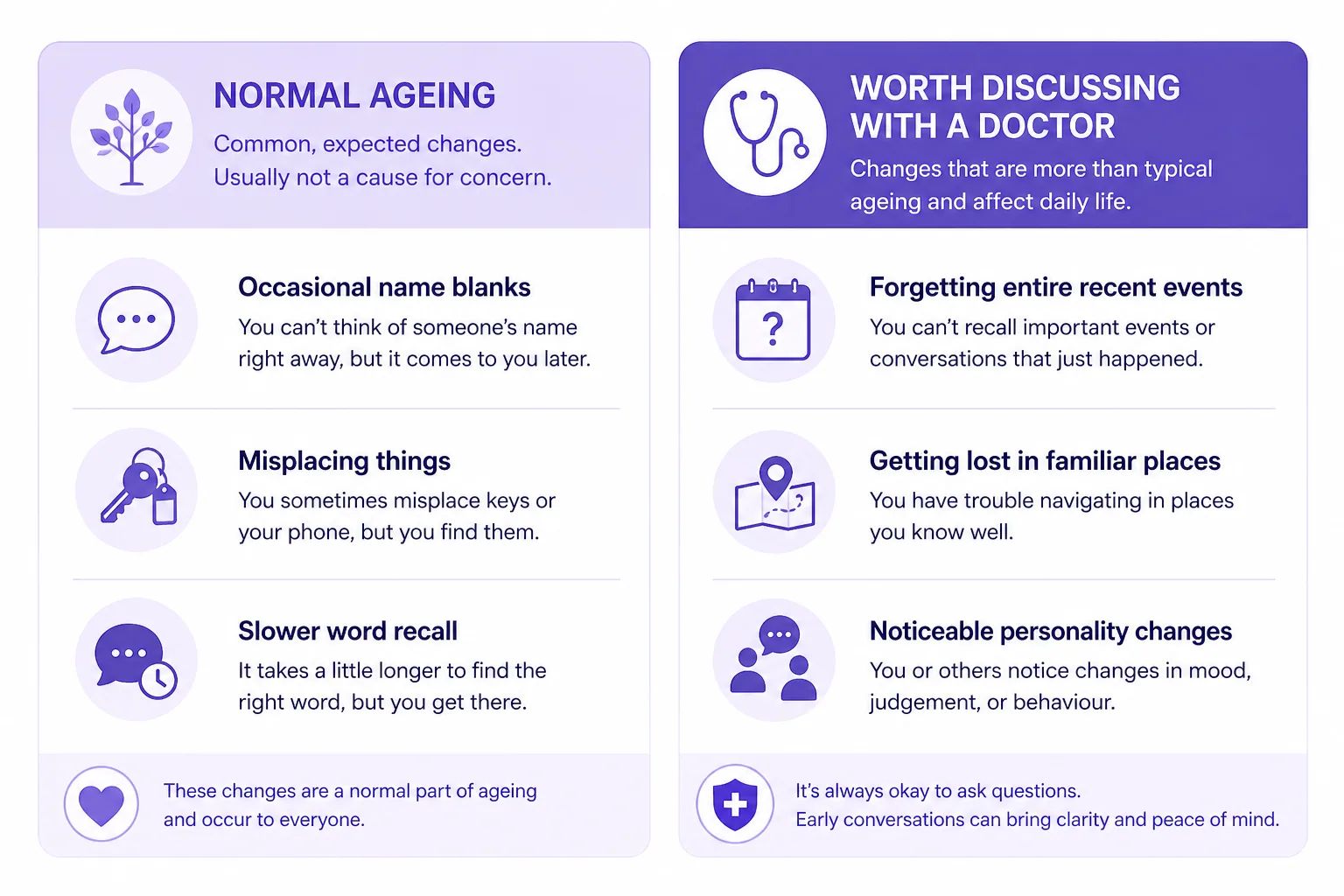
Normal age-related changes include occasionally forgetting a name but remembering it later, sometimes misplacing your keys, needing a moment longer to recall a word, or finding it harder to multitask. These are subtle, stable over time, and do not interfere with your ability to live independently.
Warning signs that warrant medical attention include frequently forgetting recent events entirely (not just details), getting lost in familiar places, difficulty following conversations or instructions, personality changes, confusion about time or place, and problems with familiar tasks like managing finances or following a recipe you’ve made dozens of times.
The key difference is impact on daily functioning. Normal age-related memory changes are annoying but manageable. Dementia-related changes progressively interfere with your ability to function independently. If you’re worried, the right step is always to speak with a healthcare professional. They can run cognitive assessments that distinguish between normal ageing and early signs of something more serious.
Cognitive Reserve: Why Some Brains Age Better
One of the most important concepts in ageing research is cognitive reserve. It refers to your brain’s ability to maintain function despite age-related structural changes. Two people with identical brain scans can have very different cognitive abilities, because their reserves are different.
A 2025 review published in Diagnostics synthesised the research on cognitive reserve and found that it is built through three main channels:
- Education and intellectual engagement. People who continue learning, reading, and engaging in intellectually stimulating activities throughout life build larger cognitive reserves. The brain develops redundant neural pathways that can compensate when primary pathways weaken.
- Social connection. Regular social interaction stimulates multiple cognitive systems simultaneously. Isolation is consistently linked to faster cognitive decline in ageing populations.
- Cognitive training. Targeted mental exercises, including memory training, help maintain and even strengthen neural pathways that would otherwise weaken with disuse. The ACTIVE Trial, a 20-year NIH-funded study, found that speed-of-processing training reduced dementia risk by 25%.
The practical message is that cognitive reserve is not fixed at birth. It’s built and maintained through what you do. And it’s never too late to start. Research shows that cognitive training produces measurable improvements in older adults, even those who begin in their 70s and 80s. (For how this works at a biological level, see our post on what happens to your brain when you play memory games.)
What You Can Do About It
The research consistently points to the same set of interventions that slow age-related memory decline:
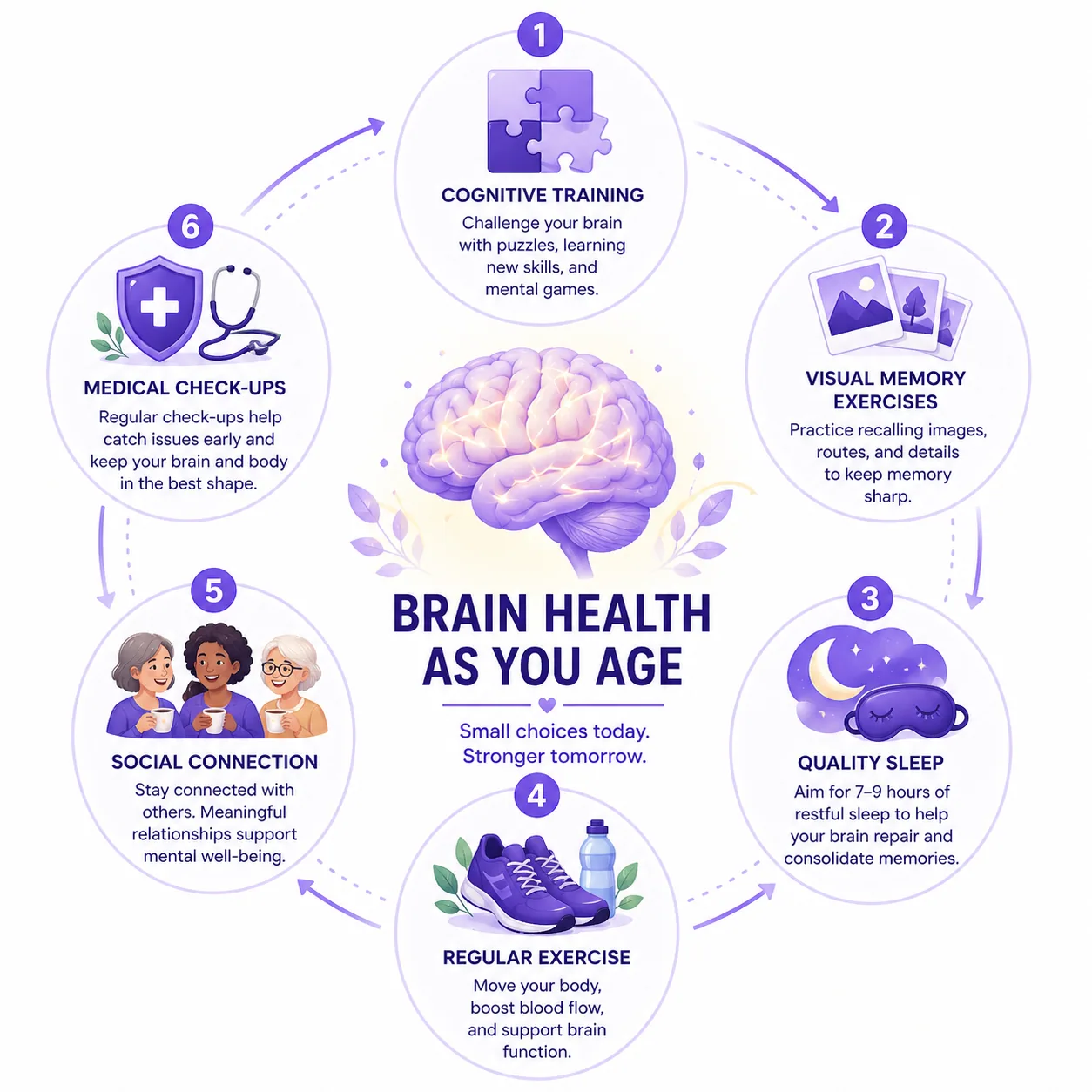
1. Stay cognitively active. Use your brain deliberately. Read challenging material. Learn something new. Play games that require memory, attention, and problem-solving. The key word is “challenge.” Passive activities (watching TV, scrolling your phone) don’t provide the cognitive stimulation needed to maintain neural pathways. Active engagement does. (For more on why passive vs active screen time matters, see our post on screen time and memory.)
2. Train your visual memory. Visual memory, the ability to recall what you’ve seen, relies on brain regions that are particularly susceptible to age-related volume loss. Training these pathways specifically helps maintain them. Blanked is designed for exactly this: 2 minutes a day of visual memory exercises that challenge your brain to encode, store, and recall information. It’s the cognitive equivalent of a daily walk for your visual memory system.
3. Prioritise sleep. Sleep is when your brain consolidates memories and clears metabolic waste. Both functions become more important, not less, as you age. Seven to nine hours of quality sleep protects both short-term memory formation and long-term brain health. (See our full guide to how sleep affects your memory.)
4. Exercise regularly. Physical exercise increases production of BDNF, a protein essential for neuron survival and growth. It’s particularly active in the hippocampus. Regular brisk walking, cycling, or swimming has been shown to slow hippocampal shrinkage and improve memory performance in older adults.
5. Stay socially connected. Social interaction engages multiple cognitive systems simultaneously: language processing, emotional regulation, attention, working memory. People with strong social networks consistently show slower rates of cognitive decline. If you’re retired or working remotely, this requires deliberate effort.
6. Don’t ignore new symptoms. If you notice memory changes that feel different from what’s described in the “normal” column above, talk to your doctor. Early detection of cognitive conditions dramatically improves outcomes. There is no benefit to worrying in silence.
Ageing changes your memory. That’s true. But the change is more selective, more gradual, and more manageable than most people believe. Your accumulated knowledge, your well-practised skills, and your verbal abilities remain strong well into old age. The areas that do decline (processing speed, working memory, episodic recall) respond to intervention. You can slow the decline, build cognitive reserve, and maintain sharper memory for longer than you might think.
The best time to start was ten years ago. The second best time is today. And if you want to begin with something simple, try Blanked for free. Two minutes a day. Your future self will appreciate it.
Frequently asked questions
At what age does memory start to decline?
Is it normal to be more forgetful as you get older?
Can brain training prevent age-related memory loss?
What is the difference between normal ageing and dementia?
What is cognitive reserve?
Train your memory. Play Blanked free.
A free visual memory game built around how memory actually works. 6 game modes, 400+ levels.
Download on the App Store