How Long Does It Actually Take to Improve Your Memory?

On this page (8)
You’ve downloaded a brain training app, played for three days, and now you’re wondering: is this actually doing anything? When will I start noticing a difference? Am I wasting my time?
These are fair questions. And most brain training companies dodge them with vague claims about “sharpening your mind” without specifying a timeline. The research, thankfully, is more specific. Here’s what the science actually says about how long it takes to improve your memory, broken down week by week.
The Honest Answer (Before We Get Into Details)
The short version: you can expect noticeable improvements in task performance within 2 to 4 weeks of consistent daily training. Functional brain changes (how efficiently your brain processes information) begin appearing at 4 to 8 weeks. Structural and biochemical changes (actual physical alterations in your brain) become measurable at 8 to 12 weeks.
The critical word in all of this is “consistent.” The research is unambiguous: short daily sessions produce better outcomes than longer sporadic ones. Two minutes every day beats thirty minutes twice a week. Your brain responds to regular, repeated stimulation. Miss a few days and the curve flattens. Show up daily and the gains compound.
Now let’s break down what each phase actually looks and feels like.
Week 1 to 2: The Adjustment Phase
What’s happening in your brain: Your brain is getting used to the type of challenge you’re presenting. It’s learning the rules, adapting to the task format, and beginning to develop basic strategies for encoding and recalling information. Neurons are starting to fire in new patterns, but the connections are still fragile.
What you’ll notice: You’ll probably get better at the game quite quickly. Scores improve, levels get easier, and you start developing instinctive approaches to the tasks. This feels like memory improvement, but it’s mostly task familiarisation. Your brain is learning the mechanics of the game, not yet deeply training the underlying skill.
What to expect: Don’t read too much into early improvements. They’re real, but they’re mostly about learning the specific task rather than broad memory gains. The real training hasn’t kicked in yet. This is the phase where most people either build the habit or abandon the app. Building the streak is everything.
Week 2 to 4: Task-Specific Improvements
What’s happening in your brain: The neural pathways involved in the trained task are beginning to strengthen through long-term potentiation (LTP). Synaptic connections between the neurons you’re using repeatedly are getting faster and more reliable. Your brain is becoming genuinely better at the specific type of memory the training targets. (For a deeper explanation of LTP, see our post on what happens to your brain when you play memory games.)
What you’ll notice: This is where you start feeling sharper in ways that go beyond just being better at the game. If you’re training visual memory, you might notice you’re recalling visual details more easily. Where you parked. What someone was wearing. The layout of a new place. These moments are subtle, but they’re the first signs of genuine transfer from training to daily life.
Research from the University of Michigan found measurable improvements in visual processing speed and working memory after just two weeks of consistent pattern recognition training. A 2016 study on working memory training in children showed significant improvement after three weeks of daily 30-minute sessions, with gains maintained at a follow-up 2 to 6 months later.
What to expect: Improvements are real but specific to the type of memory you’re training. If you’re training visual memory, visual recall improves. If you’re training verbal memory, verbal recall improves. This is not a limitation. It’s how targeted training works. (More on this specificity in our guide to how to improve your visual memory.)
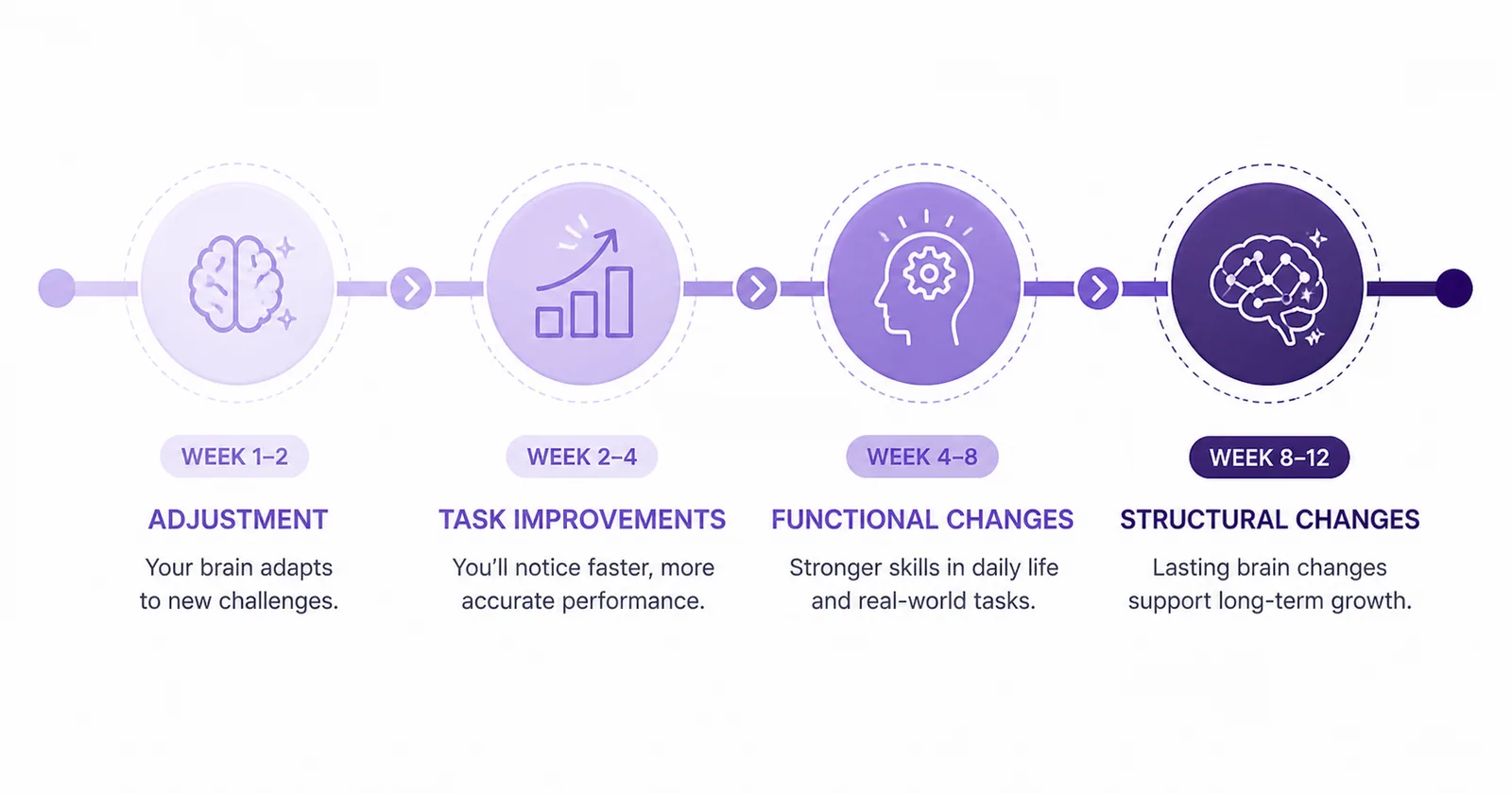
Week 4 to 8: Functional Brain Changes
What’s happening in your brain: This is where things get genuinely exciting from a neuroscience perspective. Your brain isn’t just performing better at the task. The neural networks responsible for the trained skill are becoming measurably more efficient. Brain imaging studies show increased activation in relevant regions (prefrontal cortex, hippocampus, occipital lobe for visual tasks) and faster signal transmission along the pathways you’ve been strengthening.
What you’ll notice: Processing feels faster. You encode visual information with less effort. Recalling details starts to feel more automatic. Tasks that used to require conscious concentration begin shifting toward fluency. You might also notice improvements in related areas. Better focus during meetings. Fewer “where did I park?” moments. Faster facial recognition.
A 2022 study published in Frontiers in Human Neuroscience found that 10 weeks of episodic memory training produced hippocampal volume increases in both young and older adults, confirming that functional changes at this stage are accompanied by early structural changes. The gains were maintained even during a 2-week break from training, suggesting the improvements are robust.
Week 8 to 12: Structural and Biochemical Changes
What’s happening in your brain: This is where the research gets particularly compelling. A 2025 McGill University study used PET scans to measure acetylcholine production (a neurotransmitter critical for memory and attention) before and after a 10-week brain training programme. Participants showed a 2.3% increase in acetylcholine production in the anterior cingulate cortex. The control group, who played generic entertainment games, showed no change.
A 2026 NYU study found that computerised cognitive exercises changed the brain’s white matter (the nerve fibres connecting different brain regions). These structural changes correlated directly with improvements in processing speed, attention, and working memory.
What you’ll notice: By this stage, improvements are becoming part of your baseline. The skills you’ve trained are no longer effortful. They feel natural. Visual recall is faster and more reliable. You’re holding more information in working memory with less strain. People around you might notice too: fewer forgotten details, sharper observations, quicker recall in conversations.
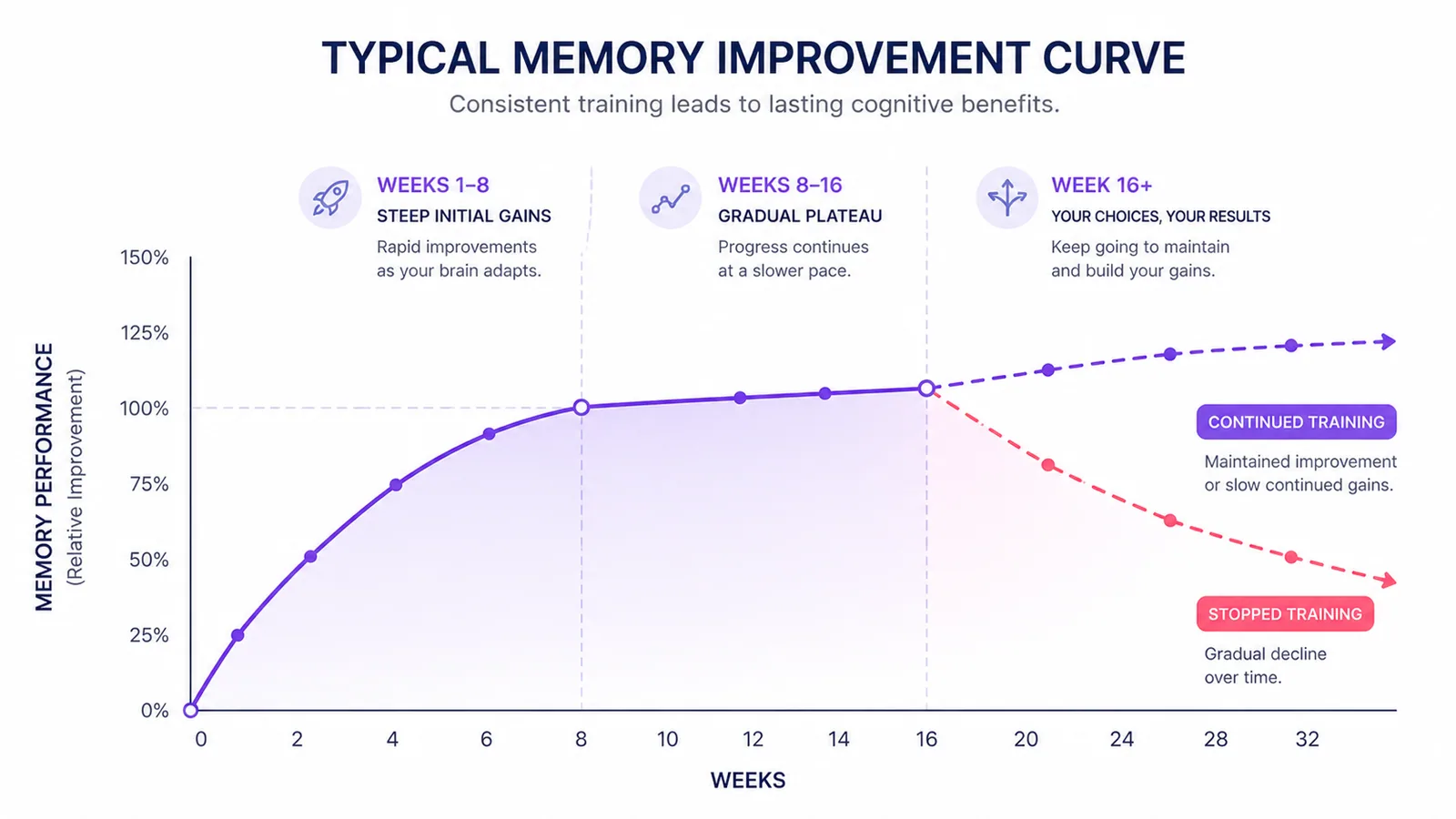
What to expect: This is also the stage where gains start to plateau. Your rapid improvement curve from the first few weeks has levelled off. This doesn’t mean training has stopped working. It means the low-hanging fruit has been picked and further improvements require sustained, consistent effort. This is normal and expected.
Beyond 12 Weeks: Long-Term Maintenance
A landmark study published in Frontiers in Aging Neuroscience followed over 1,000 healthy older adults through 6 years of memory training. The group that trained consistently (once per week over the full period) showed significantly better everyday memory than the group that trained intensively for 11 weeks and then stopped. The sustained group continued to improve even after year one.
The ACTIVE Trial, a 20-year NIH-funded study, found that speed-of-processing training benefits were still measurable a full decade after the training ended. However, participants who received booster sessions retained more improvement than those who didn’t.
The pattern is clear: initial gains can be made relatively quickly (2 to 12 weeks), but maintaining and building on those gains requires ongoing practice. Think of it like physical fitness. You can get noticeably fitter in 12 weeks, but stopping entirely means the gains gradually fade. Continuing at a reduced frequency (a few sessions per week instead of daily) appears to be enough to maintain most improvements.
The Three Things That Speed Everything Up
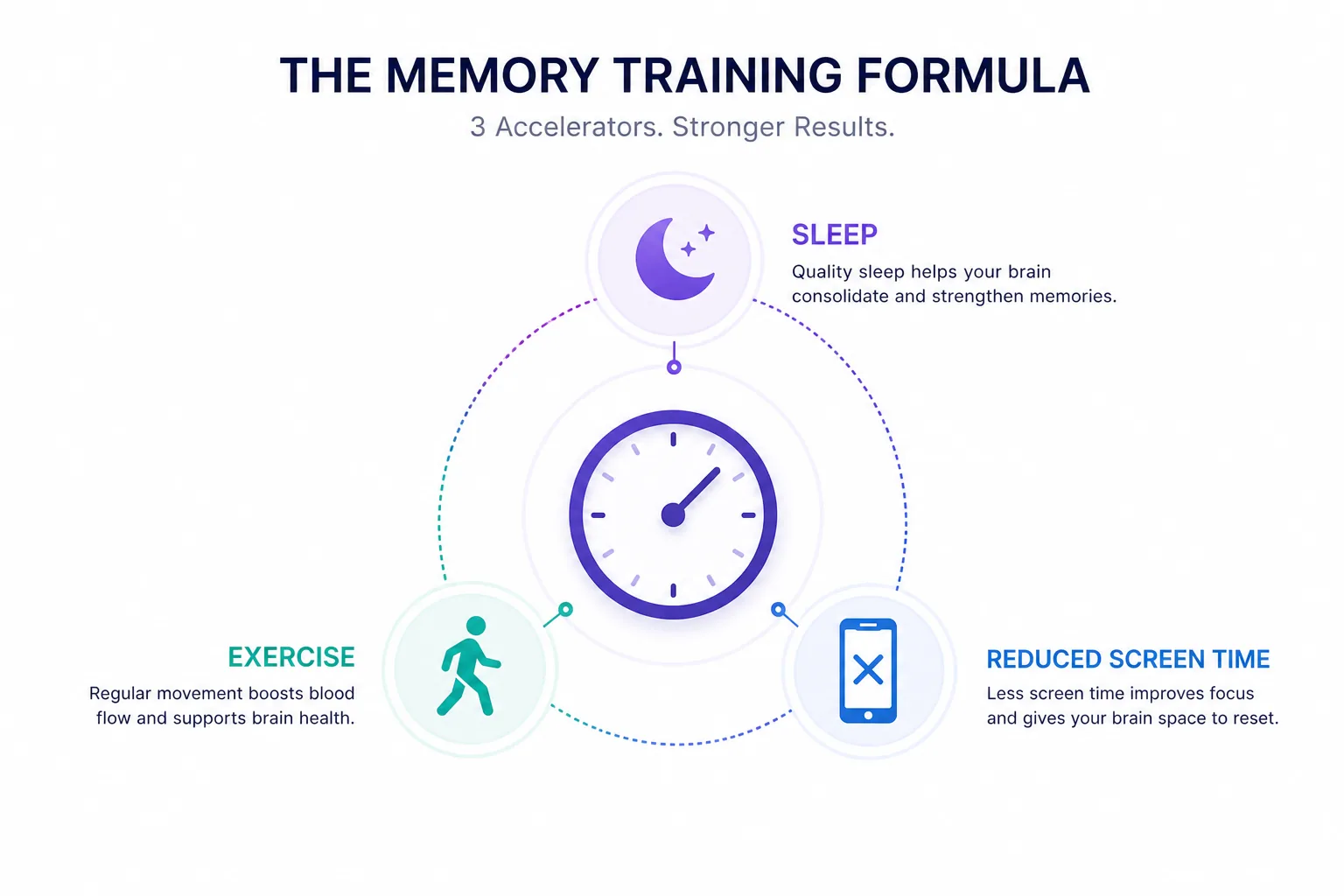
The timeline above assumes you’re doing cognitive training alone. But the research shows three factors that significantly accelerate memory improvement when combined with training:
1. Sleep. Your brain consolidates training gains during deep sleep. The hippocampal replay process that transfers short-term learning into long-term neural changes requires adequate sleep to function. Training in the evening and sleeping well that night produces the best consolidation window. Cutting sleep doesn’t just slow progress. It actively undermines it. (Full breakdown in our post on how sleep affects your memory.)
2. Physical exercise. Exercise increases BDNF production, a protein that supports neuron growth and survival. BDNF is particularly active in the hippocampus. A meta-analysis in The Lancet found that cognitive training combined with physical exercise produced stronger improvements than either alone. Even 20 minutes of brisk walking makes a measurable difference.
3. Reduced passive screen time. Passive scrolling trains your brain to process information at surface level and discard it immediately. This directly counteracts what memory training is trying to build. Replacing even 10 minutes of daily scrolling with active cognitive engagement accelerates the neural changes training is producing. (More on this in our post on screen time and memory.)
What the Research Can’t Promise
We’d be doing you a disservice if we only gave you the optimistic timeline. Here’s what the science is clear about:
Transfer effects are limited. Getting better at a visual memory game doesn’t automatically make you better at maths or reading. Improvements tend to be specific to the type of memory you train. This is why choosing training that matches the skill you want to improve matters. (We covered the transfer debate in detail in our best brain training apps 2026 post.)
Individual results vary. Age, baseline cognitive fitness, sleep quality, stress levels, and genetics all affect how quickly you’ll see improvements. The timelines above reflect research averages. You might be faster or slower.
Gains require maintenance. Like physical fitness, cognitive improvements fade without ongoing practice. The rate of decline after stopping varies, but the principle is consistent: use it or lose it.
None of this means memory training doesn’t work. It means it works within realistic parameters. If you go in expecting to become a genius in 30 days, you’ll be disappointed. If you go in expecting to noticeably sharpen a specific cognitive skill through consistent daily practice, the research firmly supports that.
If you want to start with the lowest possible time commitment, Blanked takes about 2 minutes per session. That’s roughly 14 minutes a week of targeted visual memory training. Based on the research, you should notice task-specific improvements within 2 to 4 weeks and more meaningful gains by week 8 to 12. And Blink will be there the whole time, silently judging your streak.
Frequently asked questions
How many minutes a day should I train my memory?
Can I improve my memory in 2 weeks?
Do memory training gains last?
Does age affect how quickly memory training works?
What type of memory training works fastest?
Train your memory. Play Blanked free.
A free visual memory game built around how memory actually works. 6 game modes, 400+ levels.
Download on the App Store