Blanked vs Lumosity: Honest Comparison (2026)

On this page (9)
Lumosity is the biggest name in brain training. Over 100 million users, partnerships with 100+ universities, and nearly two decades in the market. If you’ve ever Googled “brain training app,” Lumosity was probably the first result.
Blanked is newer, smaller, and deliberately narrower in scope. It doesn’t try to train everything. It focuses entirely on visual memory, wraps it in a game-first experience, and asks for about 2 minutes of your day.
These are fundamentally different apps solving different problems. So rather than declaring a winner, we’re going to break down exactly what each one does, where it’s strong, where it’s weak, and help you figure out which one actually matches what you’re looking for.
Full transparency: Blanked is our app. We’re going to be as honest about its limitations as we are about its strengths. You deserve that.
Two Very Different Approaches to Brain Training
The first thing to understand is that Blanked and Lumosity aren’t really competitors in the traditional sense. They’re built around different philosophies.
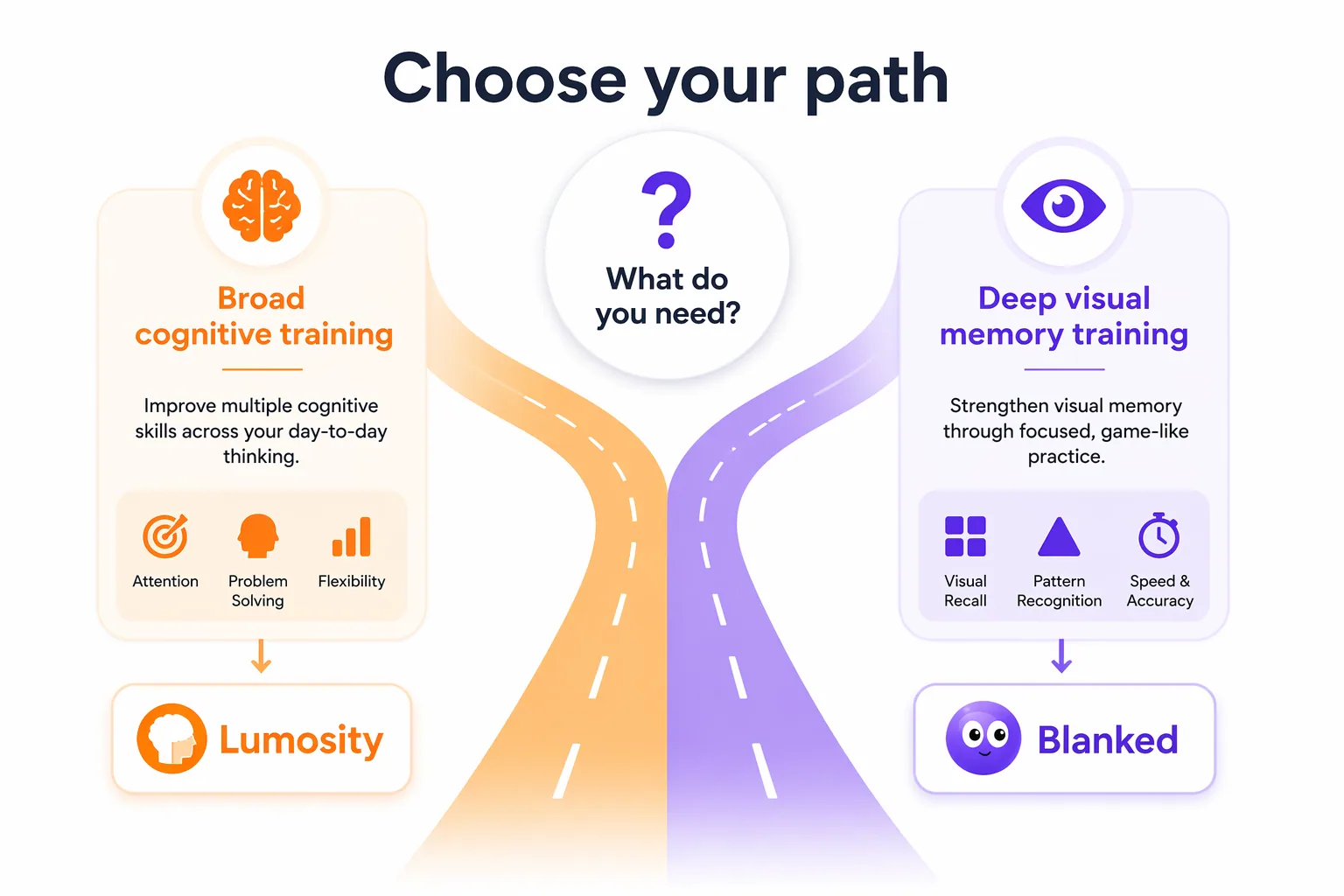
Lumosity’s approach: Cover as many cognitive areas as possible. Lumosity offers 40+ games spanning memory, attention, flexibility, processing speed, and problem-solving. It’s a broad cognitive gym. The idea is that by training across multiple domains, you improve your overall mental fitness.
Blanked’s approach: Go deep on one thing. Blanked has 6 game modes, all targeting visual memory from different angles. Rather than spreading across cognitive skills, it specialises in how well you encode, store, and recall what you’ve seen. Think of it as the difference between a general fitness class and a dedicated strength programme.
Neither approach is objectively better. It depends on what you need. If you want broad cognitive training across multiple areas, Lumosity is designed for that. If you know that visual memory is your weak spot (forgetting faces, losing track of where you put things, struggling to recall visual details), Blanked targets that directly.
What Each App Actually Trains
Lumosity
- Memory: Spatial recall, pattern matching, sequence memory
- Attention: Task switching, divided attention, selective focus
- Flexibility: Cognitive shifting, rule changes, adaptability
- Speed: Processing speed, reaction time
- Problem-solving: Logic puzzles, planning, estimation
Lumosity’s memory games include some visual elements, but memory is just one of five training categories, and the visual memory component is shared with verbal and spatial exercises. You’re not getting dedicated visual memory training. You’re getting a slice of it within a broader programme.
Blanked
- Classic: General visual memory, colour and position recall
- Speed Recall: Rapid visual encoding under time pressure
- Snap Match: Change detection and visual comparison
- Sequence: Sequential visual memory and temporal ordering
- Counting Blitz: Rapid visual scanning and selective attention
- Colour Chain: Colour discrimination and sequential recall
Every mode in Blanked trains visual memory, but each one targets a different facet of it. The result is that you’re training the same core skill from six different angles, which produces deeper improvement in that specific area. (For a full breakdown of each mode, see our beginner’s guide to Blanked.)
The Game Experience: How They Feel to Play
This is where personal preference matters more than features lists.
Lumosity feels polished and familiar. It’s been around since 2007 and the design reflects that maturity. Games are colourful, well-animated, and satisfying to play. Daily workouts are curated and take about 15 minutes. The progress tracking shows how you compare to others in your age group, which adds a competitive edge.
The downside? Lumosity’s design hasn’t evolved dramatically in recent years. Some users describe it as feeling like a “2015 app with a 2026 coat of paint.” The games are good, but if you’ve been using the app for a while, the novelty wears off. The free version is also quite restrictive (3 daily games), which can feel limiting.
Blanked feels more like a mobile game than a brain training app. The mascot (Blink, a purple blob with big expressive eyes) adds personality that Lumosity lacks. Daily streaks, cosmetics, weekly challenges, and a lives system create the kind of habit loop you’d find in Duolingo rather than a clinical training tool.
The trade-off is scope. Because Blanked only does visual memory, there’s less variety in what you’re doing day to day compared to Lumosity’s 40+ game catalogue. If you need novelty across different cognitive areas to stay engaged, Blanked’s narrower focus might feel repetitive over time.
Scientific Backing: How Honest Can We Be?
This is where things get nuanced, and where most comparison articles get lazy. So let’s be precise.
Lumosity has partnered with over 100 universities and has published multiple peer-reviewed studies. A 2020 study in PNAS found that participants who trained with Lumosity for 10 weeks showed improvements on untrained cognitive assessments compared to a control group. That’s legitimate research.
However, Lumosity also carries baggage. In 2016, the FTC fined Lumos Labs $2 million for making claims about cognitive benefits that weren’t adequately supported by evidence. Since then, the company has rebuilt its research programme and been more careful with its claims. But the broader scientific consensus (including a 2016 meta-analysis by Simons et al.) remains that improvements from brain training apps tend to be task-specific rather than broadly transferable.
Blanked doesn’t have published clinical trials. We’re a newer app and we haven’t reached that stage yet. What Blanked does have is mechanics built directly on well-established cognitive science principles: active recall (forced retrieval from memory), adaptive difficulty, spaced daily practice, and targeted visual memory training. Each of these principles has strong independent research support. (We cover the science in detail in our post on what happens to your brain when you play memory games.)
The honest summary: Lumosity has more published research behind its specific product, but the research on broad cognitive transfer is contested. Blanked’s individual mechanics are science-backed, but the app itself hasn’t been clinically tested as a whole. Neither app can honestly claim to “make you smarter.” Both can legitimately claim to improve performance on the specific skills they train.
Pricing Breakdown
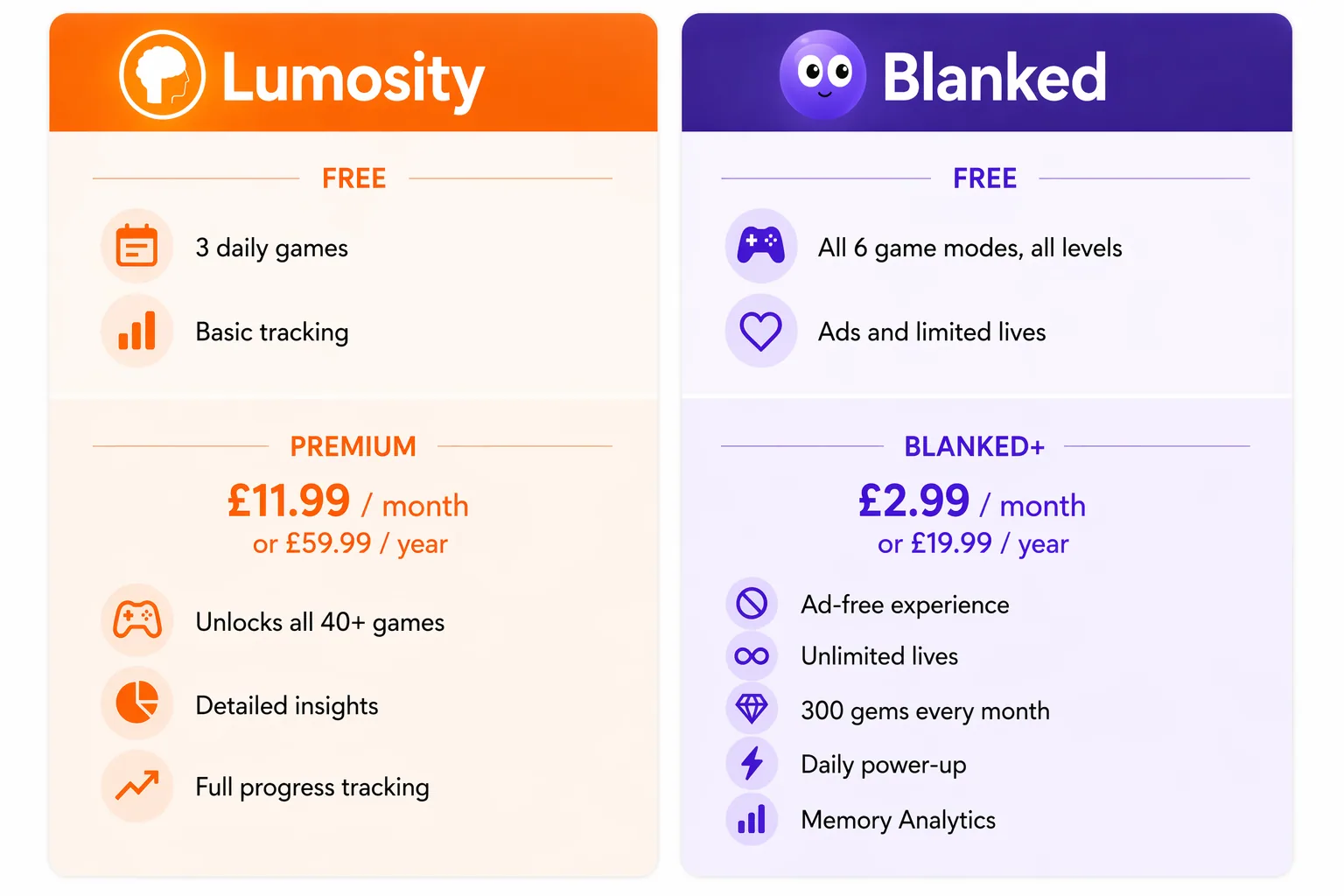
Here’s what each app costs as of 2026:
Lumosity
- Free: 3 daily games, basic tracking
- Premium: approximately £11.99/month or £59.99/year
- Premium unlocks all 40+ games, detailed insights, and full progress tracking
Blanked
- Free: all 6 game modes, all levels, ads and limited lives
- Blanked+: subscription removes ads, gives unlimited lives, 100 gems/month, daily power-up, and Memory Analytics
The key difference here is what you get for free. Lumosity’s free tier restricts you to 3 games per day from a limited selection. Blanked’s free tier gives you access to every game mode and every level. The paid upgrade in Blanked is about comfort (no ads, unlimited lives) and analytics rather than unlocking core content.
If budget is a factor, Blanked offers significantly more at the free tier. If you’re happy paying for a subscription and want the broadest range of games, Lumosity’s premium tier delivers more variety.
Session Length and Habit Design
This is an underrated factor that most comparison articles ignore, but it might be the most important one for whether an app actually works for you.
Lumosity sessions take around 15 minutes. The app curates a daily workout of 3 to 5 games, and the expectation is that you’ll sit down for a focused quarter-hour of training. For some people, that’s a perfect morning routine. For others, 15 minutes is a commitment they struggle to make consistently, especially on busy days.
Blanked sessions take about 2 minutes. That’s not a typo. The app is designed around micro-sessions that fit into any gap in your day: waiting for a kettle, sitting on the bus, between meetings. The science supports this approach. Research consistently shows that short, consistent daily sessions produce better cognitive training outcomes than longer, less frequent sessions.
Neither session length is “correct.” But be honest with yourself about which one you’ll actually do every day. The best brain training app in the world is useless if it’s sitting unopened on your second home screen page.
So Which One Should You Choose?
Here’s a straightforward decision framework:
Choose Lumosity if:
- You want broad cognitive training across memory, attention, speed, flexibility, and problem-solving
- You have 15 minutes a day to dedicate to training
- You value published research behind the specific product you’re using
- You enjoy variety and want 40+ different games to cycle through
Choose Blanked if:
- You specifically want to improve your visual memory (faces, places, details, spatial awareness)
- You prefer ultra-short sessions that fit into any day (2 minutes)
- You want a game-first experience with a mascot, streaks, and cosmetics
- Budget matters and you want full access to all game modes for free
- You bounced off clinical-feeling apps and want something that feels fun
Use both if:
You want broad cognitive coverage from Lumosity plus dedicated visual memory depth from Blanked. They complement each other well since there’s minimal overlap.
If you’re leaning toward Blanked, you can download it free from the App Store and try all six game modes without paying anything. And for a broader look at how both apps stack up against the rest of the market, see our full best brain training apps 2026 roundup.
Frequently asked questions
Is Blanked better than Lumosity?
Is Lumosity worth paying for?
Can I use Blanked and Lumosity together?
Which app has better scientific evidence?
Which app is better for beginners?
Train your memory. Play Blanked free.
A free visual memory game built around how memory actually works. 6 game modes, 400+ levels.
Download on the App Store