How Sleep Affects Memory: The Complete Guide (2026)


On this page (7)
You can eat perfectly, exercise daily, and spend an hour on brain training, but if you’re sleeping badly, a significant chunk of that effort is wasted. Sleep isn’t optional for memory. It’s where memory formation actually happens.
When you learn something new during the day, your brain doesn’t immediately file it away permanently. It holds the information in a temporary state, mostly in the hippocampus, waiting for the right conditions to consolidate it into long-term storage. Those conditions arrive when you fall asleep.
This isn’t speculation. It’s backed by over a century of research, including a major 2026 review in Physiological Reviews that called sleep-based memory consolidation one of the most robustly demonstrated phenomena in cognitive neuroscience. Here’s what’s actually happening between your ears while you’re unconscious.
Sleep Isn’t Downtime. It’s Processing Time.
The idea that sleep is a passive state where your brain “switches off” is one of the most persistent myths in popular science. In reality, certain brain regions are more active during specific sleep stages than they are when you’re awake.
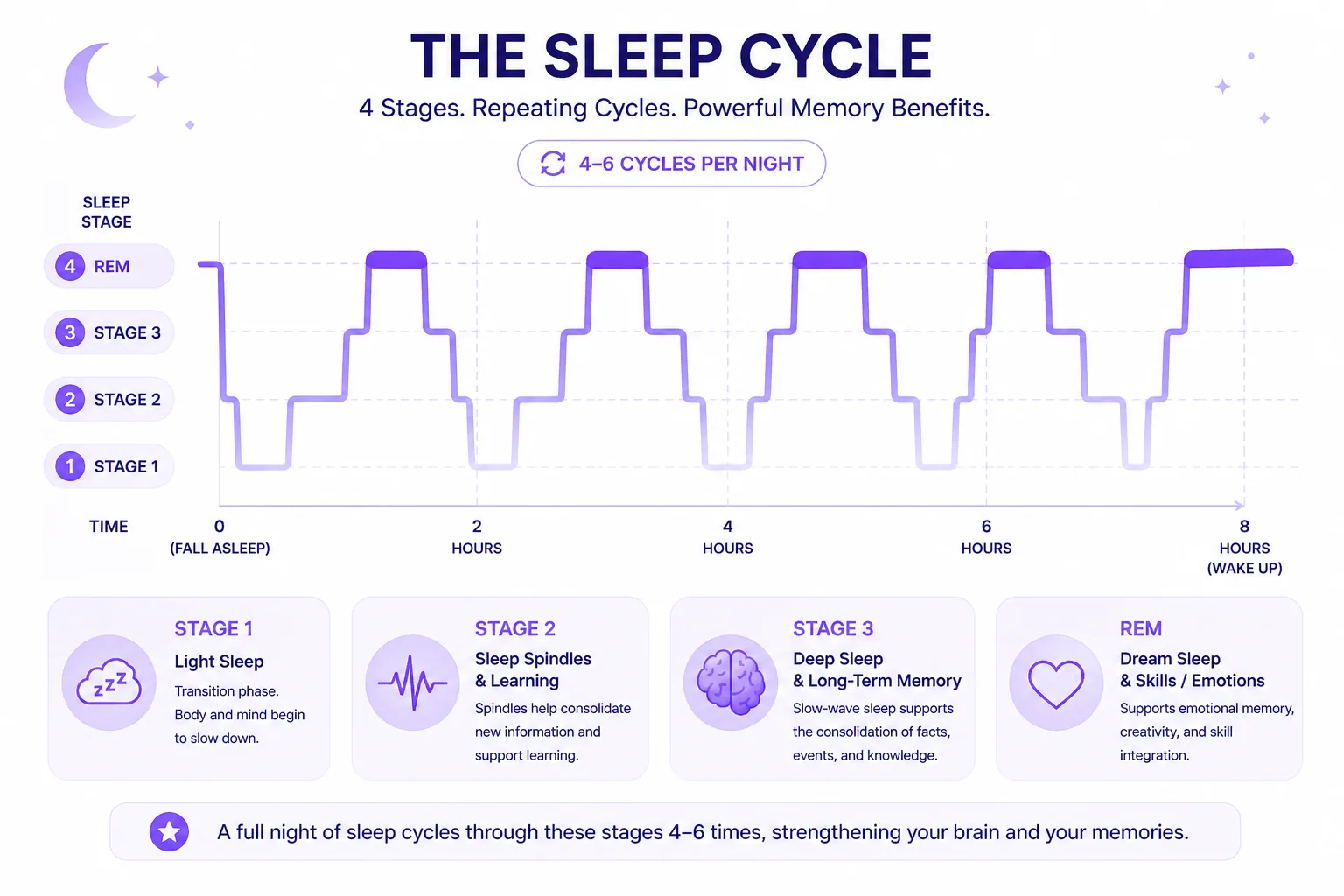
Sleep cycles through four stages, repeating roughly every 90 minutes:
- Stage 1 (Light sleep): The transition phase. You’re drifting off. Brain activity begins to slow.
- Stage 2 (Light NREM sleep): Sleep spindles appear. These bursts of neural activity are directly linked to memory consolidation and learning. More spindle activity correlates with better memory retention.
- Stage 3 (Deep/slow-wave sleep): This is where the heavy lifting happens. Your hippocampus replays the day’s experiences, transferring information to the neocortex for long-term storage. Slow-wave sleep is critical for declarative memory (facts, events, information you’ve learned).
- REM sleep: Associated with emotional memory processing and procedural memory (skills, how-to knowledge). This is also when most dreaming occurs. REM sleep helps integrate new memories with existing knowledge and may play a role in creative problem-solving.
Each stage serves a different memory function. Miss one and you lose a specific piece of the consolidation process. This is why fragmented sleep (waking frequently throughout the night) can be as damaging to memory as sleeping fewer hours overall.
What Your Brain Does With Memories While You Sleep
The centrepiece of sleep-based memory formation is a process called systems consolidation. Here’s how it works in simplified terms:
During the day, your hippocampus acts as a temporary recording device. Every new experience, fact, or visual scene gets encoded there as a fragile, short-term memory. Think of it as your brain’s inbox.
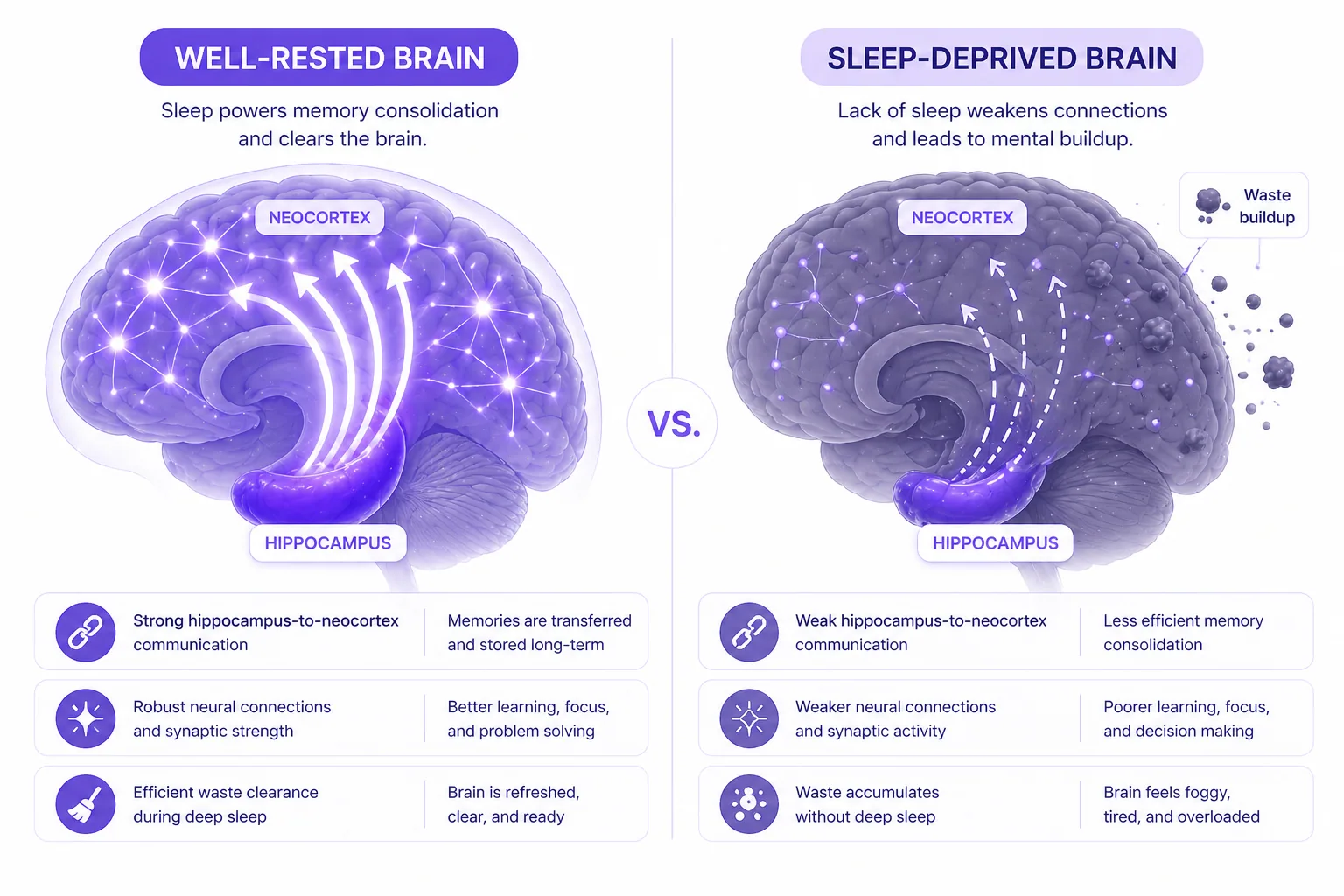
During deep sleep, the hippocampus replays these recorded experiences. Research from Yale School of Medicine has shown that neurons fire in the same sequences during sleep as they did during the original experience, essentially re-running the day’s events. This replay transfers the information from the hippocampus to the neocortex, where it’s integrated into your long-term memory networks.
This isn’t just copying. The process transforms memories. As information moves from hippocampus to neocortex, it gets stripped of irrelevant detail, connected to existing knowledge, and restructured into more abstract, generalised representations. This is why you sometimes wake up with a clearer understanding of something you were confused about the day before. Your sleeping brain reorganised the information.
As George Dragoi from Yale’s research team put it: encoding is required but not sufficient for memory formation. If encoded information is not consolidated after exposure, you simply won’t remember it. Sleep is where “not sufficient” becomes “done.”
The Glymphatic System: Your Brain’s Night Shift Cleaning Crew
Memory consolidation isn’t the only important thing happening during sleep. Your brain is also taking out the rubbish.
In 2013, researchers helped describe the glymphatic system, a waste-removal pathway in the brain that functions like a built-in cleaning service. During sleep, cerebrospinal fluid flows through the brain more freely, flushing out metabolic waste products that accumulate during waking hours.
The waste products being cleared include beta-amyloid and abnormal tau proteins, both of which are directly linked to Alzheimer’s disease and other forms of dementia. Helene Benveniste, a professor of anaesthesiology at Yale who helped characterise the system, put it simply: we now understand that another purpose of sleep may be to give the brain time to clean itself.
This has a direct connection to memory. If waste metabolites aren’t cleared properly (because of insufficient or poor-quality sleep), they can accumulate in brain regions critical for memory formation, including the hippocampus. Over time, this accumulation is associated with cognitive decline and increased dementia risk.
In other words, poor sleep doesn’t just prevent new memories from forming. It creates conditions that can damage the memory system itself.
What Happens When You Don’t Sleep Enough
A 2025 review from the University of Arizona synthesised the research on sleep deprivation and cognitive function. The findings are sobering:
- Working memory is one of the first casualties. The prefrontal cortex, which manages working memory, is highly sensitive to sleep loss. Even one night of poor sleep can reduce your ability to hold and manipulate information in real time.
- Encoding new information becomes significantly harder. Sleep-deprived individuals show reduced hippocampal activation during learning tasks, meaning less information gets properly recorded in the first place.
- Emotional regulation suffers. The amygdala becomes hyperactive while its connection to the prefrontal cortex weakens. This doesn’t just affect mood. Emotional dysregulation impairs the encoding of neutral information because your brain is disproportionately focused on processing emotional stimuli.
- Consolidation is disrupted. Even if you managed to encode information during the day, insufficient sleep means the hippocampal replay process is truncated. Memories that should have been transferred to long-term storage don’t make the journey.
The research is also clear that lost sleep can’t be fully recovered. Harvard’s Division of Sleep Medicine notes that if a student pulls an all-nighter, the memory consolidation that should have occurred that night generally can’t be made up, even if they sleep well on subsequent nights. The window closes. (This is why we emphasised sleep in our memory training for students guide.)
Naps: Do They Actually Help?
Yes. And the evidence is surprisingly strong.
A 2025 study published in Frontiers in Sleep found that participants who napped after learning a perceptual task showed improved memory compared to those who stayed awake for the same period. The nap group didn’t just retain more information. They showed generalised learning benefits, meaning the sleep helped them apply what they’d learned to new situations.
Daytime naps appear to provide similar memory consolidation benefits to a full night’s sleep, at a much smaller time cost. The key seems to be reaching Stage 2 sleep (where sleep spindles occur), which typically happens within 15 to 20 minutes of falling asleep.
Practical nap guidelines based on the research:
- 10 to 20 minutes: Ideal for a quick memory boost. You reach Stage 2 sleep without entering deep sleep, so you wake up refreshed rather than groggy.
- 60 minutes: Includes some deep sleep. Good for consolidating factual information. May cause brief grogginess upon waking.
- 90 minutes: A full sleep cycle including REM. Best for creative problem-solving and procedural memory. You wake at the end of a cycle, so grogginess is minimal.
The worst nap length is 30 to 45 minutes. You’re deep enough into slow-wave sleep to feel terrible when you wake up, but not deep enough to get the full consolidation benefit. If you’re going to nap, go short (20 minutes) or long (90 minutes).
How to Optimise Sleep for Better Memory
If sleep is where memory consolidation happens, then improving your sleep quality is one of the highest-leverage things you can do for your memory. Here are five evidence-based strategies:
1. Protect the first sleep cycle. The first 90-minute cycle contains the highest proportion of deep slow-wave sleep, which is when the most intensive memory consolidation occurs. Disrupting this first cycle (through alcohol, noise, screen light, or late caffeine) disproportionately affects memory formation.
2. Keep a consistent schedule. Your circadian rhythm regulates when different sleep stages occur. Irregular sleep times confuse this system, reducing the quality of deep sleep and REM sleep even if total hours are adequate. Going to bed and waking up at roughly the same time, including weekends, optimises your sleep architecture.
3. Learn before you sleep. Research consistently shows that material studied in the evening, closer to sleep onset, is consolidated more effectively than material studied earlier in the day. If you’re preparing for an exam or trying to retain new information, a study session in the early evening followed by sleep is the optimal sequence.
4. Cut screens in the last hour. Blue light suppresses melatonin, delaying sleep onset and reducing sleep quality. But beyond the light, the cognitive stimulation from scrolling or watching content keeps your brain in a processing state when it should be winding down. (We cover this in detail in our post on how screen time affects your memory.)
5. Aim for 7 to 9 hours. This is the range that most adults need to complete 4 to 6 full sleep cycles. Cutting sleep to 5 or 6 hours means fewer cycles, which means less time for consolidation and less time for glymphatic cleaning. Chronic short sleep doesn’t just impair today’s memory. It accumulates risk over time.
The Memory Training Connection
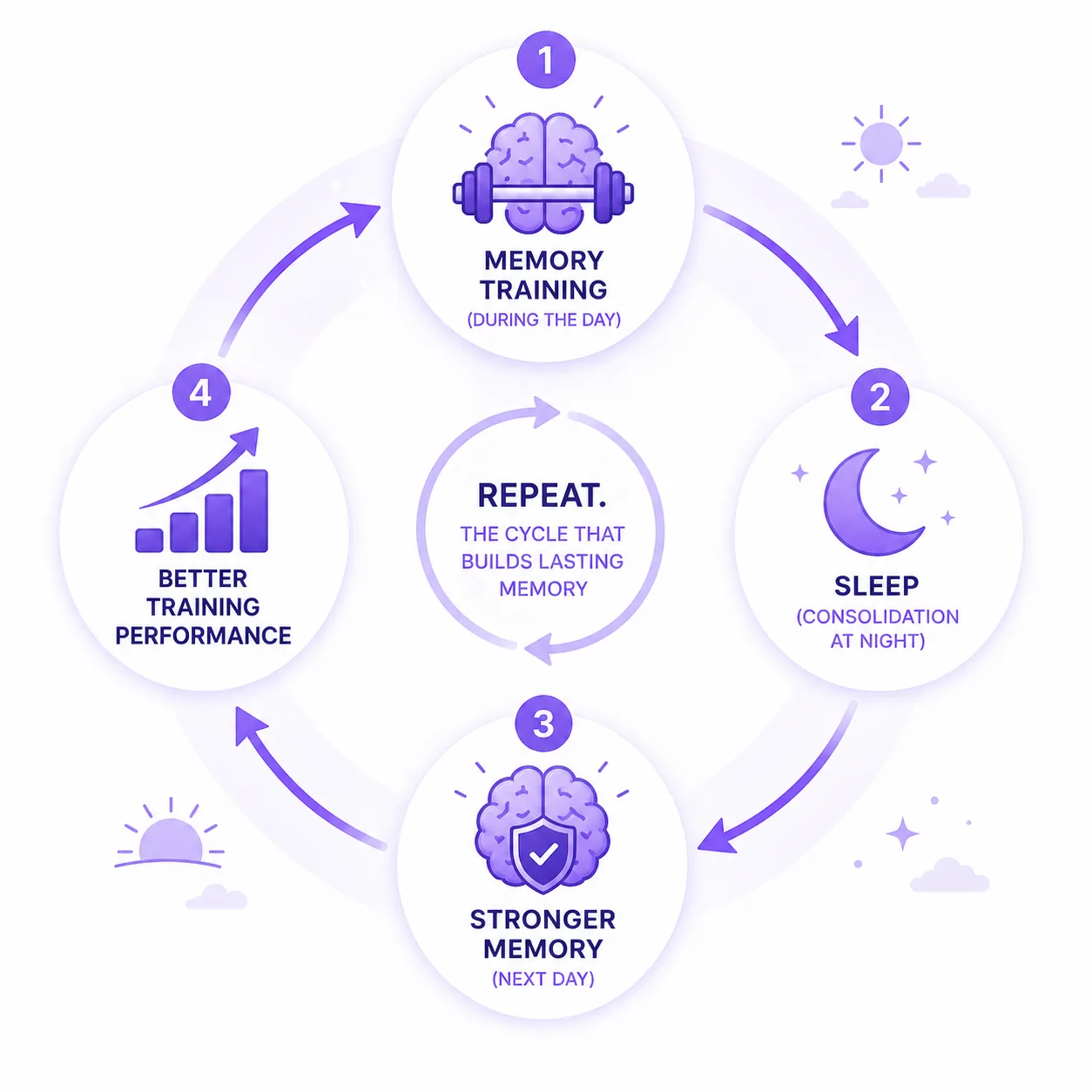
Here’s where sleep and memory training create a powerful feedback loop.
When you train your memory during the day (through visual memory exercises, active recall practice, or any cognitively demanding task), you’re creating new neural patterns that need to be consolidated. Sleep is where that consolidation happens. Without adequate sleep, the training gains don’t fully lock in.
Conversely, better sleep quality improves your encoding ability the following day. A 2026 study in Neuropsychologia confirmed that sleep enhances both memory consolidation and next-day learning capacity. The two processes reinforce each other. (For the neuroscience behind this loop, see our post on what happens to your brain when you play memory games.)
This is why we keep coming back to the same formula across this blog: targeted training + consistent sleep + physical exercise = the best conditions for memory improvement. None of these elements works as well in isolation.
If you’re already using Blanked for daily visual memory training, pairing it with good sleep hygiene is the simplest way to amplify the results. Two minutes of training before bed, followed by 7 to 9 hours of quality sleep, gives your brain the stimulus and the conditions to strengthen the visual memory pathways you’ve just exercised. (For more techniques, see our full guide to how to improve your visual memory.)
Sleep is the most underrated factor in memory performance. You can have the best training routine, the most effective study techniques, and the healthiest diet, but if you’re consistently under-sleeping, you’re leaving results on the table. Your brain needs processing time. Give it the hours, and it’ll do the rest.
Frequently asked questions
How many hours of sleep do you need for good memory?
Does sleeping after studying help you remember?
Can a nap improve memory?
Does poor sleep cause permanent memory damage?
What stage of sleep is most important for memory?
Train your memory. Play Blanked free.
A free visual memory game built around how memory actually works. 6 game modes, 400+ levels.
Download on the App Store