How Streaks Train Your Brain: The Neuroscience (2026)

On this page (7)
You’re on day 23 of your Blanked streak. You’re tired. You’ve had a long day. You could skip it. It’s only a game. But something in your brain won’t let you. You open the app, play a 2-minute session, watch the streak counter tick up to 24, and feel a small but real wave of satisfaction.
That feeling isn’t random. It’s neurochemistry. And it’s doing something far more useful than just making you feel good about a number on a screen. The streak is the delivery mechanism that makes memory training actually work.
Here’s the neuroscience behind why streaks are more than gamification, and how Blanked’s streak system is specifically designed to produce real cognitive results.
Why Streaks Aren’t Just a Gimmick
Every piece of research on memory training reaches the same conclusion: consistency is the single most important variable. Not session length. Not difficulty level. Not which specific exercises you do. Consistency.
A 2-minute daily session produces better cognitive outcomes than a 30-minute session done once a week. A six-year study of over 1,000 older adults found that sustained weekly training dramatically outperformed intensive short-term training. The ACTIVE Trial showed that booster sessions years after initial training helped maintain gains. (We covered the full timeline in our post on how long it takes to improve your memory.)
The problem is obvious: knowing that consistency matters and actually being consistent are completely different things. This is where streaks come in. They’re not a marketing trick. They’re a behavioural design tool that leverages your brain’s own reward and habit-formation systems to keep you coming back. And that consistency is what produces the neural changes that improve your memory.
The Habit Loop: Cue, Routine, Reward
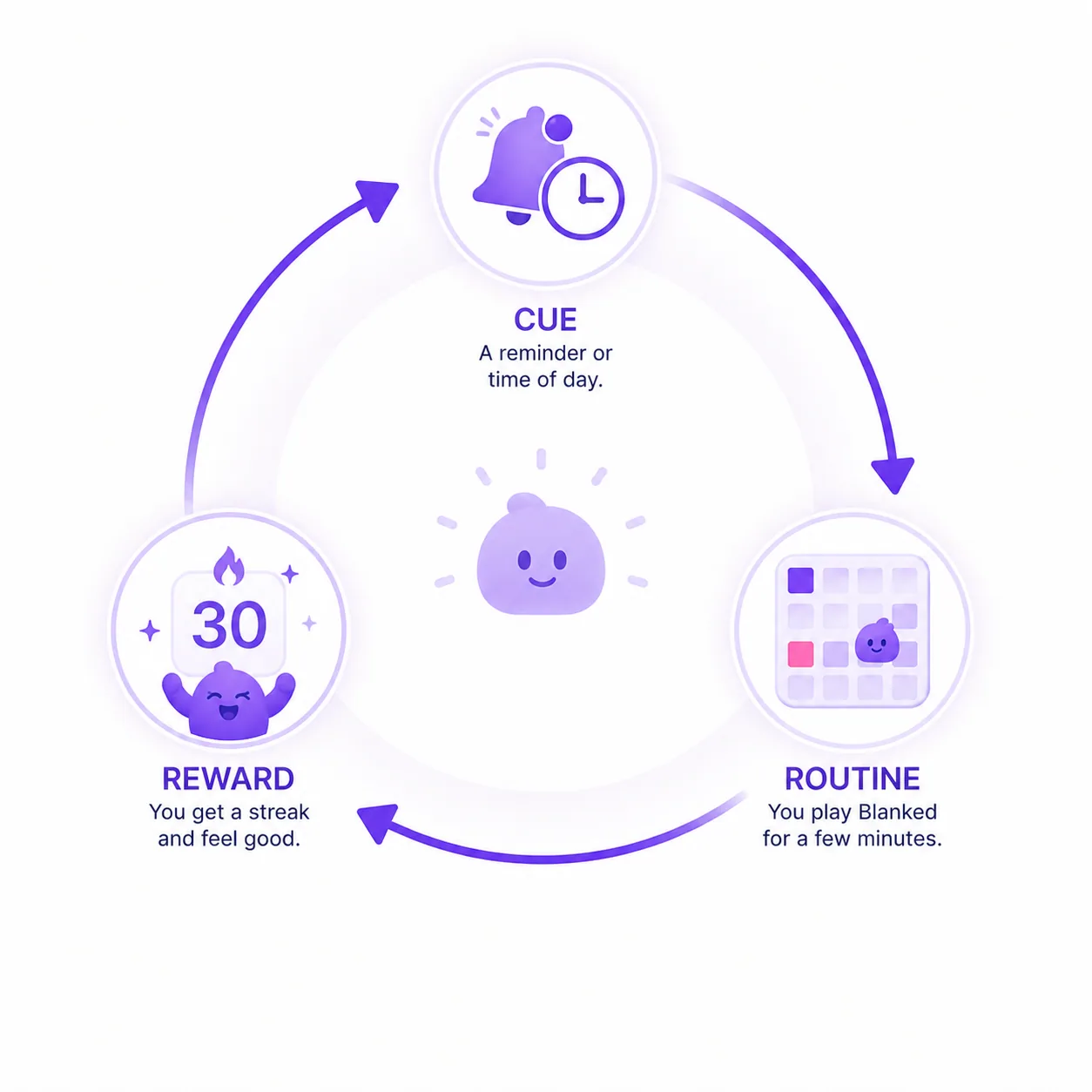
In 2012, Charles Duhigg popularised a framework from neuroscience research that describes how habits form in the brain. It’s called the habit loop, and it has three components:
1. Cue. A trigger that tells your brain to initiate the behaviour. It could be a time of day, a location, an emotional state, or a notification.
2. Routine. The behaviour itself. In this case, opening Blanked and playing a session.
3. Reward. The positive outcome your brain receives. The streak counter going up. The satisfaction of getting answers right. Blink’s reaction. The feeling of having done something good for your brain.
When this loop repeats consistently, the basal ganglia (a set of structures deep in your brain responsible for automatic behaviours) begins encoding it as a routine. Over time, the behaviour shifts from something you have to consciously decide to do into something you do automatically. This is the neurological definition of a habit.
Research by Ann Graybiel at MIT has shown that the basal ganglia stores habit patterns as “chunks” of behaviour. Once a habit is chunked, it requires minimal prefrontal cortex involvement, which is why established habits feel effortless. The effort isn’t in doing them. It’s in building them. And that’s exactly what the streak system helps with.
Dopamine Isn’t What You Think It Is
Most people think dopamine is the “pleasure chemical.” It’s not. Dopamine is the anticipation chemical. It’s released not when you receive a reward, but when you expect one.
This distinction matters enormously for understanding why streaks work. When you open Blanked and see your streak counter, your brain releases dopamine in anticipation of the reward (the counter going up, the sense of accomplishment). That dopamine surge creates motivational salience, which is neuroscience’s way of saying it makes you want to do the thing.
Over time, a pattern emerges. The cue (seeing the app, remembering your streak) triggers dopamine release, which motivates the routine (playing a session), which delivers the reward (streak maintained, score achieved). Each cycle strengthens the neural pathway. The more you repeat it, the more automatic it becomes.
This is the same mechanism that makes social media addictive. But there’s a crucial difference. Passive scrolling activates your dopamine system without providing any cognitive benefit. Your brain gets the reward loop, but the routine is empty. Playing Blanked activates the same dopamine system, but the routine involves genuine cognitive work: encoding visual scenes, holding them in working memory, and recalling them from memory. You get the habit-building power of dopamine attached to an activity that actually strengthens your brain. (For more on passive vs active screen time, see our post on screen time and memory.)
Loss Aversion: Why Breaking a Streak Feels Terrible
Behavioural economics has a principle called loss aversion: losing something feels approximately twice as bad as gaining something feels good. A study by Kahneman and Tversky demonstrated this consistently across dozens of experiments. People are far more motivated to avoid losing what they have than to gain something new.
Streaks leverage this powerfully. On day 1, your streak is worth very little. On day 30, it represents a month of consistent effort. You’ve invested in it. The endowment effect (another behavioural economics principle) means you value something more highly simply because you own it. Your 30-day streak isn’t just a number. It’s proof that you showed up every day for a month. Breaking it feels like losing something real.
This is why streak shields exist in Blanked. They’re not a way to cheat the system. They’re a safety net that prevents a single missed day from destroying the motivational structure you’ve built. Research on habit formation shows that missing one day doesn’t significantly affect long-term habit strength, but the psychological impact of seeing a streak reset to zero can cause people to abandon the habit entirely. Streak shields prevent that catastrophic loss while keeping the accountability loop intact.
66 Days: How Long It Takes to Build the Habit
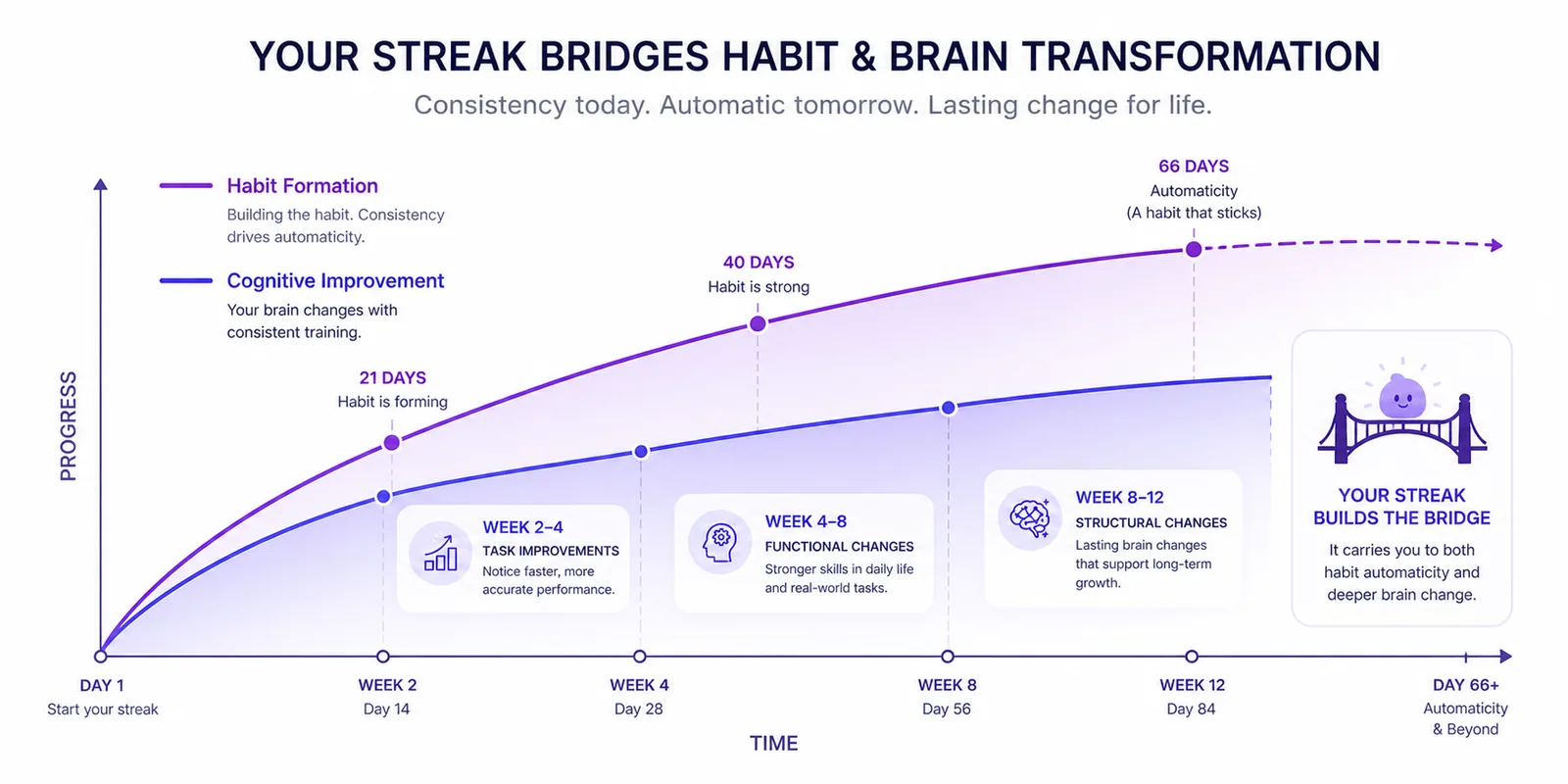
A landmark 2009 study by Philippa Lally at University College London found that it takes an average of 66 days for a new behaviour to become automatic. Not 21 days, as the popular myth suggests. The actual range in the study was 18 to 254 days, depending on the complexity of the behaviour and the individual.
For a simple daily action like opening an app and playing for 2 minutes, the habit formation period is likely at the shorter end of that range. But the principle holds: you need weeks of consistent repetition before the behaviour shifts from “something I choose to do” to “something I do automatically.”
This aligns perfectly with the memory training timeline. Research shows task-specific improvements appearing at 2 to 4 weeks, functional brain changes at 4 to 8 weeks, and structural changes at 8 to 12 weeks. The habit formation period overlaps almost exactly with the cognitive improvement timeline. By the time the training has become automatic, the brain changes are well underway. (Full timeline in our post on how long it takes to improve your memory.)
The streak system bridges the gap between starting and automation. It provides external motivation during the 4 to 10 weeks when the behaviour is still effortful, carrying you through until the habit loop is strong enough to sustain itself.
How Blanked’s Streak System Is Designed
Not all streak systems are created equal. Here’s how Blanked’s is built to maximise the connection between daily habit and genuine cognitive training:
Ultra-short sessions remove the barrier. The biggest reason people break streaks is time pressure. “I don’t have 15 minutes today.” Blanked sessions take about 2 minutes. That’s short enough to fit into any gap: waiting for a kettle, sitting on the bus, between meetings. When the barrier to maintaining a streak is 2 minutes, the excuses evaporate.
Blink creates emotional accountability. Research on mascot attachment shows that emotional connection to a character increases daily return rates. Blink isn’t just cute. Blink reacts to your performance, celebrates your wins, and gives you a look when you’re about to break your streak. That emotional layer adds social-like accountability without requiring another person.
Streak shields protect the investment. One missed day shouldn’t undo weeks of consistency. Streak shields let you miss a day without resetting to zero, preventing the “all-or-nothing” mindset that kills habits. You earn them through play or get them with Blanked+.
Milestone rewards reinforce the loop. At specific streak milestones, you earn cosmetics and rewards for Blink. These are deliberately spaced to provide fresh dopamine hits at intervals where motivation typically dips: day 7, day 14, day 30, and beyond. Each milestone gives your brain a reason to keep going.
The training itself is the routine. Unlike social media streaks (where the “routine” is meaningless engagement), Blanked’s routine involves genuine cognitive work. Every session forces your brain through the encode-store-retrieve cycle that strengthens visual memory pathways. The streak system ensures you do it daily. The training ensures it counts. (For what’s happening in your brain during each session, see our post on what happens to your brain when you play memory games.)
When Streaks Go Wrong (And How We Avoid It)
It would be dishonest not to address the criticism. Streaks can be manipulative. Duolingo has been widely criticised for streak-anxiety, where users feel genuine distress about breaking their streak. Some people do the minimum possible just to maintain the number, which means the streak becomes the goal rather than the learning.
We think about this a lot when designing Blanked’s system. Here’s how we try to keep streaks serving the training rather than the other way around:
The minimum session is already training. Even a single round of Blanked involves genuine visual memory work. You can’t “game” the streak by doing something meaningless. Every session, however short, puts your brain through the encode-store-retrieve cycle.
Streak shields normalise missed days. By building streak shields into the system, we’re signalling that missing a day is normal and expected. Life happens. The streak is a tool, not a prison.
Difficulty scales independently. Your streak length doesn’t affect difficulty. Levels get harder based on performance, not streak count. This means a long streak reflects consistent training, not just showing up.
The goal is a streak system that feels motivating, not stressful. If Blanked’s streak ever makes you feel anxious rather than motivated, that’s a sign to take a step back and remember: the streak serves you. You don’t serve the streak.
Streaks work because they solve the only problem that truly matters in memory training: showing up. The science is clear that consistency produces results. The neuroscience is clear that habit loops, dopamine, and loss aversion can be harnessed to create consistency. And Blanked’s streak system is designed to connect those two facts.
If you haven’t started yet, download Blanked for free and see how far your first streak takes you. Or start smaller: today’s daily memory challenge in your browser is a one-puzzle streak you can begin right now. Day 1 is the hardest. By day 30, Blink won’t let you stop.
Frequently asked questions
Do streaks actually help with learning?
How long do I need to maintain a streak before it becomes a habit?
What happens if I break my streak?
Are streaks manipulative?
Does the streak affect game difficulty?
Train your memory. Play Blanked free.
A free visual memory game built around how memory actually works. 6 game modes, 400+ levels.
Download on the App Store