How to Remember Names: 5 Techniques That Work (2026)

On this page (9)
You meet someone. They say their name. Ten seconds later, it is gone. You spend the rest of the conversation hoping someone else will say it, or waiting for a moment to check their badge, or just avoiding using their name entirely.
This is not a character flaw. It is not a sign of ageing, low intelligence, or a bad memory. It is a specific encoding problem that affects virtually every adult, and it has a specific fix.
The reason names are uniquely difficult to remember is well understood by neuroscience, and the techniques that solve the problem are backed by randomised controlled trials. Here is why names slip away and 5 techniques that make them stick.
Why Names Are So Hard to Remember
Names are one of the hardest things for the human brain to encode, and the reason comes down to how memory works at a biological level.
Your brain encodes information through connections. When you learn a new fact, your hippocampus links it to your existing knowledge network: related concepts, sensory details, emotional associations, and spatial context. The more connections you create, the more retrieval pathways you have, and the easier it is to recall the information later.
Names have almost no natural connections. The name "Sarah" tells you nothing about the person. It has no inherent meaning, no visual component, no emotional content, and no connection to the person’s appearance, personality, or role. It is an arbitrary verbal label attached to a visual stimulus (the face). Your brain has nothing to hook it onto.
Compare this to faces. Your brain has an entire dedicated region (the fusiform face area) for processing facial features. Faces are rich in visual detail, emotional expression, and distinctiveness. They are encoded through the high-capacity visual memory system. Names are encoded through the phonological loop, which is lower-capacity and more vulnerable to interference.
This is why you recognise someone’s face instantly but cannot retrieve their name. The face was encoded through a powerful, dedicated visual system. The name was encoded through a weaker, general-purpose verbal system with no meaningful connections to anchor it. (For the full neuroscience, see our post on why your brain remembers faces but forgets names.)
The good news: every technique that works for name memory works by creating the connections that names naturally lack. You are building the hooks that your brain needs to store and retrieve the name.
The 5 Techniques
Technique 1: Pay Full Attention During the Introduction
This sounds obvious, but it is the step most people skip. The number one reason you forget names is that you were not paying attention when the name was spoken. You were thinking about what to say next, processing the person’s appearance, managing your own anxiety, or mentally preparing your own introduction.
During those 2 to 3 seconds when someone says their name, your working memory is often full of other things. The name enters your auditory system but never makes it past the attention filter into working memory. It was never encoded. You did not forget it. You never had it. (This is the same encoding failure we explained in our post on why you forget things so quickly.)
How to apply it: When someone is about to tell you their name, clear your mental slate. Stop thinking about your response. Make eye contact. Listen to the name as if it is the most important word in the conversation. Give those 2 to 3 seconds your full, undivided attention. This single change will immediately improve your name recall by ensuring the information enters working memory in the first place.
Technique 2: Say the Name Back Immediately
The moment you hear the name, say it back in your response. "Nice to meet you, Sarah." This does three things simultaneously: it confirms you heard the name correctly, it creates a second encoding event (you are now producing the name, not just receiving it), and it creates a social association (your brain links the name to the conversational context).
Research on conversational rehearsal shows that using someone’s name within the first 10 seconds of meeting them significantly improves retention. The retrieval-production cycle (hearing the name, then producing it) is far more powerful than passive repetition (hearing the name and silently repeating it in your head).
How to apply it: Build the habit of always using the name in your first response. "Sarah, great to meet you." Then use it naturally one or two more times during the conversation. "So Sarah, how do you know..." Each use is a retrieval event that strengthens the memory trace. Do not overdo it. Three uses in a conversation is enough to create a durable trace.
Technique 3: The Face-Feature Association
This is the most powerful technique on the list and the one used by competitive memory athletes. It works by creating a visual connection between the person’s name and a distinctive feature of their face.
The method, validated in randomised controlled trials by Hampstead and colleagues, has three steps:
Step 1: Identify one distinctive facial feature. Not something they might change (hairstyle, glasses) but something structural: a strong jawline, deep-set eyes, a prominent nose, high cheekbones, thick eyebrows. Pick the feature that stands out most.
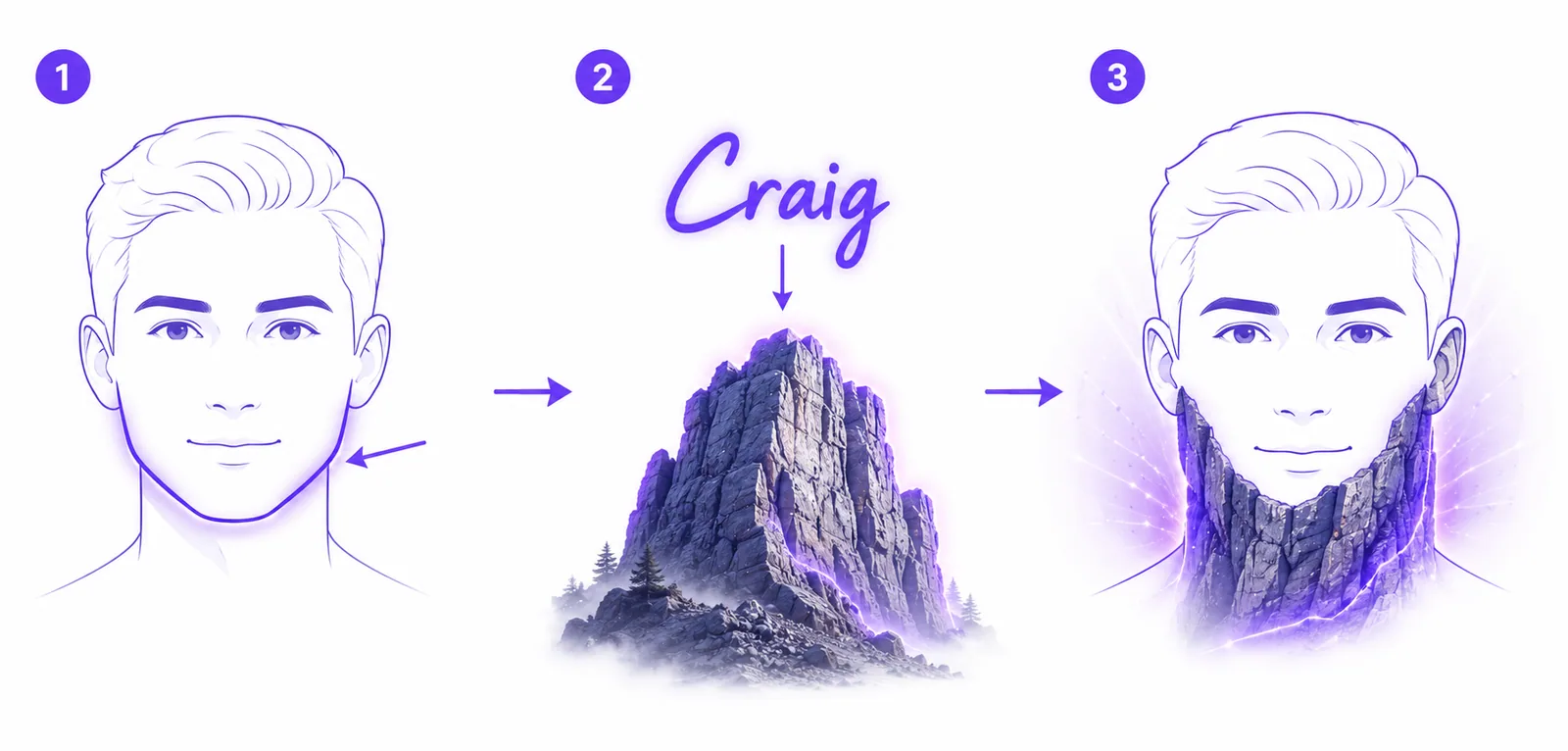
Step 2: Convert the name into a visual image. "Sarah" might become "Sahara desert." "Craig" might become "crag" (a rocky cliff). "Rose" becomes a literal rose. Find a word or image that sounds like or connects to the name.
Step 3: Create a vivid mental image connecting the facial feature to the name image. Picture Sarah with a tiny Sahara desert on her prominent cheekbones, complete with sand dunes and a camel. Picture Craig with a rocky crag growing out of his strong jawline. The more bizarre, vivid, and exaggerated the image, the better. Your brain remembers the unusual far more reliably than the mundane.
When you see Sarah again, your visual memory system recognises her face, the distinctive cheekbones trigger the image of the Sahara, and the Sahara triggers the name. You have converted an arbitrary verbal label into a vivid visual scene anchored to a facial feature. Instead of relying on the weak phonological system, you are now using the powerful visual memory system.
How to apply it: This takes practice, and it feels awkward at first. Start with 2 to 3 people at your next social event. With practice, the process becomes faster and more automatic. Within a few weeks, you will be creating associations in seconds.
Technique 4: Context Anchoring
When you meet someone, deliberately encode not just their name but the context around them: where you met, what they were doing, what you talked about, who introduced you. This creates multiple retrieval pathways to the name.
"Sarah from the marketing conference, she was wearing a blue jacket, we talked about her dog, she was introduced by James." Each of these contextual details creates an additional connection to the name. Later, when you see Sarah, any of those contextual cues can trigger the retrieval: "blue jacket... marketing conference... dog... James... Sarah."
This technique works because it exploits the brain’s natural associative structure. Memories are not stored as isolated files. They are stored as networks of connected information. The more nodes in the network, the more ways you can access the memory.
How to apply it: After meeting someone, take 10 seconds to mentally note three things about the encounter: where, what you discussed, and one visual detail about the person. These three anchors create a web of associations around the name.
Technique 5: The End-of-Event Review
Within 30 minutes of leaving a social event, meeting, or introduction, mentally review the names you learned. Close your eyes and picture each person’s face. Try to recall their name. If you created a face-feature association, replay the visual image.
This end-of-event review is a retrieval practice session: the single most effective technique for consolidating information from short-term into long-term memory. The retrieval attempt strengthens the neural pathway between the face and the name. If you cannot recall a name, the gap tells you which associations were too weak, and you can reinforce them.
Research shows that a single retrieval attempt within 30 minutes of encoding produces significantly better retention than no review at all. The window matters: the sooner you retrieve after encoding, the stronger the consolidation effect.
How to apply it: In the car after a party, on the walk home from a meeting, or in the lift after a networking event, mentally run through every person you met. Picture their face. Recall their name. Replay the association. This 2-minute review can be the difference between remembering someone next week and forgetting them by tomorrow.
Putting It All Together: A Real-World Example
You are at a work event. Someone approaches.
Step 1 (Attention): You clear your mental slate and focus entirely on the introduction.
Step 2 (Say it back): "Hi, I’m Craig." You respond: "Craig, great to meet you."
Step 3 (Face-feature association): You notice Craig has a strong, angular jawline. Craig sounds like crag. You picture a rocky crag growing out of his jawline. Bizarre, vivid, memorable.
Step 4 (Context anchoring): You note: Craig from accounting, met at the rooftop bar, talked about marathon training.
Step 5 (End-of-event review): On the way home, you picture Craig’s face, replay the crag on his jawline, and recall: Craig, accounting, marathon runner.
The next time you see Craig, your visual memory recognises his face, the jawline triggers the crag image, and the crag triggers the name. "Craig! How’s the marathon training going?" He is impressed. You feel competent. The 30 seconds you invested have produced a social connection that passive hearing never would have.
The Underlying Skill That Makes Everything Easier
Every technique on this list depends on one underlying cognitive ability: visual working memory. The face-feature association requires holding a facial feature in mind while generating and connecting a visual image. Context anchoring requires encoding visual details of the environment. The end-of-event review requires picturing faces from memory.
The stronger your visual working memory, the easier all of these techniques become. You can hold more visual detail, generate associations faster, and retrieve visual scenes more reliably. This is why training your visual memory has practical benefits beyond game scores. It builds the cognitive infrastructure that supports real-world skills like name recall.
Blanked trains exactly this system. Every session exercises the encode-store-retrieve cycle for visual information: the same cycle you use when encoding a face-feature association, holding a visual context, or reviewing faces from memory. Two minutes of daily training strengthens the visual working memory system that all name-remembering techniques rely on. Download Blanked for free and start building the skill that makes names stick.
Frequently asked questions
Why am I so bad at remembering names?
Is forgetting names a sign of ageing?
How long does it take to get good at remembering names?
What if I forget the name despite using these techniques?
Does the face-feature technique work for everyone?
Can visual memory training help with name recall?
Train your memory. Play Blanked free.
A free visual memory game built around how memory actually works. 6 game modes, 400+ levels.
Download on the App Store