Why Do Smells Trigger Memories? The Science (2026)

On this page (6)
Sun cream. Cut grass. A particular perfume you have not smelled in years. The inside of your grandmother's house. Some smells do not just remind you of the past, they drop you back into it, whole and sudden, with a force no photograph or song can match. One breath and you are eight years old again, and the feeling arrives before you can even name what you are smelling.
This is not your imagination, and it is not the same as ordinary remembering. Smell has a special, almost unfair relationship with memory, wired into the architecture of your brain in a way no other sense is. Here is why a scent can unlock a memory you did not know you still had, and why those memories feel so intensely real.
The One Sense That Skips the Queue
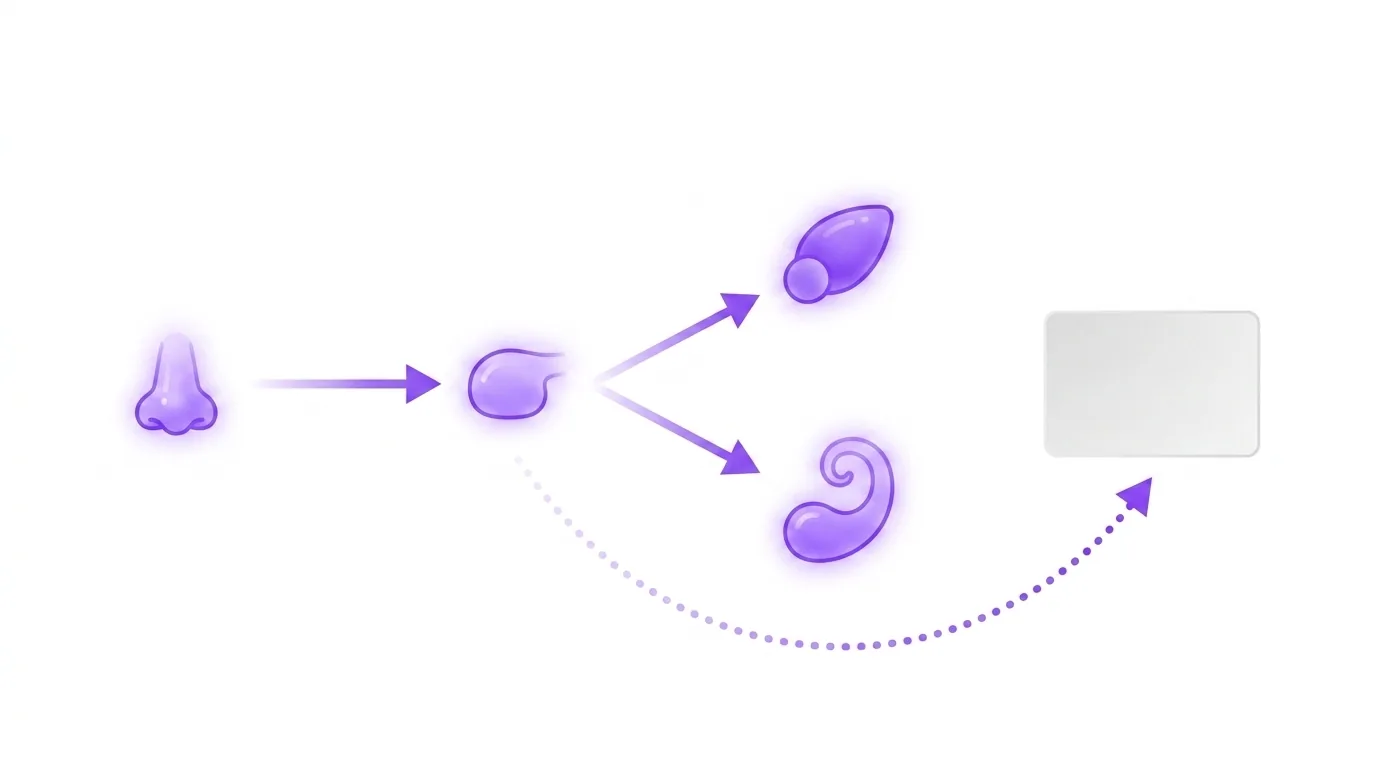
To understand why smell is different, you have to know how your other senses reach your brain. When you see or hear something, the signal first passes through a relay station in the middle of the brain called the thalamus, which processes and routes sensory information before sending it onward. Sight, sound, touch, taste: they all check in at the thalamus first. It is the brain's sorting office.
Smell does not. It is the only sense that bypasses the thalamus entirely.
When odour molecules land on receptors high in your nose, they fire signals to a structure called the olfactory bulb, and from there the information takes a direct, one-step route to two of the most important structures in the emotional and memory systems: the amygdala and the hippocampus. No relay, no detour, no sorting office. Smell has a private door straight into the parts of the brain that handle feeling and remembering.
That anatomy is the whole story in miniature. The amygdala tags experiences with emotion. The hippocampus, the brain's memory-binding hub, files experiences away and pulls them back. Smell wires directly into both, which is why an odour can trigger a memory that is instant, involuntary, and soaked in feeling, all before your conscious mind has caught up.
Why Scent Memories Feel Like Time Travel
Ordinary remembering is something you do. You decide to recall where you parked, and you effortfully reconstruct it. Scent memory is something that happens to you. You do not summon it; it ambushes you.
There are two reasons these memories feel so much more vivid and emotional than the ones you deliberately dig up.
The first is that direct line to the amygdala. Because smell reaches the emotional centre before anything else, odour-triggered memories come pre-loaded with feeling. You do not just remember the event, you re-feel it. The emotional charge is not added afterward; it arrives in the same instant as the memory, fused to it.
The second is timing. Researchers who study odour-evoked memory, notably the psychologist Rachel Herz, have found that memories triggered by smell tend to be older than those triggered by words or pictures, often reaching back into early childhood. Where a photograph might return you to your twenties, a smell is more likely to return you to your childhood kitchen. Smell forms some of our earliest associations, in the years before language dominates how we store experience, and those associations sit undisturbed for decades because we rarely encounter the exact smell that would trigger them.
That rarity matters. You see and hear the same things constantly, so those cues get worn smooth through repetition. But a specific smell from your childhood might not cross your nose for thirty years, which means the memory attached to it never gets updated, softened, or overwritten. When it finally does arrive, it is startlingly intact. This is the opposite of the everyday decay behind why you forget things minutes after seeing them: a scent memory is preserved precisely because it is so rarely disturbed.
The Proust Effect
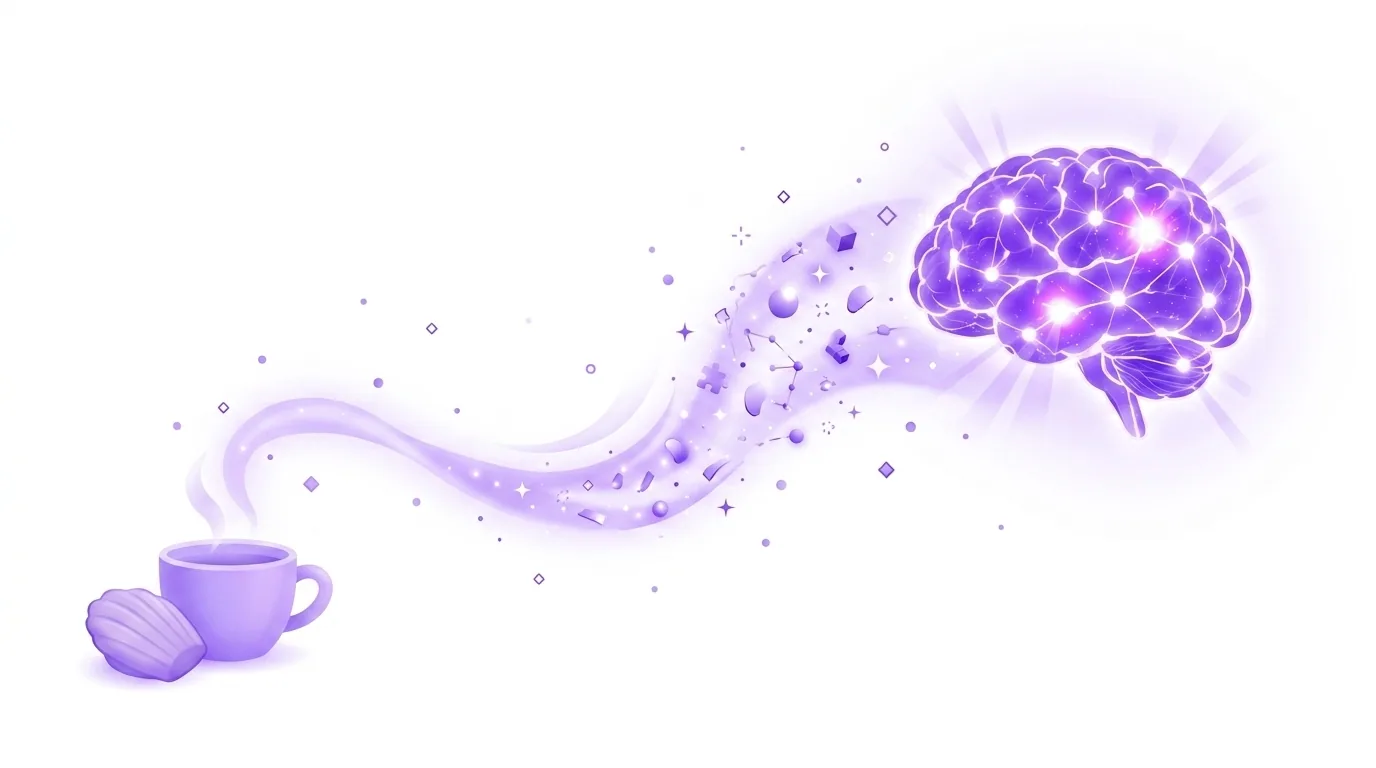
This phenomenon has a name, and it comes from literature. In his novel In Search of Lost Time, the French writer Marcel Proust described his narrator dipping a small shell-shaped cake, a madeleine, into a cup of tea. The taste and smell unleashed an involuntary flood of childhood memory: his aunt's house, Sunday mornings, an entire vanished world returning uninvited and complete.
Scientists borrowed his name for it. The Proust effect, or Proustian memory, refers to the way smells and tastes trigger autobiographical memories that are more vivid, more emotional, and more detailed than memories cued any other way. It is one of the rare cases where a nineteenth-century novelist described a neurological mechanism decades before the neuroscience existed to explain it. Proust was right: he just did not know why.
What Is Happening in the Brain as You Sniff
The direct pathway is only half the mechanism. The other half is rhythm.
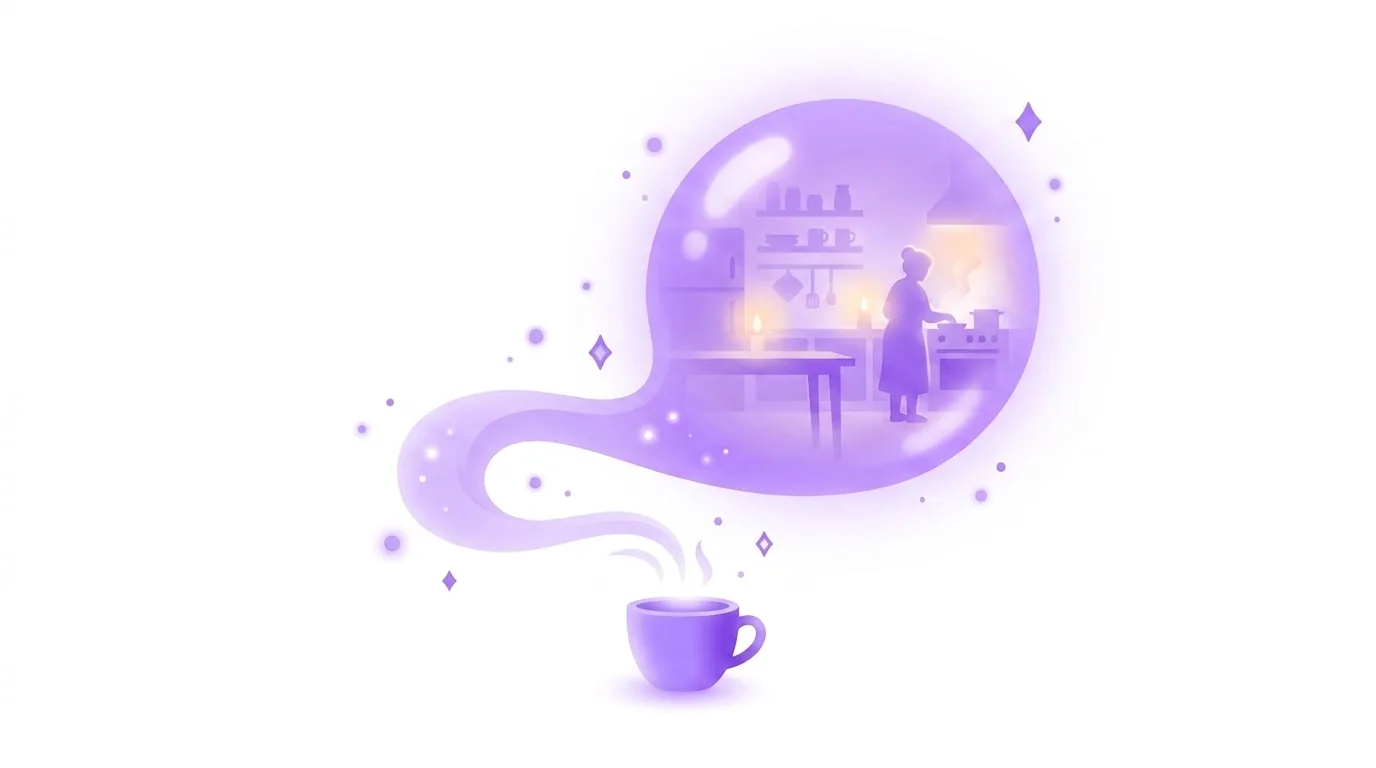
When you actively sniff, the olfactory bulb and the hippocampus begin to synchronise their electrical activity, firing together in a rhythm called theta. This coordinated oscillation appears to be how the brain links the smell you are experiencing right now to the memories stored in the hippocampus, tuning the two structures to the same frequency so information can pass between them. Sniffing is not just drawing in more molecules; it is actively syncing your perception with your memory.
This is the same hippocampus doing the same binding work it does for every memory you form. What makes smell special is not a separate memory system, but a uniquely direct and emotionally charged route into the one you already have. The machinery is shared; the wiring is privileged.
Why Your Brain Is Built This Way
If this seems like an oddly powerful feature for something as everyday as smell, consider what smell was for, evolutionarily. Long before language or complex vision, organisms needed to know instantly whether something was food or poison, safe or dangerous, and to remember it after a single encounter. A smell linked directly to emotion and memory is a survival tool: one whiff of something that once made you ill, and you avoid it for life, no conscious reasoning required.
That ancient wiring is still in you. The reason a scent can flood you with a childhood afternoon is the same reason your ancestors could remember, from a single smell, which berry to never eat again. The system was built for fast, durable, emotionally weighted learning, and nostalgia is a side effect of a mechanism designed to keep you alive.
Using the Scent-Memory Link on Purpose
Because the connection is so reliable, you can exploit it deliberately.
The clearest practical use is context-dependent memory. Memories are easier to retrieve in the presence of cues that were there when you formed them, and smell is an exceptionally strong cue. There is research suggesting that studying material while exposed to a distinctive scent, then re-exposing yourself to that same scent later (during sleep, or before a test), can improve recall. The smell becomes a retrieval handle for everything learned alongside it. It is a niche technique, but a real one, and it works precisely because of the direct pathway described above.
More broadly, scent memory is a vivid demonstration of a principle that runs through all of memory: retrieval depends on cues. A memory that feels completely gone is often just a memory without a trigger, sitting intact and waiting for the right key, exactly as a scent memory waits years for the one odour that will unlock it. The better and richer the cues you attach to something when you learn it, the more ways back in you have later.
That is the trainable part. Smell does its cue-binding automatically, but the deliberate encoding and retrieval that the rest of your memory relies on can be strengthened with practice. If you are curious how sharp your visual recall is, our free visual memory test takes about two minutes, and a few focused minutes a day with a visual memory game trains the encoding and cue-based retrieval that turns fleeting impressions into memories you can actually get back to.
The next time a smell stops you in the street and pulls you decades into the past, you will know what just happened: a molecule found the one door in your brain that opens straight onto feeling and memory, and for a second, no photograph could ever compete.
Frequently asked questions
Why do smells trigger memories so strongly?
What is the Proust effect?
Why are smell-triggered memories usually from childhood?
Which part of the brain links smell and memory?
Can you use smell to improve memory?
Train your memory. Play Blanked free.
A free visual memory game built around how memory actually works. 6 game modes, 400+ levels.
Download on the App Store