The Zeigarnik Effect: Why Unfinished Tasks Stay in Your Head (2026)


On this page (5)
It is late. You finished work hours ago. And yet there it is again, that one email you did not send, the form you left half-filled, the awkward thing you meant to reply to. Your brain keeps surfacing it, unprompted, like a notification that will not clear. Meanwhile the dozen tasks you actually completed today have vanished from your mind entirely, as if they never happened.
This is not a personal failing or a sign of an anxious mind. It is a well-documented quirk of memory called the Zeigarnik effect, and it has a clear cause, a hundred-year-old origin story, and, best of all, a simple fix that does not require you to actually finish anything. Once you understand why unfinished tasks haunt you, you can switch the nagging off almost at will.
The Waiter Who Only Remembered Open Tabs
The story begins in a Vienna café in the 1920s. The psychologist Bluma Zeigarnik was sitting with her mentor, Kurt Lewin, when they noticed something odd about their waiter. He took complex orders for a whole table without writing anything down, and he got every one right. His memory seemed extraordinary.
Then they tested it. After the bill was paid and the table had left, they asked him to recall what those same customers had ordered. He could not. The moment the order was complete and settled, it fell out of his head completely. His remarkable memory was not for orders in general. It was only for orders still open, still owed, still unfinished.
Zeigarnik took this observation into the lab. She gave people a series of small tasks and interrupted them partway through some of them, letting them complete others. Later she asked what they could remember. The result was striking: people recalled the interrupted, unfinished tasks far better than the ones they had completed, in her studies roughly twice as well. Finishing a task, it turned out, was also the brain's signal to let it go.
Why Your Brain Holds Onto the Unfinished
The explanation comes from Lewin's lab and it is elegant. When you form an intention to do something, your mind creates a kind of internal tension, a state of low-level arousal that keeps the goal active and accessible. Think of it as an open loop. That tension is useful: it is your brain keeping the unfinished task within reach so you do not forget to return to it.
When you complete the task, the loop closes and the tension discharges. The goal is done, so your mind releases it and lets the memory fade. But when the task stays unfinished, the loop stays open, and the tension keeps the task primed in your memory, nudging it back into awareness at quiet moments, in the shower, on the walk home, at 1am, whether you want it there or not.
So the intrusive reminders are not your mind malfunctioning. They are your mind doing its job: keeping unfinished business active so it does not slip away. The problem is that in modern life we carry dozens of open loops at once, and all that low-level tension adds up into a background hum of mental clutter and unease.
This is the same mechanism behind other everyday experiences. It is a large part of why a song gets stuck in your head: a fragment that stops before resolving is an unfinished loop, and your mind keeps replaying it, trying to complete it. It is why a cliffhanger works, why an unfinished series nags at you, why a progress bar left at 80 percent bothers you more than one at zero.
The Cost of Too Many Open Loops
Here is the part that matters for how well your mind works day to day. Every open loop consumes a little of your working memory, the limited mental workspace you use to think, focus, and hold information in mind.
When unfinished tasks keep intruding, they are not just annoying. They are actively occupying cognitive resources you need for whatever you are trying to do now. Research has shown that unfulfilled goals produce intrusive thoughts during unrelated activities, make goal-related ideas more mentally accessible, and measurably impair performance on completely separate tasks. The half-written email is quietly making you worse at everything else, because part of your mind is still holding the loop open.
This is why a day full of unfinished business leaves you feeling mentally scattered even if you were not especially busy. It is not the work that drains you. It is the accumulated tension of everything left open.
The Fix: You Do Not Have to Finish, You Have to Plan
Now the genuinely useful discovery, and it is counterintuitive. You would assume the only way to close an open loop is to complete the task. It is not.
In a set of studies, the psychologists E.J. Masicampo and Roy Baumeister found that simply making a specific, concrete plan for an unfinished task released almost all of its grip on the mind. Participants who wrote down exactly how and when they would tackle an unfinished goal stopped having intrusive thoughts about it, and their performance on unrelated tasks recovered, even though the goal itself remained undone.
The reason fits the theory perfectly. The tension exists to make sure you do not forget to act on the intention. A credible, specific plan reassures your brain that the intention is safely captured and will be handled, which is enough to discharge the tension. Your mind does not actually need the task finished. It needs to trust that it will not be dropped.
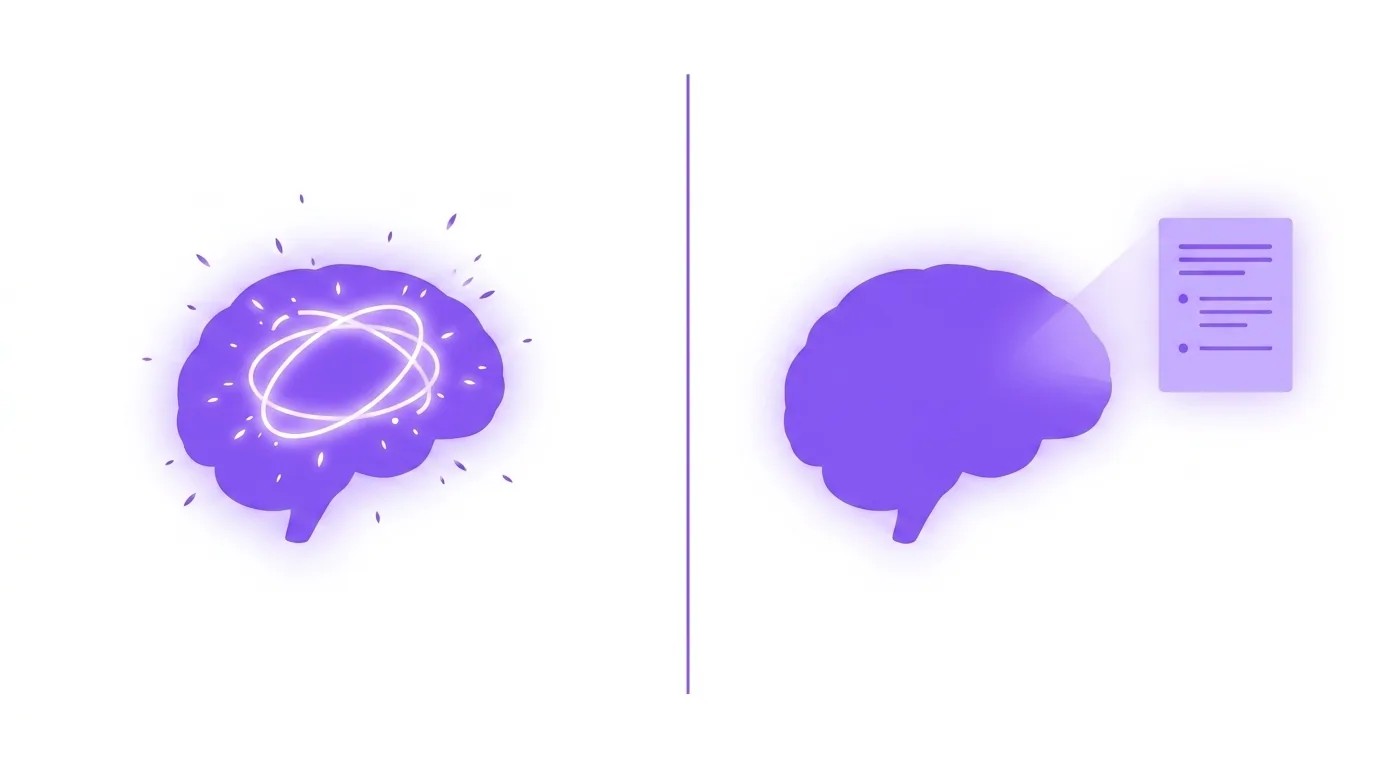
This is the mechanism behind why writing a to-do list feels so relieving, and why "get it out of your head and onto paper" is the core of nearly every productivity system. You are not just organising. You are deliberately closing open loops so your working memory stops holding them for you.
How to Use the Zeigarnik Effect on Purpose
Once you understand the effect, you can work with it in both directions.
To quiet a nagging mind, make plans, not just lists. A vague list of everything you have not done can actually make the tension worse, because none of the loops is truly closed. The trick is specificity: for the task that keeps intruding, write down the concrete next action, when you will do it, and where. That is what discharges it. A plan your brain believes is a plan your brain can let go of.
Do a brain dump before bed. Late-night intrusions are open loops surfacing in the quiet. Spend two minutes writing tomorrow's specific plan and you give your mind permission to stop holding the tasks overnight.
Use open loops to your advantage when learning. The same effect that nags you can help you. Stopping a study session or a piece of work mid-flow, rather than at a natural finish, leaves the loop open, which keeps the material active in your mind and can make it easier to pick back up. Sometimes the best place to stop is in the middle.
Underneath all of it is one idea worth taking to heart: your memory is not a to-do list, and it is a mistake to use it as one. It will hold your open loops faithfully, but at the cost of the mental space you need to actually think. The more you offload intentions into trusted plans, the more of your working memory you free for the task in front of you.
That workspace, your ability to hold and direct information in the moment, is also something you can strengthen directly. If the idea of a clearer, less cluttered mind appeals to you, our free memory test is a quick way to see how much your working memory can hold, and a few focused minutes a day with a memory game trains the attention and control that decide how well you think when it counts.
The unfinished task was never a flaw in your memory. It was a feature, working a little too well. Give your brain a plan it can trust, and the loop finally closes, even if the task is still waiting for tomorrow.
Frequently asked questions
What is the Zeigarnik effect?
Why can't I stop thinking about unfinished tasks?
How do you get rid of Zeigarnik effect intrusions?
Why does writing a to-do list feel so relieving?
Can the Zeigarnik effect help you study?
Train your memory. Play Blanked free.
A free visual memory game built around how memory actually works. 6 game modes, 400+ levels.
Download on the App Store