Games Like Wordle: 9 Daily Brain Challenges (2026)

On this page (4)
Wordle did something no brain-training company ever managed: it got tens of millions of people to do a small cognitive workout every single day, voluntarily, and then brag about it. No streak notifications begging you to come back. No subscription. Just one puzzle, the same for everyone, once a day, with a little grid of squares to show for it.
The formula turned out to be repeatable, and the last few years have produced an entire genre of daily challenges built on it: one attempt, shared puzzle, shareable result. Some train words, some train numbers, some train geography, and at least one trains the thing this site cares about most: memory.
Here are nine worth adding to your morning rotation, what each one actually exercises, and an honest note on what a daily puzzle can and cannot do for your brain.
Why the Once-a-Day Formula Works
Before the list, it is worth understanding why this format sticks when brain-training apps with 10x the budget struggle to keep users.
Scarcity does the discipline for you. You cannot binge Wordle. One puzzle, then a locked door until midnight. That removes the burnout cycle (play 40 rounds, get sick of it, never return) and replaces it with a small daily appointment.
Everyone plays the same puzzle. Your result is comparable with your group chat's results, which turns a solo cognitive task into a social one. The share grid is the whole marketing department.
Streaks make consistency visible. A streak is a running score for showing up, and the brain treats it like something owned: losing it feels like a loss, not a missed session. That loss-aversion quirk is remarkably effective at building habits, and we wrote a full breakdown of the neuroscience of streaks if you want the mechanism.
The honest caveat, before anyone oversells this: a single daily puzzle is a nudge, not a training programme. Research on cognitive training (Simons et al., 2016) is clear that improvements tend to stay close to the trained task. A daily word game makes you better at word games. What the daily format genuinely delivers is consistency, and consistency is the ingredient every real training effect depends on.
The 9 Daily Challenges Worth Playing
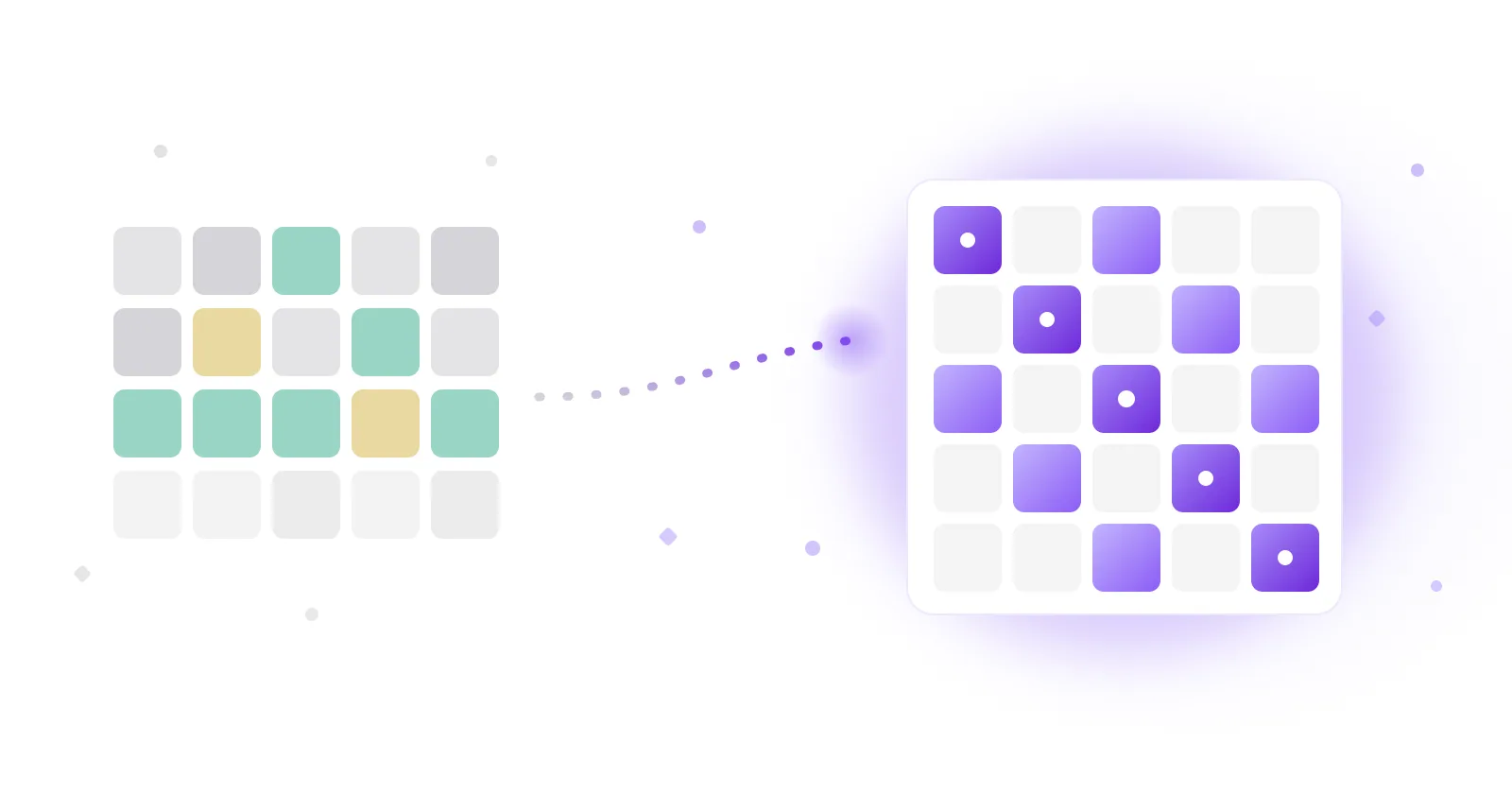
1. Blanked Daily (visual memory). Ours, so we are biased, and we built it precisely because the genre had no serious memory entry. Five rounds on a grid: tiles flash for just over a second, you reproduce what you saw, each round adds a tile. Same puzzle for every player worldwide, one attempt per day, share grid at the end. It exercises visuospatial working memory, the hold-positions-in-mind skill measured by the classic Corsi task. Play today's challenge free in your browser; no signup.
2. Wordle (vocabulary and deduction). The original and still the cleanest design in the genre. Six guesses to find a five-letter word, with feedback that turns each guess into a logic puzzle. The skill is less vocabulary than constraint management: holding what you know (green, yellow, grey) in mind while generating candidates that fit. That juggling act runs on working memory.
3. Connections (categorical thinking). Sixteen words, four hidden groups, and a designer who wants you to put "straw" in the wrong one. The skill here is flexible categorisation, resisting the obvious grouping long enough to consider alternatives. The step from "these four are colours" to "wait, three of them are also Pink Floyd albums" is genuine cognitive flexibility work.
4. Quordle (divided attention). Four Wordles at once, sharing one set of guesses. The load is real: every guess produces feedback on four boards, and you have to track and integrate all of it. If Wordle stopped being effortful months ago, this is the correct difficulty bump.
5. Waffle (spatial rearrangement). Wordle's feedback system applied to a crossword-shaped grid where you swap letters into place with a limited number of moves. Planning the swap order matters, which pulls in spatial reasoning and a little lookahead planning alongside the word knowledge.
6. Nerdle (arithmetic). Wordle for equations: guess the hidden calculation (like 12+35=47) with the same colour feedback. It quietly forces mental arithmetic and place-value reasoning that most adults have not exercised since school. Surprisingly satisfying if numbers are your thing.
7. Worldle (geography and shape recognition). A country's silhouette, six guesses, with distance-and-direction hints after each. The interesting skill is visual: recognising shapes out of context, which is a genuine visual memory retrieval task if you have ever looked at a map.
8. Contexto (semantic search). Guess the secret word; the game tells you how semantically close your guess is, ranked by an AI language model. Games regularly run to dozens of guesses, and the skill is exploring meaning-space efficiently: moving from "hot" to "stove" to "kitchen" and noticing which direction the numbers improve. There is no other game quite like it.
9. Chess.com Daily Puzzle (planning). Not Wordle-shaped, but it predates the whole genre and fits the same slot: one position, one correct line, once a day. Chess puzzles exercise calculation and forward planning, holding a sequence of imagined moves in mind before committing, which is working memory under another name.
What a Daily Puzzle Actually Does for Your Brain
The genre's honest value, in three parts.
Retrieval and effort, daily. Each of these games forces a few minutes of genuinely effortful thinking: generating candidates, holding constraints, resisting first instincts. Effortful retrieval is the active ingredient in most things that genuinely help memory, and a daily puzzle guarantees a minimum dose.
A keystone habit. The reliable finding across habit research is that small, consistent, cued behaviours survive where ambitious ones collapse. A two-minute daily puzzle attached to your morning coffee is about as robust as habits get, and it can anchor bigger routines around it.
Not a substitute for training. If your goal is measurably better memory rather than a pleasant ritual, one puzzle a day is the appetiser. Improvement comes from repeated, varied practice at the edge of your ability, the structure a proper memory training programme provides and a single fixed daily puzzle deliberately does not. Our own take on that structure is Blanked: six modes, 400+ levels, two minutes a day, free on iOS.
Building the Rotation
A practical suggestion, since the genre now has more games than anyone's morning can hold: pick three. One verbal (Wordle or Connections), one numerical or logical (Nerdle or the chess puzzle), one visual (Blanked Daily or Worldle). That covers three different cognitive systems in under ten minutes, keeps each game fresh, and gives you three streaks to protect instead of one.
And if you want a baseline before you start, take our free visual memory test today, play your rotation for a month, and test again. The number that comes back is the only brain-training claim worth trusting: your own.
Frequently asked questions
Are daily brain games actually good for your brain?
What is the best game like Wordle?
Why do these games only allow one puzzle per day?
Do daily puzzle games prevent memory loss or dementia?
Is there a daily memory challenge like Wordle?
Train your memory. Play Blanked free.
A free visual memory game built around how memory actually works. 6 game modes, 400+ levels.
Download on the App Store