Why Do Words Get Stuck on the Tip of Your Tongue? (2026)

On this page (5)
You know the word. You definitely know it. You can picture the thing, you know it starts with a B, you know it has three syllables, you can feel the shape of it sitting right there. And yet it will not come. You stand mid-sentence with your mouth slightly open, saying "it is, you know, the... the thing", while the word hovers maddeningly out of reach.
This is the tip-of-the-tongue state, and it is one of the most peculiar experiences in all of memory. You are not failing to remember the word. You are, in a very real sense, half-remembering it: you have retrieved almost everything about it except the one thing you actually need, its sound. Here is what is genuinely happening in your brain when a word gets stuck, why it happens more as you get older, and how to shake the word loose.
What a Tip-of-the-Tongue State Actually Is
The tip-of-the-tongue phenomenon (researchers call it TOT) is a temporary failure to retrieve a word that you clearly know, combined with a strong feeling that retrieval is imminent. That second part is what makes it so distinctive. You are not guessing whether you know the word. You are certain you do, which is why it is so frustrating.
The strangest feature is how much you can access while the word itself stays hidden. In a tip-of-the-tongue state, people can often correctly report the first letter of the missing word, the number of syllables, where the stress falls, and even words that sound similar. You have the meaning, you have fragments of the sound, you have a confident sense of knowing. You are just missing the complete word.
That specific pattern, everything except the full sound, is the clue that cracked the mystery, and it points to exactly where in the memory system the breakdown happens.
The Science: A Word Has Two Separate Parts
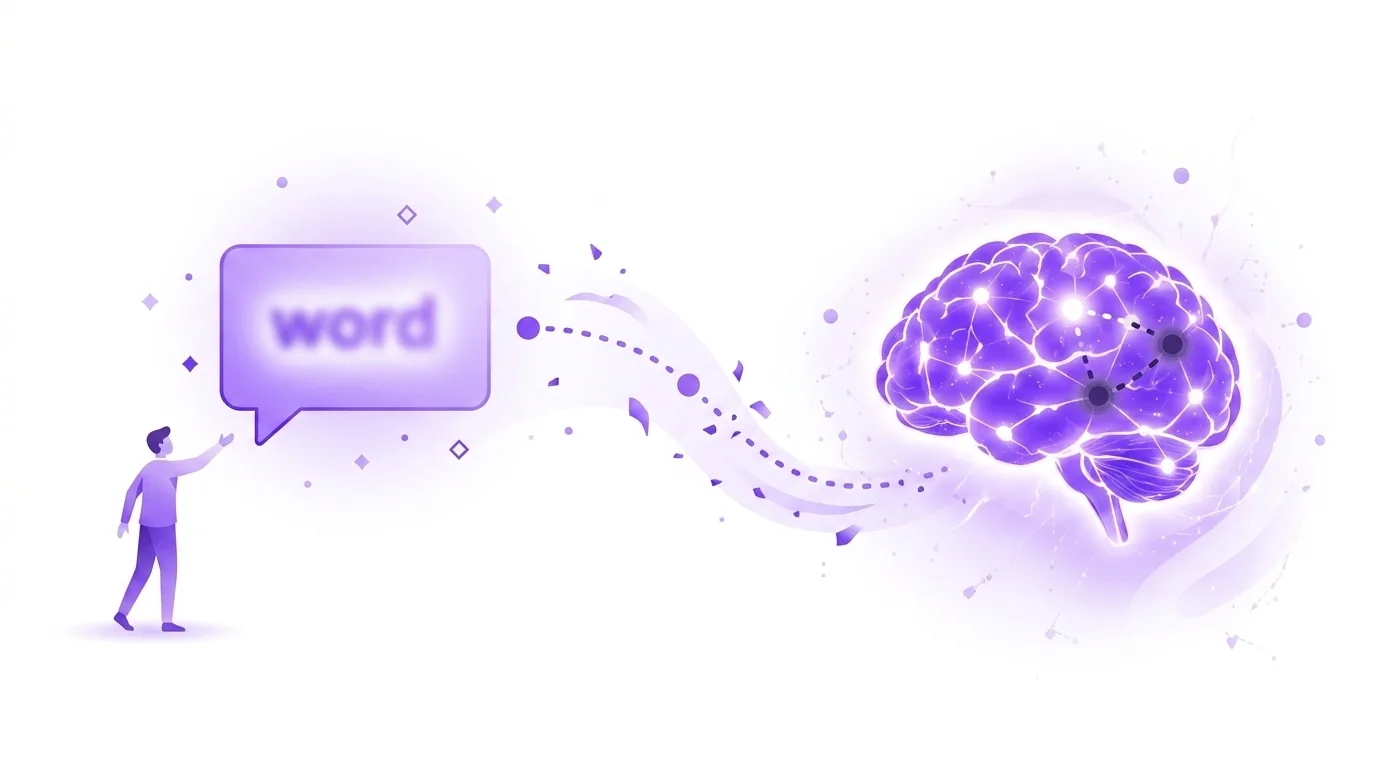
Here is the key idea. In your brain, a word is not stored as a single lump. Its meaning and its sound are held in two different places, connected by a link.
There is a semantic level, which holds what the word means, the concept, everything you know about the thing. And there is a phonological level, which holds how the word sounds, the actual sequence of sounds you need to say it out loud. When you use a word normally, activation flows from the meaning to the sound in a fraction of a second, and the word comes out.
A tip-of-the-tongue state is what happens when that flow breaks down. This is the leading scientific explanation, called the transmission deficit model, developed by researchers including Deborah Burke and Donald MacKay. According to this model, the meaning of the word activates fully, but the activation fails to transmit completely across to the sound. The connection between the concept and its pronunciation is too weak, in that moment, to carry the signal all the way.
That is why the experience feels the way it does. You have full access to the meaning (which is why you are certain you know the word) and partial access to the sound (which is why you can grab the first letter or the rhythm), but the complete phonological form does not fire. You are not missing the word. You are missing the bridge to its sound.

Why Some Words Get Stuck More Than Others
If tip-of-the-tongue states come from weak connections, then anything that weakens a word's connection makes it more likely to get stuck. Three factors stand out.
Infrequent use. Connections you use often stay strong; connections you rarely use go slack. Words you seldom say, technical terms, obscure vocabulary, the name of an actor you have not thought about in years, are exactly the ones that end up on the tip of your tongue, because their links have gone quiet from disuse.
Recency. A word you have not used in a long time is more vulnerable than one you used yesterday. Every use refreshes the connection.
Proper names, worst of all. Names of people and places are the single most common trigger for tip-of-the-tongue states, and the two-part model explains why. Most words have rich meaning connections feeding into their sound from many directions. A name is different: it is an arbitrary label attached to one person, with almost no supporting meaning to reinforce the path to its sound. There is only one fragile link, so it fails easily. This is the same reason your brain remembers faces but forgets names: a name is a word with unusually little to hold it in place.
Why It Gets Worse With Age
Tip-of-the-tongue states are nearly universal, and young adults typically get one or two a week. They become more frequent with age, with older adults reporting them noticeably more often.
The reassuring part is what this does and does not mean. Getting more tip-of-the-tongue states with age is not a sign that you are losing words or knowledge. The knowledge is intact; you prove that every time the word arrives ten minutes later. What changes is the strength of the connections that carry activation from meaning to sound. Those links weaken gradually with age, so the transmission fails more often, even though nothing has actually been forgotten.
This is worth holding on to, because a tip-of-the-tongue moment can feel alarming, like a glimpse of decline. In almost all cases it is nothing of the sort. It is a retrieval and connection issue, not a storage one, and it is a normal part of a normally ageing brain. (A sudden, dramatic increase in word-finding trouble, especially alongside other cognitive changes, is worth mentioning to a doctor, but the ordinary weekly blank is simply how word retrieval works.) If you want the fuller picture of what genuinely changes, our guide on memory and ageing covers what declines and what does not.
How to Get the Word to Come
Once you understand that the problem is a weak connection to the word's sound, the tricks that actually work make sense.
Stop chasing it. This is the counterintuitive one, and it is genuinely effective. Straining to force the word often strengthens a wrong, similar-sounding word that is blocking the right one. Let it go, change the subject, and the correct word frequently pops up on its own minutes later, once the interference fades. That delayed pop-up is your brain resolving the transmission in the background.
Go through the alphabet. Because you often have partial access to the sound, deliberately cueing yourself with letters ("is it an A? a B?") can supply the missing phonological fragment that lets the full word fire.
Chase the sound, not the meaning. You already have the meaning; more meaning will not help. Try to recall anything about how the word sounds, its rhythm, its ending, a word it rhymes with. You are trying to reach the sound layer, so aim there.
Think around it. Recall where you last heard the word, who said it, the context. Related cues can feed activation into the network from a different direction and complete the path.
Underneath all of these is a single principle: tip-of-the-tongue states are about connection strength, and connections strengthen with use. The more actively you engage a word, read it, say it, retrieve it, the stronger its link stays and the less often it sticks. That is the same reason effortful retrieval, rather than passive exposure, is what keeps any memory accessible.
Your everyday word-finding runs on the same attention and retrieval machinery that all memory does, and that machinery responds to being exercised. If a word getting stuck made you curious about how sharp your own recall is, our free memory test takes about two minutes, and a few focused minutes a day with a memory game trains the attention and retrieval that keep the words, and everything else, coming when you call for them.
The next time a word sits just out of reach, you will know it is not lost. The meaning made it through; only the sound stalled on a weak connection. Stop pulling, let it settle, and more often than not the word will arrive on its own, a little late, exactly as you knew it would.
Frequently asked questions
Why do words get stuck on the tip of your tongue?
What is the tip-of-the-tongue phenomenon?
Why can't I remember words as I get older?
Why are names the hardest to remember?
How do you get a word off the tip of your tongue?
Train your memory. Play Blanked free.
A free visual memory game built around how memory actually works. 6 game modes, 400+ levels.
Download on the App Store