Why You Can’t Remember Your Dreams (The Science)

On this page (7)
You were in the middle of a vivid dream. You could see faces, hear voices, feel emotions. Then your alarm went off. For about 3 seconds, you could still feel the dream. By the time you picked up your phone, it was gone. Completely. As if it never happened.
This is one of the strangest experiences in human cognition. You just spent 20 minutes in a detailed, immersive, emotionally charged experience, and your brain deleted it before you could finish waking up. It feels like a glitch. Like your memory failed.
It is not a failure. It is a feature. And the neuroscience behind it reveals something fascinating about how your memory system works.
You Are Not Failing to Remember. Your Brain Is Choosing to Forget.
The default assumption most people have is that dreams are experiences that should be remembered, and forgetting them is a problem. This assumption is backwards.
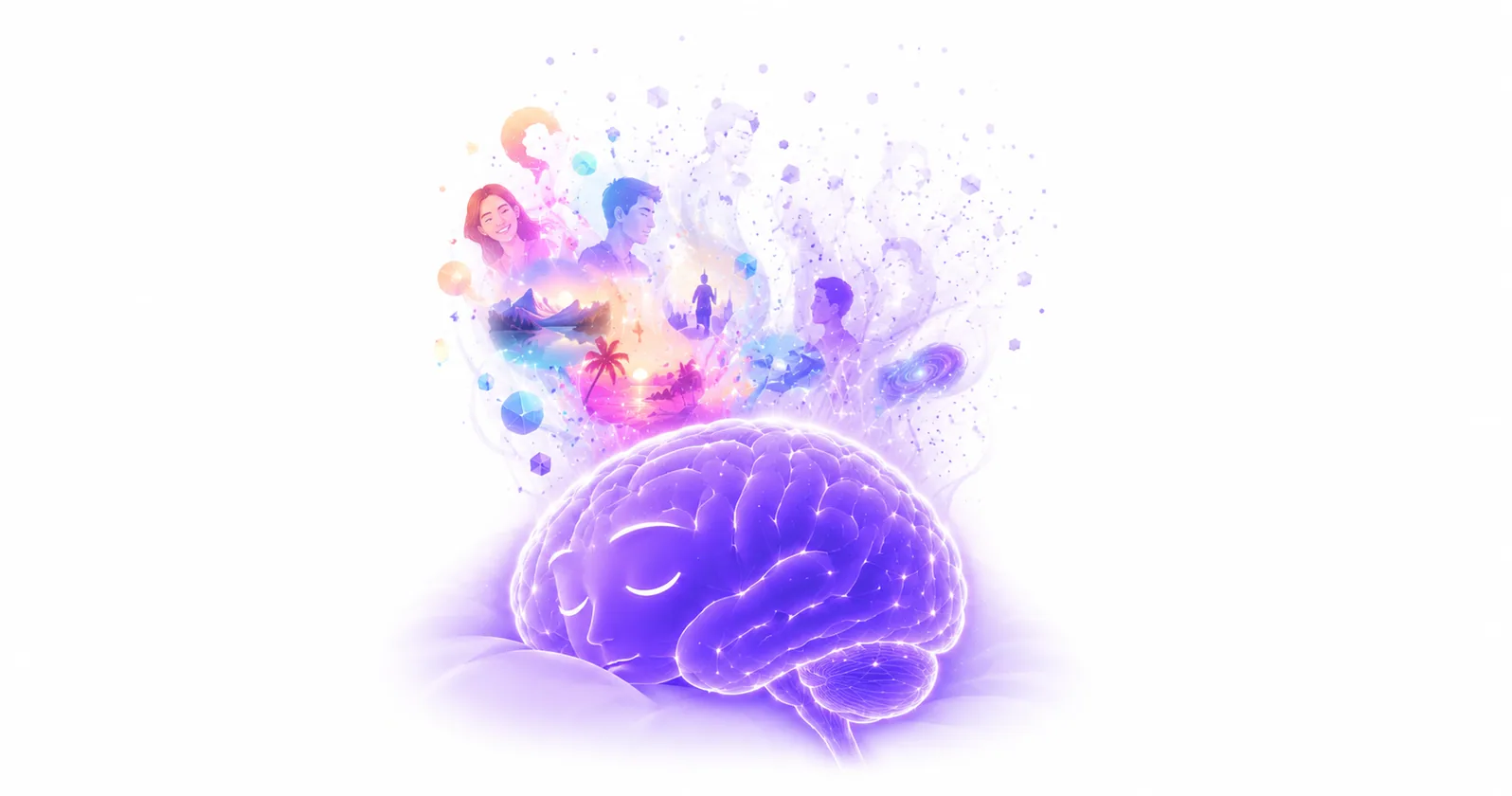
Dreams are a byproduct of the most important memory process your brain performs: overnight consolidation. During sleep, your hippocampus replays the day’s experiences, selectively strengthening the neural connections that represent important memories and weakening the ones that represent unimportant information. Dreams appear to be the subjective experience of this process, the flickering, fragmented, emotionally charged scenes that result from the hippocampus activating and deactivating memory traces during consolidation.
Your brain does not need you to remember this process. It needs to perform it. Remembering the dream would actually be counterproductive: it would create a new memory of the consolidation process itself, cluttering your long-term storage with content that was never meant to be stored. (For the full breakdown of how sleep consolidation works, see our post on how sleep affects memory.)
What Happens in Your Brain During Dreams
To understand why dreams are forgotten, you need to understand the brain state that produces them.
Most vivid dreaming occurs during REM (rapid eye movement) sleep. During REM, your brain is highly active, often as active as during waking hours. But it is active in a very specific configuration:
The visual cortex is active. This is why dreams are overwhelmingly visual. Your brain is generating vivid visual imagery without any external input. The same neural circuits that process real visual scenes during the day are firing during dreams, which is why dreams feel so real while they are happening.
The prefrontal cortex is largely offline. The region responsible for logical reasoning, self-awareness, working memory, and critical thinking is suppressed during REM sleep. This is why dreams feel perfectly normal while they are happening, no matter how bizarre. You do not question the talking dog or the ability to fly because the brain region that would say "wait, that is impossible" is not functioning.
The hippocampus is in replay mode. Rather than encoding new experiences (its daytime job), the hippocampus is replaying and processing existing memories. It is in output mode, not input mode. Information flows out of the hippocampus for consolidation, not into it for storage.
Norepinephrine is absent. This neurotransmitter, which during waking hours helps stamp new experiences into memory, drops to its lowest levels during REM sleep. Without norepinephrine, the molecular machinery for forming new long-term memories is essentially switched off.
This combination means that during REM sleep, your brain is generating vivid experiences (active visual cortex), without the ability to think critically about them (suppressed prefrontal cortex), while the memory-formation system is turned off (hippocampus in replay mode, no norepinephrine). You are having experiences that your brain is simultaneously preventing you from storing.
The MCH Discovery: Your Brain’s Dream Eraser
In 2019, a landmark study published in Science revealed that dream forgetting is not just passive (the memory system being turned off). It is active. Your brain has a dedicated mechanism for erasing dream content.
Researchers at SRI International and Nagoya University discovered that neurons in the hypothalamus that produce melanin-concentrating hormone (MCH) fire specifically during REM sleep and send inhibitory signals directly to the hippocampus. These MCH neurons actively suppress hippocampal memory formation during the exact sleep stage when dreams are most vivid.
The findings were striking. When researchers activated MCH neurons in mice, the mice performed worse on memory tasks: the neurons were actively interfering with memory consolidation. When they inhibited MCH neurons (turned off the dream eraser), the mice actually performed better on memory tasks.
The lead researcher described the implications directly: these MCH neurons may prevent the content of dreams from being stored in the hippocampus, which is why dreams are quickly forgotten upon waking.
This means your brain is not passively failing to record dreams. It is actively erasing them. There is a dedicated neural circuit whose job during REM sleep is to suppress hippocampal memory formation, ensuring that dream content does not contaminate your long-term memory storage.
Why Your Brain Deletes Dreams on Purpose
If your brain is going to the trouble of actively erasing dream content, there must be a reason. The current scientific understanding points to two:
1. Preventing memory contamination. Dreams are not accurate recordings of reality. They are fragmented, distorted, emotionally exaggerated recombinations of real experiences. If your brain stored them as memories, you would have difficulty distinguishing between things that actually happened and things you dreamed. Dream content would contaminate your autobiographical memory with false experiences.
This is not hypothetical. People who do remember their dreams very frequently report occasional confusion about whether something happened in real life or in a dream. The brain’s active erasure of dream content protects the integrity of your waking memory.
2. Protecting the consolidation process. During REM sleep, the hippocampus is replaying and strengthening important memories from the day. If it were simultaneously encoding the dream content being generated, the new encoding would interfere with the consolidation process. The MCH neurons ensure that the hippocampus can perform its consolidation work without being disrupted by the byproducts of that work.
Think of it like editing a document. While you are reorganising and revising the text (consolidation), you do not want the editing process itself to be saved as part of the document (dream storage). The MCH system ensures that only the final product (consolidated memories) is kept, not the messy process that produced it.
The 5-Minute Window: Why Some Dreams Survive
Despite the active erasure system, you do sometimes remember dreams. This happens because the erasure is not instantaneous. There is a window.
When you wake up during or immediately after a REM period, the dream content is briefly held in short-term memory. The MCH neurons stop firing when you wake up, and the norepinephrine system reactivates. For approximately 5 minutes after waking, you have a window where the dream content is still available in short-term memory and the encoding system is coming back online.
If you actively rehearse the dream content during that window (thinking about it, replaying it mentally, writing it down), you can encode it into long-term memory before it decays. If you do anything else (check your phone, think about your day, get out of bed), the dream content decays from short-term memory within minutes and is lost permanently.
This is why dream recall is highest when you wake up naturally during a REM period (common in the early morning hours when REM periods are longest) and lowest when you are woken by an alarm during non-REM sleep. It is also why people who journal immediately upon waking report dramatically better dream recall than those who wait even 10 minutes.
The 5-minute window is the same decay principle that governs all short-term memory loss: information that is not actively rehearsed or encoded fades within seconds to minutes. Dreams just have the additional challenge of an active erasure system working against them.
What Dream Recall Actually Tells You About Your Memory
Here is where this becomes relevant to everyday memory health.
Your ability to recall dreams is not a measure of your dream quality. It is a measure of your encoding speed upon waking. People who remember more dreams tend to have faster cortical reactivation upon waking (the prefrontal cortex and encoding systems come back online more quickly), which gives them a longer window to encode dream content before it decays.
This means dream recall is indirectly linked to overall memory encoding efficiency. People with stronger working memory and faster processing speed tend to recall more dreams, not because they dream differently, but because their encoding system reactivates faster.
Changes in dream recall can also reflect changes in sleep architecture. If you suddenly stop remembering dreams when you used to remember them regularly, it may indicate that your sleep quality has changed: you may be getting less REM sleep, waking less frequently during REM periods, or sleeping more deeply (which is not necessarily a bad thing).
If you are concerned about a significant change in dream recall alongside other cognitive symptoms (daytime brain fog, difficulty concentrating, memory lapses during the day), it is worth discussing with a doctor. But on its own, not remembering dreams is completely normal and is exactly what your brain is designed to do.
How to Remember More Dreams (If You Want To)
Dream recall is a trainable skill. If you want to remember more dreams (for curiosity, creative inspiration, or self-reflection), these techniques work by exploiting the 5-minute encoding window:
1. Keep a journal by your bed. The moment you wake up, before doing anything else, write down whatever you can recall. Even fragments. The act of writing engages the encoding system and transfers the content from decaying short-term memory into more durable storage.
2. Set the intention before sleep. Tell yourself "I will remember my dreams tonight." This sounds unscientific, but research on prospective memory shows that setting a future intention increases the likelihood of performing that intention. The instruction primes your brain to prioritise dream content upon waking.
3. Wake up without an alarm when possible. Natural waking is more likely to occur during or just after a REM period, which means the dream content is fresh. Alarms can jolt you out of non-REM sleep where no vivid dream content is available.
4. Stay still for 30 seconds after waking. Movement activates the motor cortex and shifts your brain’s processing resources away from the memory systems holding the dream content. Lying still for 30 seconds and mentally replaying the dream gives the encoding system time to capture it.
5. Do not check your phone. The moment you check your phone, you flood your working memory with new information (notifications, messages, time) that displaces the dream content. The dream was held in a limited-capacity short-term buffer. New input pushes it out.
Dream recall and waking memory are built on the same encoding systems. The speed and efficiency with which you capture a fading dream upon waking is the same speed and efficiency you use to encode a colleague’s name, a visual detail, or a piece of information during the day. Training your visual memory with daily exercises strengthens the encoding infrastructure that all memory depends on, dream recall included.
Your brain forgets your dreams on purpose. It is not a flaw. It is a system working exactly as designed: protecting your waking memory from contamination, preserving the consolidation process, and keeping your long-term storage clean. The MCH neurons are doing their job. And the 5-minute window, when it opens, gives you just enough time to grab whatever you want to keep before the eraser catches up.
Frequently asked questions
Why do I forget my dreams so fast?
Is it normal to never remember dreams?
Does not remembering dreams mean you sleep badly?
Do dreams affect memory?
Can you train yourself to remember dreams?
Train your memory. Play Blanked free.
A free visual memory game built around how memory actually works. 6 game modes, 400+ levels.
Download on the App Store