How Stress Affects Your Memory (And How to Fix It)

On this page (15)
You remember exactly where you were on the most stressful day of your life. Every detail. The room, the words, the feeling in your chest. But you cannot remember what your colleague said in yesterday’s meeting, even though you were sitting right there.
This contradiction sits at the heart of how stress affects memory. Stress does not simply destroy your ability to remember. It reshapes it. It amplifies some memories (the emotional, the threatening, the significant) while suppressing others (the neutral, the routine, the things you actually need to recall). Understanding this distinction is the key to understanding why stress makes you feel like your memory is failing, and what you can do about it.
Stress Does Not Simply Destroy Memory
Most articles on stress and memory tell a simple story: stress releases cortisol, cortisol damages the hippocampus, and your memory gets worse. This is not wrong, but it is dangerously incomplete.
A 2023 study at Yale School of Medicine found something more nuanced. While cortisol can impair hippocampal function for neutral information, it simultaneously enhances the hippocampus’s ability to encode emotionally significant memories. The researchers gave participants either cortisol or a placebo and then showed them images while scanning their brains with high-resolution fMRI. The cortisol group showed impaired general hippocampal signals but increased connectivity within the hippocampus specifically for emotional content.
This means stress does not switch your memory off. It reprioritises it. Under stress, your brain redirects its memory resources toward information that seems threatening or emotionally significant, at the expense of everything else. From an evolutionary perspective, this makes perfect sense: if a predator is chasing you, remembering the escape route matters more than remembering what you had for breakfast.
The problem is that modern stress is not a predator. It is a demanding boss, a full inbox, financial pressure, relationship tension, and a constant low-grade hum of cortisol that never fully switches off. Your brain is perpetually in "threat mode," prioritising emotional encoding at the expense of the neutral, everyday memories you actually need.
What Cortisol Does to Your Brain
Cortisol is the primary stress hormone, released by the adrenal glands when the hypothalamic-pituitary-adrenal (HPA) axis is activated. In short bursts, cortisol is useful: it increases alertness, sharpens focus, and mobilises energy. The problems start when cortisol levels remain elevated for extended periods.
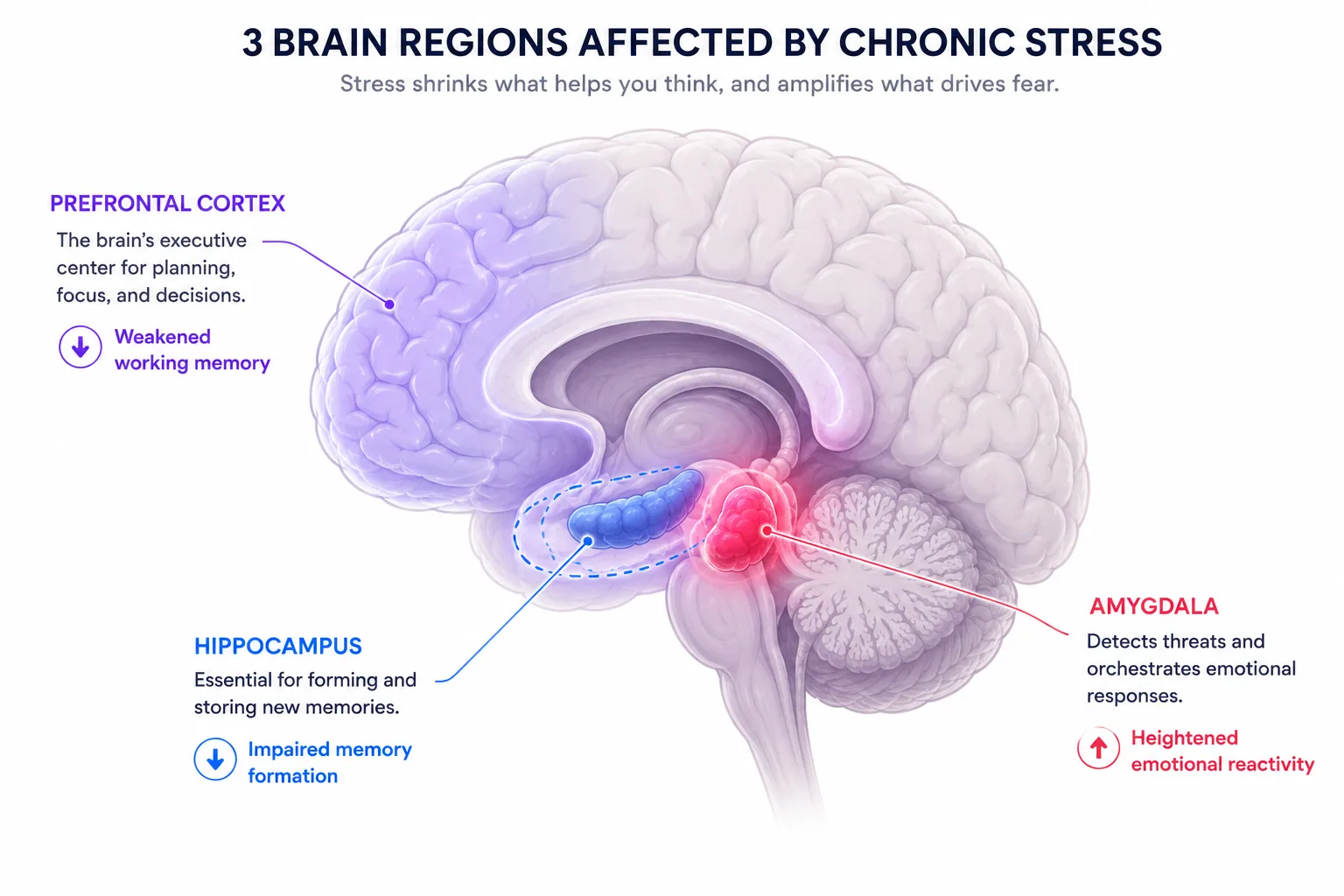
The hippocampus. Your hippocampus, the brain structure responsible for converting short-term memories into long-term ones, has one of the highest concentrations of cortisol receptors in the entire brain. This makes it exceptionally sensitive to stress. Moderate cortisol enhances hippocampal function. Excessive or prolonged cortisol impairs it. In animal models, chronic cortisol exposure causes shortening of hippocampal dendrites (the branches that receive signals from other neurons) and reduced neurogenesis (the birth of new neurons) in the dentate gyrus.
The prefrontal cortex. Your prefrontal cortex, which manages working memory, attention, and decision-making, is also heavily affected by stress. Acute severe stress can temporarily shut down prefrontal function, which is why you cannot think clearly in a panic. Chronic stress gradually weakens prefrontal networks, reducing your ability to hold information in working memory and filter out distractions.
The amygdala. While the hippocampus and prefrontal cortex are impaired by chronic stress, the amygdala (your brain’s threat-detection centre) is enhanced by it. Chronic stress causes the amygdala to grow larger and more reactive, which means you become more sensitive to perceived threats, more emotionally reactive, and more likely to form strong memories of negative experiences. This is the biological basis of the stress-memory paradox: vivid emotional memories combined with poor everyday recall.
Acute Stress vs Chronic Stress: Two Very Different Effects
The distinction between acute and chronic stress is critical because they produce opposite effects on memory.
Acute Stress (Short-Term)
A sudden, intense stressor (a near-miss car accident, a public speaking moment, an unexpected confrontation) triggers a rapid cortisol spike that typically resolves within 1 to 2 hours. This acute stress response can actually enhance memory formation for the stressful event itself. The cortisol spike increases alertness, sharpens attention, and tells the hippocampus: "This is important. Store it."
This is why flashbulb memories (vivid, detailed memories of emotionally intense moments) feel so much stronger than ordinary memories. The stress response literally enhanced the encoding process. However, acute stress simultaneously impairs memory for information encountered immediately before or after the stressful event. Your brain is so busy encoding the threat that it drops everything else.
Chronic Stress (Long-Term)
Chronic stress is a sustained elevation of cortisol over weeks, months, or years. This is the pattern produced by ongoing work pressure, financial strain, relationship problems, or health concerns. Unlike acute stress, chronic stress does not enhance memory. It impairs it across the board.
With chronic stress, cortisol levels never fully return to baseline. The hippocampus is bathed in a constant low-to-moderate cortisol environment that, over time, reduces its volume and function. Research tracking elderly adults over 5 years found that those with chronically elevated cortisol showed reduced hippocampal volume and worse performance on memory tasks compared to those with normal cortisol levels.
Chronic stress also disrupts sleep, which further compounds the memory problem. Cortisol follows a circadian rhythm (high in the morning, low at night). Chronic stress flattens this rhythm, keeping cortisol elevated at night, which disrupts the deep sleep stages where memory consolidation occurs. So chronic stress impairs both encoding (through hippocampal disruption) and consolidation (through sleep disruption). A double hit.
The Inverted U: Why Some Stress Helps and Too Much Hurts
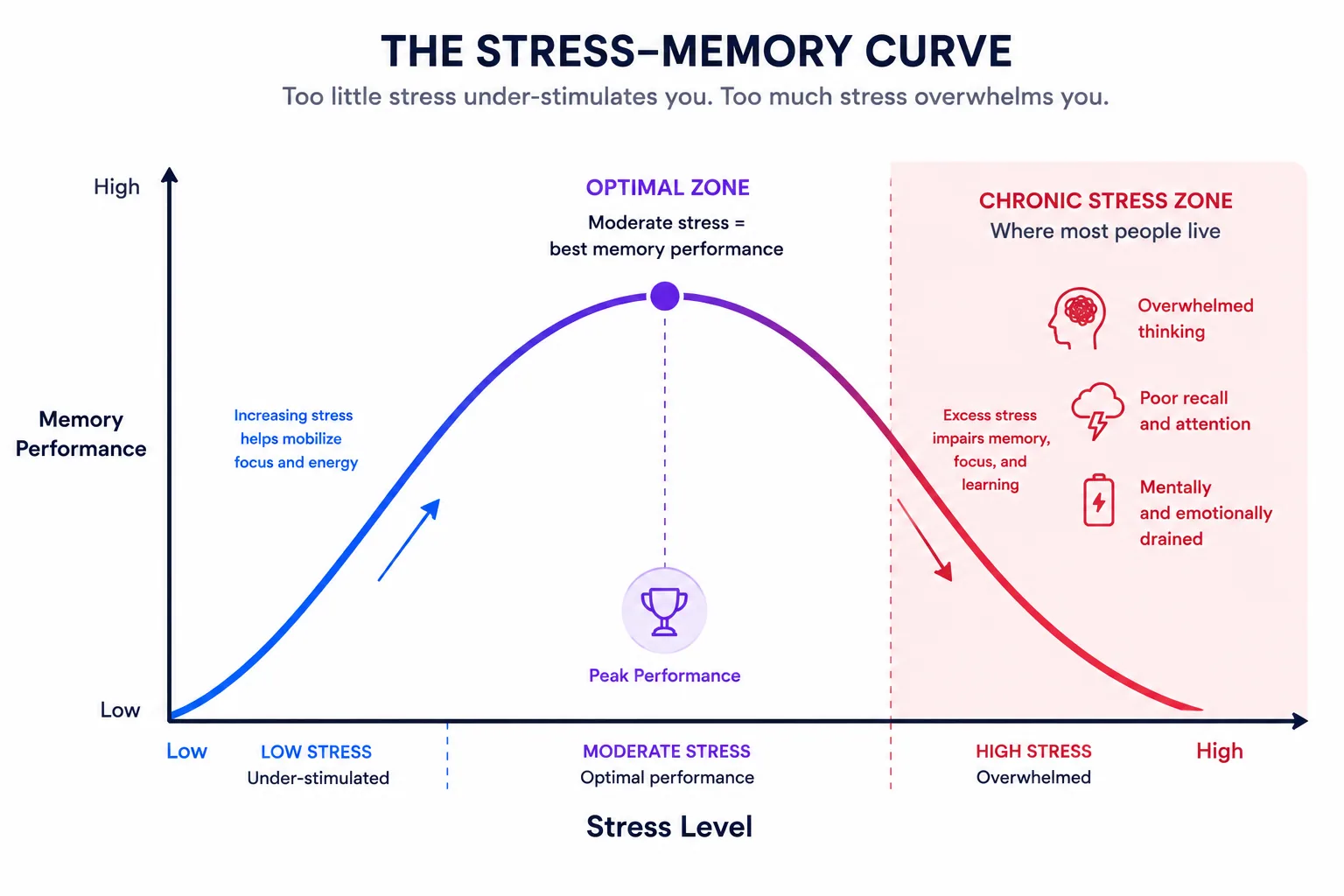
The relationship between stress and cognitive performance follows an inverted U curve (sometimes called the Yerkes-Dodson law). At low stress levels, you are under-aroused: sluggish, unfocused, not encoding much. At moderate stress levels, you are at peak performance: alert, focused, encoding efficiently. At high stress levels, performance collapses: the hippocampus is overwhelmed, the prefrontal cortex shuts down, and encoding fails.
This means the goal is not to eliminate stress entirely. Some stress is necessary for optimal cognitive function. The goal is to keep stress in the moderate zone where it enhances rather than impairs performance, and to prevent chronic elevation that pushes you permanently into the high-stress, low-performance zone.
Most people in modern life are not under-stressed. They are chronically over-stressed, living on the right side of the inverted U, where every additional stressor pushes them further into impairment. The strategies below are designed to pull you back toward the peak of the curve.
How Chronic Stress Physically Changes Your Brain
The effects of chronic stress on the brain are not just functional (temporary performance changes). They are structural (physical changes to brain tissue). Understanding this is important because it explains why the memory effects of stress can persist even after the stressor is removed.
Hippocampal volume reduction. Chronic stress is associated with measurable reductions in hippocampal volume. This has been documented in patients with Cushing’s disease (a condition of excessive cortisol production), in people with PTSD, and in otherwise healthy individuals with prolonged life stress. The volume reduction corresponds to dendritic retraction in the CA3 region and reduced neurogenesis in the dentate gyrus.
Prefrontal cortex thinning. Chronic stress is associated with reduced dendritic complexity in the prefrontal cortex, which weakens the neural networks responsible for working memory, attention control, and executive function. This is why chronically stressed people often report difficulty concentrating, losing their train of thought, and struggling with tasks that require holding multiple pieces of information simultaneously.
Amygdala growth. While the hippocampus and prefrontal cortex shrink under chronic stress, the amygdala shows the opposite pattern: increased dendritic branching and heightened reactivity. This structural change makes you more sensitive to perceived threats and more likely to interpret ambiguous situations as stressful, creating a feedback loop where stress begets more stress.
The crucial point: these changes are reversible. The brain’s neuroplasticity means that reducing chronic stress allows hippocampal neurogenesis to resume, dendritic complexity to recover, and amygdala reactivity to normalise. The recovery takes time (weeks to months), but the brain is capable of rebuilding what stress has eroded.
7 Ways to Protect Your Memory From Stress
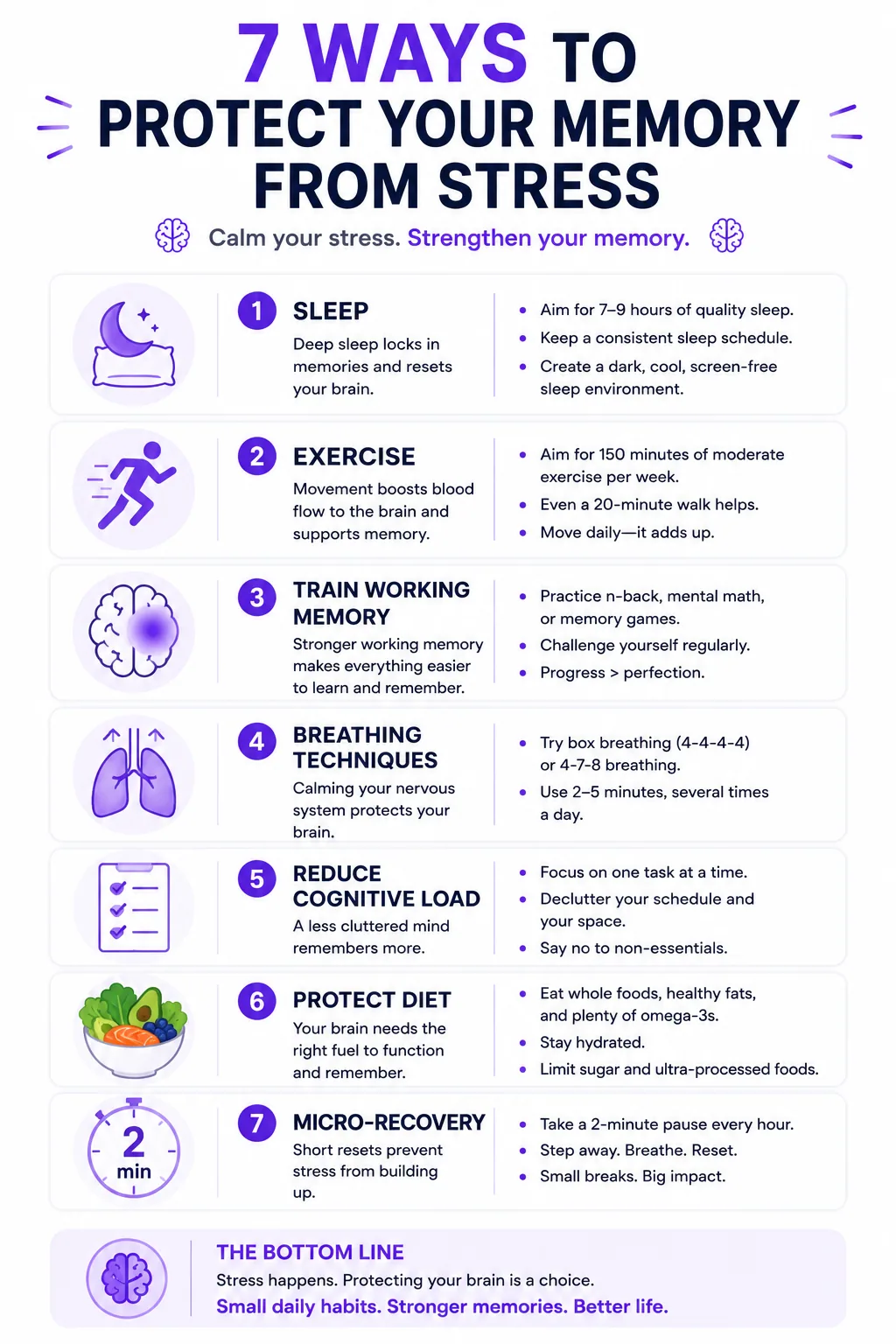
1. Prioritise Sleep Above Everything Else
Sleep is the single most important buffer between stress and memory damage. During deep sleep, cortisol levels drop to their daily minimum, giving the hippocampus a recovery window. Sleep is also when memory consolidation occurs. Protecting 7 to 9 hours of quality sleep protects both processes. If chronic stress is disrupting your sleep, addressing the sleep problem is the highest-leverage intervention. (Full guide in our post on how sleep affects memory.)
2. Exercise Regularly
Aerobic exercise is one of the most effective cortisol regulators available. A 30-minute run or brisk walk produces BDNF (brain-derived neurotrophic factor), which promotes hippocampal neurogenesis and counteracts the dendritic retraction caused by chronic stress. Exercise also improves sleep quality and reduces baseline cortisol levels. The memory benefits of regular exercise are well-documented and substantial.
3. Train Your Working Memory
This might seem counterintuitive, but strengthening your working memory directly protects against stress-related cognitive impairment. A stronger prefrontal cortex is more resilient to cortisol disruption. When you train your visual working memory with a focused, single-task exercise like Blanked, you are building the neural infrastructure that stress is trying to erode. Two minutes of daily training is a direct investment in prefrontal resilience.
4. Use Breathing Techniques to Lower Acute Cortisol
When you notice acute stress building, physiological sighing (a double inhale through the nose followed by a long exhale through the mouth) is the fastest evidence-based technique for lowering cortisol in real time. Stanford research has shown this technique is more effective than mindfulness meditation for reducing acute stress. It works because the extended exhale activates the parasympathetic nervous system, which directly counteracts the cortisol response.
5. Reduce Cognitive Load
Chronic stress consumes working memory resources, leaving less capacity for everyday tasks. Reducing unnecessary cognitive load (writing things down instead of trying to remember them, using checklists, simplifying routines, minimising decisions) frees up the limited working memory capacity that stress has not already claimed. This is practical compensation: you cannot always reduce the stress, but you can reduce the demands on the system stress is impairing. (For more strategies, see our post on how to improve focus and concentration.)
6. Protect Your Diet
Chronic stress often leads to dietary changes (increased sugar, caffeine, alcohol, processed food) that independently impair memory. The Mediterranean and MIND diets are both associated with better cognitive outcomes and lower inflammation. Omega-3 fatty acids in particular have anti-inflammatory properties that may help buffer hippocampal tissue against cortisol damage. Eating well during stressful periods is not self-indulgence. It is cognitive self-defence. (Full breakdown in our post on foods that boost memory.)
7. Create Micro-Recovery Moments
You do not need a two-week holiday to recover from chronic stress (though that helps). Short, intentional recovery moments throughout the day can prevent cortisol from building to damaging levels. A 2-minute Blanked session works as a micro-recovery: it demands complete, focused attention on a single non-threatening task, which temporarily disengages the stress response and gives the prefrontal cortex a structured, low-stakes task to perform. It is not meditation, but the mechanism is similar: a brief period of controlled, focused cognitive engagement that interrupts the stress cycle.
Stress is not going away. Modern life is structurally stressful, and pretending otherwise is not useful. But understanding what stress actually does to your memory (reprioritises rather than destroys, impairs neutral encoding while enhancing emotional encoding, follows an inverted U curve, causes reversible structural changes) gives you the information you need to protect yourself.
The most actionable takeaway: your brain’s stress response and your brain’s memory system are not separate. They share the same hardware (hippocampus, prefrontal cortex, amygdala) and the same chemical messenger (cortisol). Anything that reduces chronic cortisol exposure or strengthens the neural infrastructure cortisol is eroding will protect your memory.
Sleep well. Move your body. Train your working memory. And give your brain at least two minutes of focused, stress-free attention every day. It needs the break more than you think.
Frequently asked questions
Can stress cause memory loss?
Why do I remember stressful events so clearly?
How long does it take for stress to affect memory?
Can you reverse stress-related memory damage?
Does anxiety affect memory the same way as stress?
Train your memory. Play Blanked free.
A free visual memory game built around how memory actually works. 6 game modes, 400+ levels.
Download on the App Store