Neuroplasticity Explained: Can You Rewire Your Brain? (2026)

On this page (11)
If you’ve spent any time reading about brain health, you’ve encountered neuroplasticity. It’s the most frequently cited concept in every article about memory training, meditation, learning, and cognitive decline. And it’s usually accompanied by the claim that you can “rewire your brain.”
The concept is real. The research behind it is substantial. But the way it’s discussed in popular media is often simplified to the point of being misleading. Your brain isn’t a circuit board that can be rewired like a faulty lamp. The process is slower, messier, and more conditional than the metaphor suggests.
Here’s what neuroplasticity actually is, what it can and can’t do, and how to trigger it in ways that genuinely improve your memory and cognitive function.
“Rewiring” Is a Misleading Metaphor (Here’s a Better One)
The word “rewiring” borrows its confidence from engineering, where a broken system is fixed by swapping components. As a recent essay in Aeon put it, the metaphor smuggles mechanical precision into biology, where change is actually slower, messier, and often incomplete.
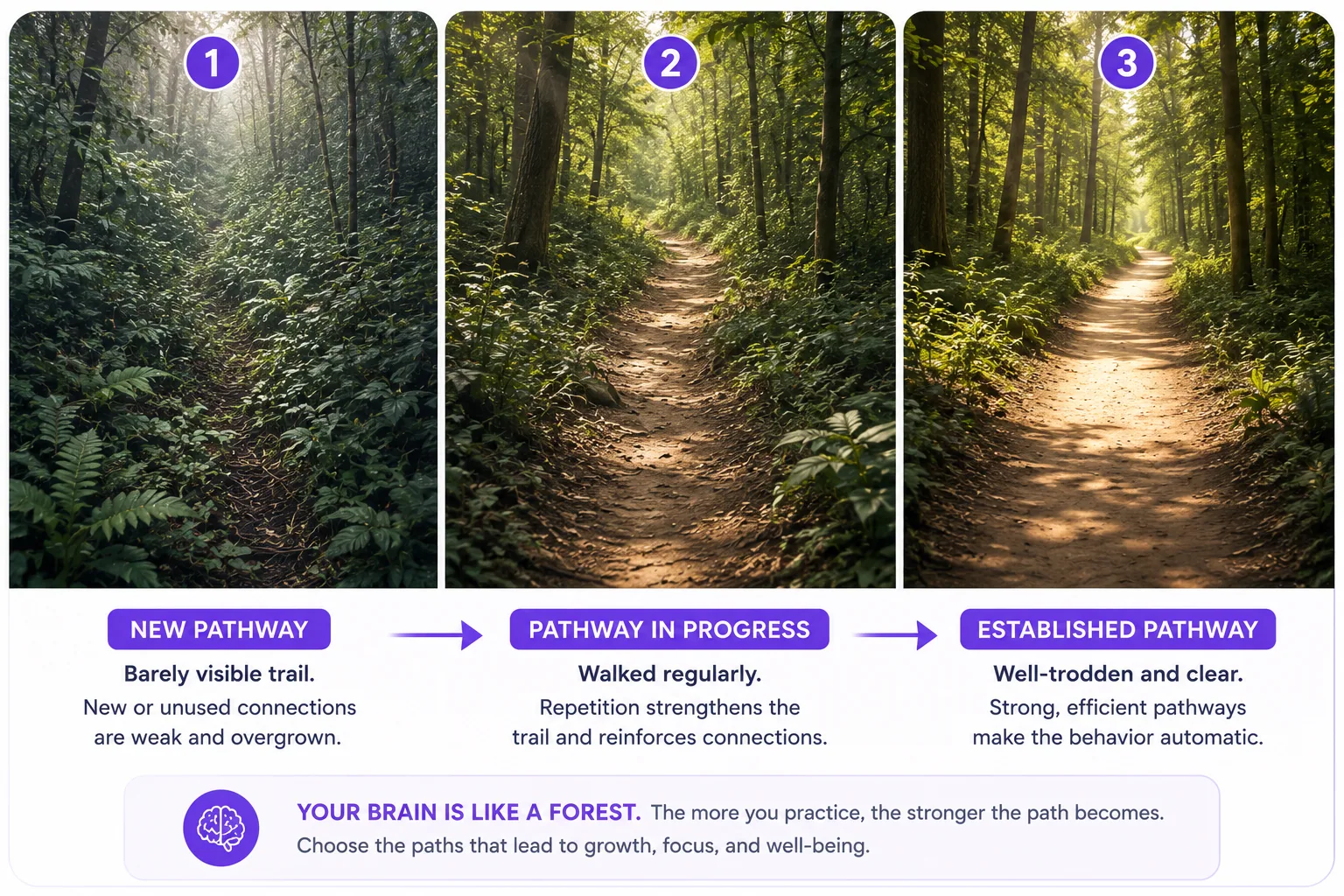
A better metaphor is a forest. Imagine your brain as a vast woodland with countless paths running through it. Walk one path every day and it becomes a clear, well-trodden trail. Abandon a path for months and the undergrowth reclaims it. New paths can be created, but it takes repeated walking before they become established. And old paths don’t disappear instantly. They fade gradually.
This metaphor is more accurate because it captures three things the “rewiring” metaphor misses: change takes repetition, not a single event. Change is gradual, not instantaneous. And change is reversible. Stop reinforcing a pathway and it weakens over time. These principles matter enormously for anyone trying to use neuroplasticity to improve their memory or cognitive skills.
What Neuroplasticity Actually Is
Neuroplasticity is your brain’s ability to change its structure and function in response to experience, learning, and environmental demands. It happens at multiple levels simultaneously:
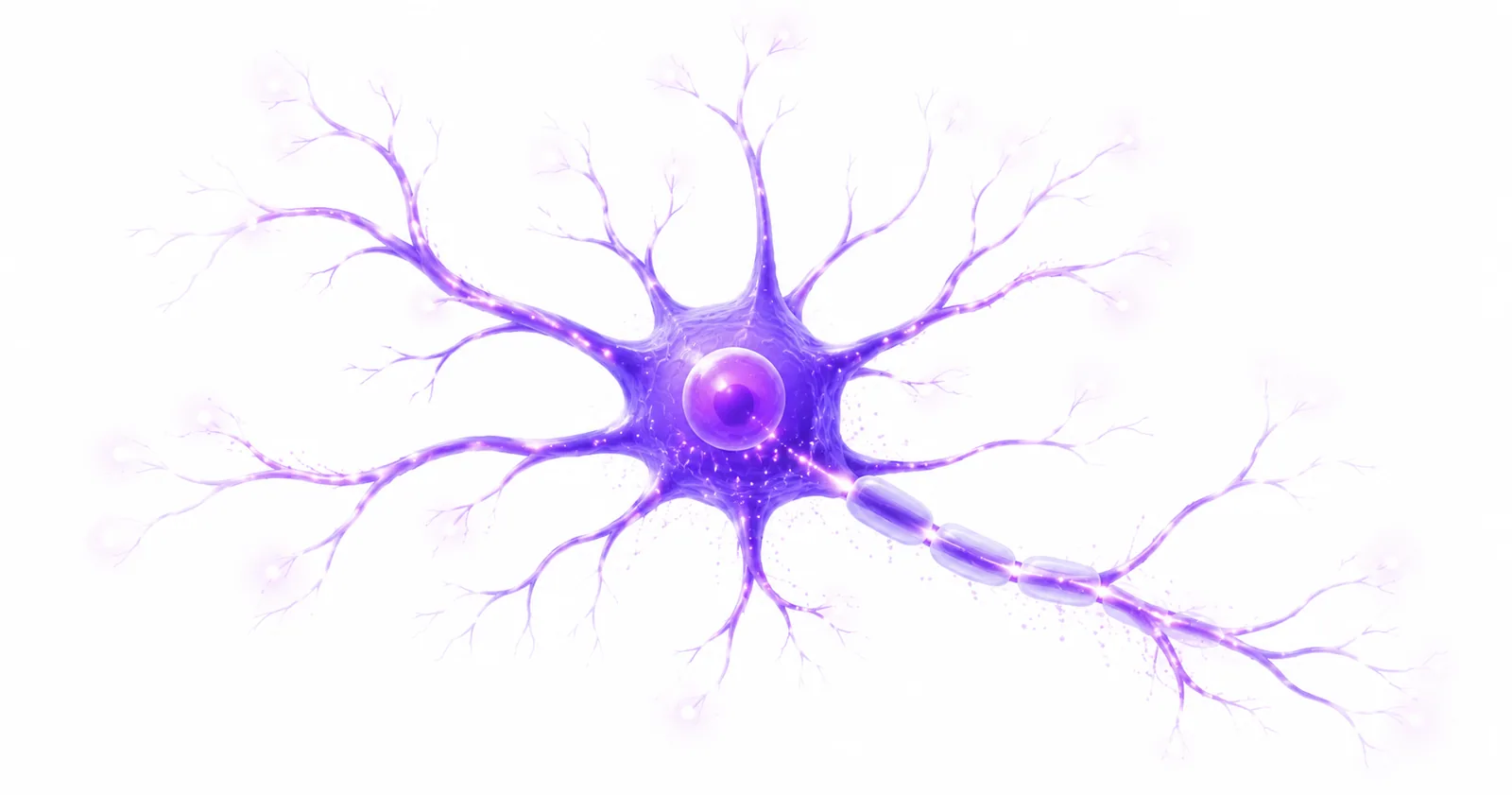
At the synaptic level, connections between neurons strengthen or weaken based on use. When two neurons fire together repeatedly, the synapse between them becomes more efficient. This is long-term potentiation (LTP), first described by Donald Hebb in 1949 with the principle “neurons that fire together, wire together.” It’s the primary mechanism behind learning and memory formation.
At the structural level, the brain physically changes shape. Grey matter density can increase in regions that are heavily used (London taxi drivers famously have larger hippocampi from years of navigating complex streets). White matter tracts, the nerve fibres connecting brain regions, can thicken with training. A 2026 NYU study confirmed that computerised cognitive exercises changed white matter structure in measurable ways. (We covered this in our post on what happens to your brain when you play memory games.)
At the biochemical level, the brain adjusts its neurotransmitter production based on demands. The 2025 McGill University study showed that 10 weeks of brain training increased acetylcholine production, the neurotransmitter most associated with memory and attention. This means training didn’t just make participants perform better. It changed their brain chemistry.
The Three Types of Brain Change
Not all neuroplastic change is the same. Understanding the three main types helps explain why some changes happen quickly while others take months.
1. Functional Plasticity
This is when the brain reroutes processing to different regions. If one area is damaged (through stroke, for example), neighbouring regions can gradually take over some of the lost functions. This is also what happens during learning: brain regions not originally involved in a task can be recruited to help as the task becomes more complex or familiar.
Functional plasticity is why stroke patients can sometimes recover abilities that seemed permanently lost. It’s also why blind individuals often develop enhanced hearing and touch. The brain redirects resources to the senses that are still available.
2. Structural Plasticity
This involves physical growth or change in brain tissue. New dendritic branches form. Existing connections thicken. Grey matter density increases in heavily used regions. The hippocampus can even generate entirely new neurons through neurogenesis, though the rate and extent of adult neurogenesis remains an active area of research.
Structural changes take longer than functional ones. They typically require weeks to months of consistent stimulation. This is why memory training research shows task-specific improvements at 2 to 4 weeks but structural brain changes at 8 to 12 weeks. (For the full timeline, see our post on how long it takes to improve your memory.)
3. Synaptic Plasticity
This is the most common and fastest form of neuroplastic change. Synapses (the gaps between neurons where signals are transmitted) can strengthen within minutes of repeated activation. Long-term potentiation can begin in a single training session, though lasting synaptic changes require repeated reinforcement over days and weeks.
Synaptic plasticity is what’s happening every time you learn something new, memorise a fact, or practise a skill. It’s the fastest type of neuroplastic change, but it’s also the most fragile. Without reinforcement, newly formed synaptic connections weaken rapidly. This is the biological basis of the forgetting curve. (More on this in our post on why you forget things so quickly.)
The “Use It or Lose It” Principle
Neuroplasticity works in both directions. The same mechanisms that strengthen pathways through use also weaken pathways through disuse. This is called synaptic pruning, and it’s your brain’s way of being efficient. Connections that are regularly activated get reinforced. Connections that aren’t used get cleared away to free up resources.
This has practical implications for anyone interested in brain training or memory improvement. The gains you build through regular practice can fade if you stop entirely. Like physical fitness, the improvements are maintained through ongoing use, not locked in permanently after a single training period.
The ACTIVE Trial’s 20-year follow-up illustrated this clearly: participants who received booster sessions years after their initial training retained more cognitive improvement than those who trained once and stopped. The initial training created the pathways. The boosters maintained them.
This is also why daily consistency matters more than occasional intensity. Walking the path every day keeps it clear. Walking it once a month lets the undergrowth creep back. (This principle is central to how Blanked’s streak system is designed, creating the habit loop that ensures daily reinforcement of visual memory pathways.)
Does Neuroplasticity Stop With Age?
No. This is one of the most persistent myths about the brain, and the science has thoroughly debunked it.
Neuroplasticity is more robust in childhood, when the brain is developing rapidly and forming its foundational architecture. This is why children learn languages and musical instruments with seemingly effortless speed. But plasticity doesn’t switch off at 25, despite the popular claim. It becomes more effort-dependent. Change is still possible at any age. It simply requires more deliberate, sustained practice.
A 2022 study published in Frontiers in Human Neuroscience found that 10 weeks of episodic memory training produced hippocampal volume increases in both young and older adults. The gains were comparable between age groups. Harvard research has confirmed that the hippocampus continues producing new neurons into old age, though the rate decreases. The ACTIVE Trial demonstrated meaningful cognitive improvements in adults aged 65 and older, with benefits lasting over a decade.
The practical takeaway: if you’re over 40 and wondering whether training your brain is “too late,” it isn’t. The pathways are harder to build than they were at 15, but they still form. And the cognitive reserve you build protects against age-related decline. (More on this in our post on memory and ageing.)
What Triggers Neuroplastic Change
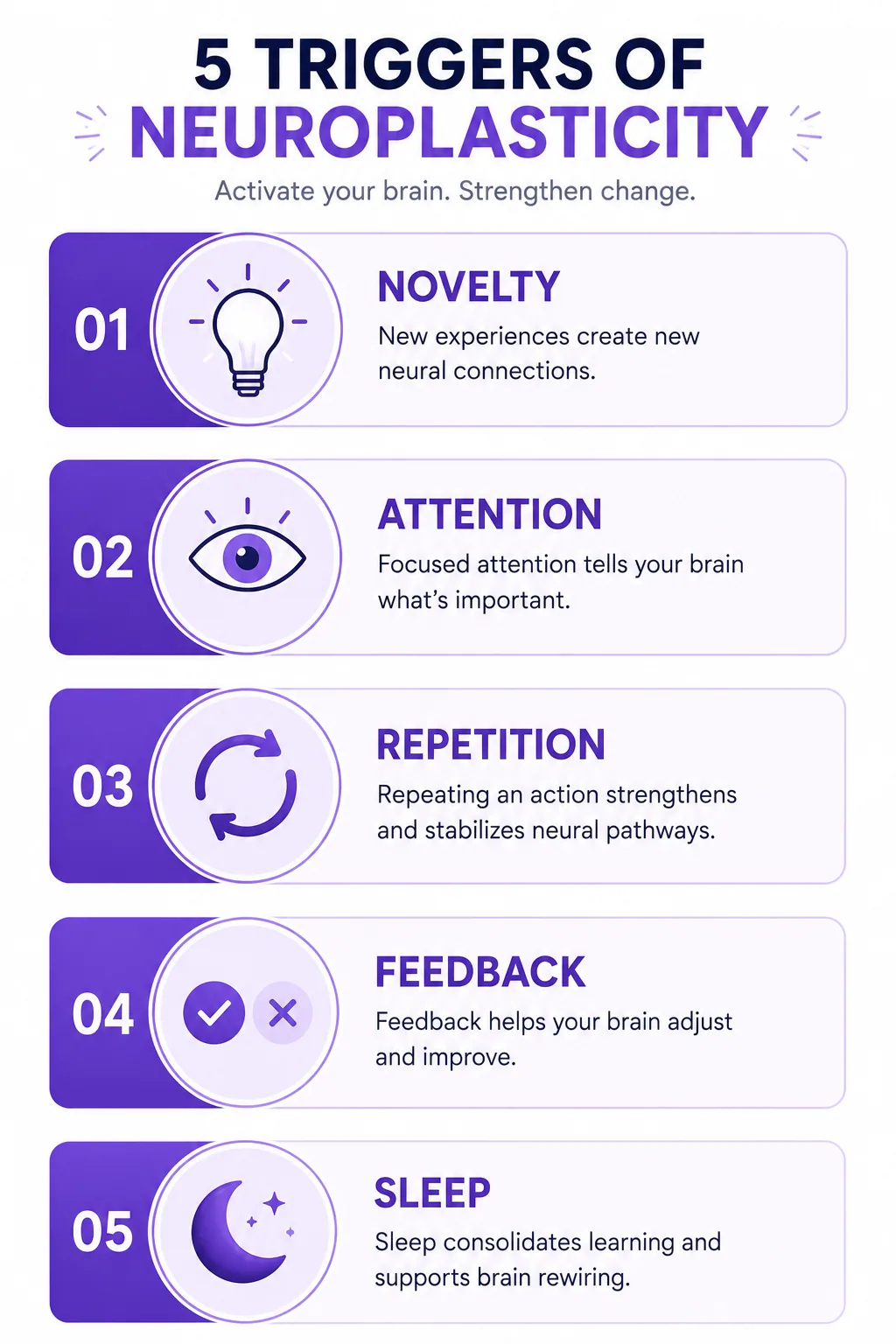
Not all activities trigger meaningful neuroplastic change. Your brain needs specific conditions to initiate the process:
Novelty. Your brain responds most strongly to new challenges. Repeating a task you’ve already mastered doesn’t stimulate significant plasticity. The task needs to be at the edge of your current ability, difficult enough to demand focused effort but not so hard that you disengage entirely.
Attention. Passive exposure to stimulation doesn’t produce plasticity. You need to be actively paying attention to the task. This is why passive activities like scrolling social media don’t strengthen neural pathways despite providing constant visual stimulation. The brain needs focused, directed attention to trigger LTP. (This is the attention-memory connection we explored in our post on how to improve concentration and focus.)
Repetition. One exposure is rarely enough. Synaptic connections need repeated activation to strengthen from fragile to durable. This is why spaced practice (short sessions repeated over days and weeks) outperforms massed practice (one long session). Each repetition reinforces the pathway.
Feedback. Your brain needs to know whether its predictions were correct. Getting an answer right strengthens the pathway. Getting it wrong triggers an error signal that adjusts future processing. Games and training tools that provide immediate feedback after each trial are leveraging this mechanism directly.
Sleep. The consolidation of new neural pathways happens primarily during deep sleep. Without adequate sleep, the synaptic changes initiated during waking practice don’t get locked in. Sleep is not optional for neuroplasticity. It’s where the construction work actually finishes. (Full breakdown in our post on how sleep affects your memory.)
The New Science: Dendritic Plasticity (2025)
The understanding of neuroplasticity is still evolving. A 2025 review published in Quanta Magazine described a recently characterised form of plasticity called behavioural timescale synaptic plasticity (BTSP), which operates through dendrites, the branching extensions of neurons that receive signals from other cells.
Unlike traditional Hebbian plasticity (which requires repeated co-activation over many trials), BTSP can create strong synaptic changes from a single experience. The research suggests that dendrites can fire their own electrical spikes and perform complex computations independently of the neuron’s cell body. This means individual neurons are capable of far more sophisticated processing than previously understood.
What does this mean practically? It’s still early-stage research, but it suggests that under the right conditions (high emotional salience, strong attentional focus, or significant novelty), your brain can form durable new connections faster than the traditional model predicted. This may help explain why some vivid experiences, like a frightening event or a profound insight, can produce lasting changes after a single occurrence while routine learning requires many repetitions.
How to Harness Neuroplasticity in Daily Life
Based on the five triggers above, here’s how to create the conditions for meaningful neuroplastic change:
1. Challenge your brain with novel, targeted tasks. Choose activities that are new and progressively difficult. Learning a musical instrument, studying a language, or training a specific cognitive skill like visual memory all qualify. The key is that the task must demand focused effort. If it feels easy, it’s not triggering plasticity. Visual memory training through Blanked is designed around this principle: adaptive difficulty ensures you’re always working at the edge of your current ability.
2. Keep sessions short and frequent. Two minutes daily beats thirty minutes weekly. Your brain responds to frequent reinforcement, not marathon sessions. The forgetting curve shows that neural pathways weaken fastest in the first 24 hours after formation. Daily practice catches them before they fade.
3. Pay attention on purpose. Passive exposure doesn’t work. When you’re training, eliminate distractions and give the task your full attention. The quality of your attention directly determines the strength of the synaptic change.
4. Protect your sleep. Sleep is when your brain consolidates the day’s neuroplastic changes into durable structural improvements. Seven to nine hours of quality sleep is not a luxury. It’s a prerequisite for effective training.
5. Combine cognitive training with physical exercise. Exercise increases BDNF production, which directly supports neuroplastic change by promoting neuron growth and survival. The combination of physical exercise and cognitive training consistently produces stronger neuroplastic outcomes than either approach alone. (For more strategies, see our full guide to brain exercises for adults.)
Neuroplasticity is real, powerful, and available at any age. But it’s not magic. It requires the right conditions: novelty, attention, repetition, feedback, and sleep. It’s not instantaneous. Meaningful structural changes take 8 to 12 weeks of consistent practice. And it’s not permanent without maintenance. Pathways you stop using gradually weaken.
The good news is that once you understand these principles, you can apply them to any cognitive skill you want to strengthen. And if you want to start with the simplest possible application, Blanked gives you a 2-minute daily session that hits all five triggers: novel visual challenges, focused attention required, daily repetition, immediate feedback, and adaptive difficulty. The forest path metaphor in action.
Frequently asked questions
What is neuroplasticity in simple terms?
Can you really rewire your brain?
Does neuroplasticity decrease with age?
How long does it take for neuroplastic changes to happen?
What activities trigger neuroplasticity?
Train your memory. Play Blanked free.
A free visual memory game built around how memory actually works. 6 game modes, 400+ levels.
Download on the App Store