How to Improve Focus and Concentration (2026)


On this page (13)
You sit down to work on something important. Within three minutes, you’ve checked your phone, opened a new browser tab, remembered you need to reply to an email, and lost the thread of what you were doing entirely. You weren’t being lazy. Your brain just defaulted to its path of least resistance.
If this sounds familiar, you’re not alone. The average adult’s sustained attention span has shortened measurably over the past two decades. A Microsoft study found that the average attention span dropped from 12 seconds in 2000 to 8 seconds by 2015. More recent research suggests the trend has continued, driven by the constant availability of digital stimulation.
But here’s what most “how to focus” articles get wrong: concentration isn’t a personality trait. It’s a cognitive skill. And like any cognitive skill, it can be trained. The neuroscience of attention is well understood, and the interventions that strengthen it are specific and evidence-based. This isn’t about willpower. It’s about understanding what your brain needs to sustain focus and giving it those conditions.
Why Focusing Is So Hard in 2026
Before we talk about solutions, it helps to understand why focus has become so difficult. The answer isn’t that your brain is broken. It’s that your environment has changed faster than your biology can adapt.
Constant interruptions. The average person checks their phone 96 times per day. Each check is an attention interruption. Research on task switching shows that every interruption costs 15 to 25 minutes of refocusing time, not because you’re slow, but because your prefrontal cortex has to reload the context of what you were doing. Over a full day, those interruptions consume hours of productive focus.
Dopamine conditioning. Social media, short-form video, and notification systems have conditioned your brain to expect frequent, small dopamine hits. When you sit down to do something that doesn’t deliver immediate rewards (deep work, studying, writing), your brain craves the stimulation it’s been trained to expect. That craving manifests as the urge to check your phone, switch tabs, or find something more immediately stimulating. (We covered this mechanism in detail in our post on how screen time affects your memory.)
Chronic stress and poor sleep. Cortisol, your primary stress hormone, directly impairs prefrontal cortex function. When you’re stressed, your brain shifts resources away from focused thinking and toward threat detection. This was useful when threats were physical. It’s counterproductive when the “threat” is an overflowing inbox. Sleep deprivation compounds this: even one night of poor sleep reduces sustained attention and working memory capacity the following day. (More on this in our post on how sleep affects your memory.)
Multitasking culture. Despite decades of research proving that multitasking reduces performance on every task involved, modern work culture still rewards the appearance of doing multiple things simultaneously. True multitasking is a myth. What your brain actually does is rapidly switch between tasks, paying a cognitive cost each time. The result is that nothing gets your full attention, and everything takes longer than it should.
What’s Actually Happening in Your Brain When You Focus
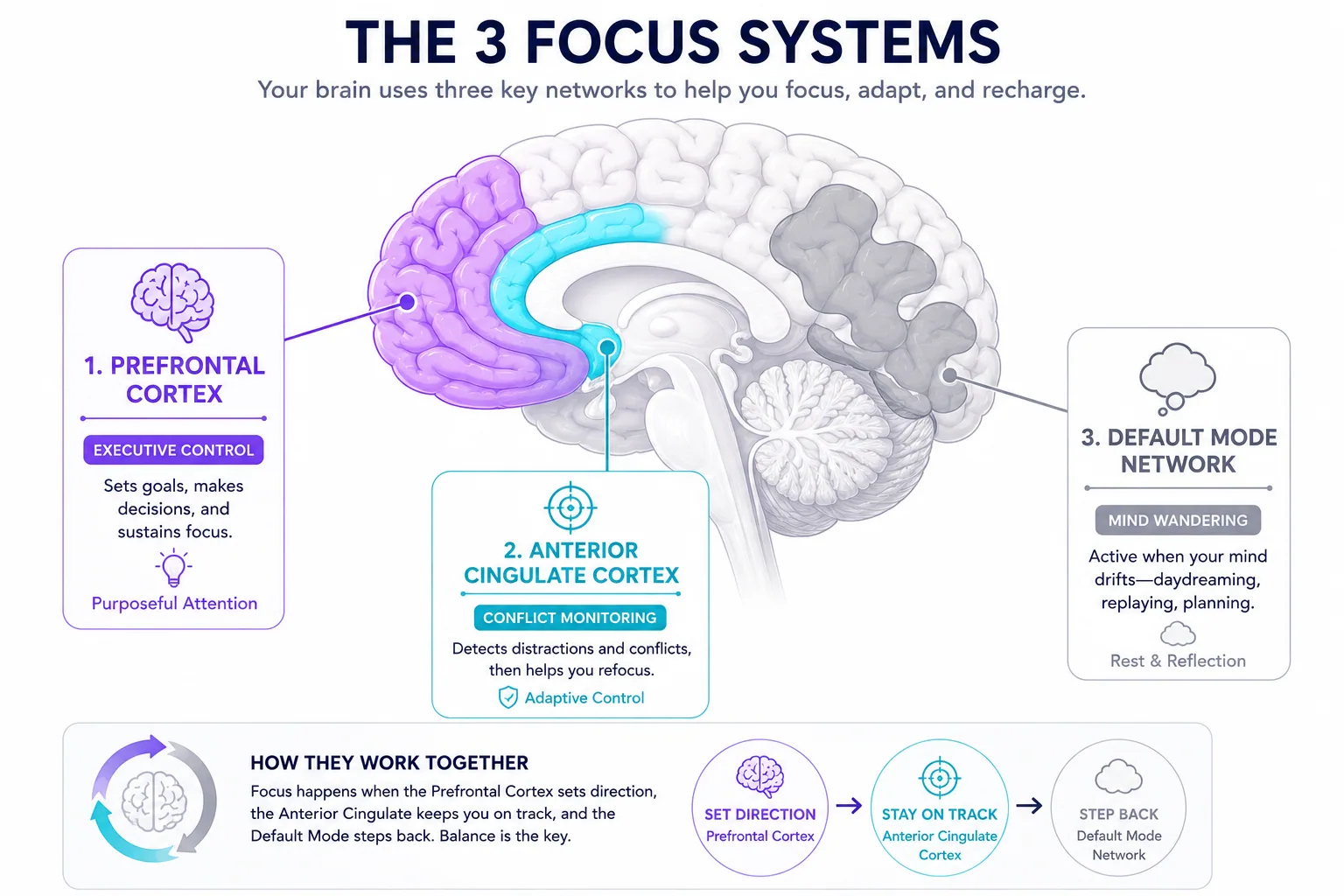
Concentration isn’t a single process. It’s a coordinated effort between several brain systems:
The prefrontal cortex is your brain’s executive controller. It manages what you pay attention to, suppresses irrelevant information, and keeps your working memory locked on the current task. When you’re deeply focused, the prefrontal cortex is highly active, filtering out distractions and directing cognitive resources toward the task at hand.
The anterior cingulate cortex (ACC) acts as a conflict monitor. It detects when competing stimuli are pulling your attention in different directions and signals the prefrontal cortex to intervene. A strong ACC means you’re better at noticing when you’re getting distracted, which is the first step to redirecting your focus.
The default mode network (DMN) is what activates when your mind wanders. It’s your brain’s autopilot, the system responsible for daydreaming, rumination, and internal chatter. When you’re focused, the DMN is suppressed. When you lose focus, the DMN takes over. The ability to quickly suppress the DMN and re-engage the prefrontal cortex is essentially what we mean by “good concentration.”
All three systems can be strengthened through targeted practice. Meditation strengthens ACC monitoring. Memory training strengthens prefrontal cortex engagement. Reducing passive screen time weakens the DMN’s grip. This is why focus is a trainable skill, not a fixed trait.
The Attention-Memory Connection Most People Miss
Here’s an insight that no other “how to focus” article covers: attention and memory are not separate systems. They’re deeply intertwined. Attention is the gateway to memory encoding. If you don’t pay attention to something, your brain never encodes it, which means you can’t remember it later.
This is why you “forget” where you put your keys. You didn’t forget. You never encoded the location because your attention was elsewhere when you set them down. The memory was never formed. (We explained this encoding failure mechanism in our post on why you forget things so quickly.)
The connection works in both directions. Training your attention improves your memory because better focus means better encoding. And training your memory improves your attention because memory exercises require sustained concentration to perform well. They’re a reinforcing loop.
This is one of the reasons visual memory training functions as attention training at the same time. When you play a game like Blanked, you have to focus intensely on a visual scene for a few seconds, hold the details in working memory, and then retrieve them. That sequence demands sustained, selective attention. You can’t perform the task while your mind wanders. The game itself is an attention workout disguised as a memory game.
8 Methods That Genuinely Improve Focus
1. Train Your Attention Through Memory Exercises
This is the method that ties focus directly to cognitive training. Memory exercises that require you to encode visual information, hold it in working memory, and recall it from scratch are inherently attention-intensive. You cannot let your mind wander during the encoding phase or the information is lost.
Research shows that working memory training strengthens the prefrontal cortex, the same region responsible for sustained attention. By training working memory, you’re simultaneously training the brain’s focus infrastructure. A 2-minute session of visual memory training in Blanked exercises sustained attention, selective attention, and working memory in a single sitting. (For the full neuroscience, see our post on what happens to your brain when you play memory games.)
How to start: One visual memory training session daily. Two minutes. The focus demands of the task do the work for you.
2. Practise Mindfulness Meditation
Meditation is the most researched attention training intervention in the literature. A 2023 review found that mindfulness-based therapy improved brain functional network reconfiguration efficiency, meaning the brain became better at switching from the default mode network (mind wandering) to the task-positive network (focused attention).
The Harvard 8-week study showed measurable increases in grey matter in the prefrontal cortex and hippocampus after daily meditation. The mechanism is simple: meditation involves repeatedly noticing when your attention has drifted and redirecting it. That noticing-and-redirecting cycle is literally attention training.
How to start: 10 minutes of breath-focused meditation daily. When your mind wanders, notice it and return to the breath. The wandering isn’t failure. The returning is the exercise.
3. Use Time Blocking (Not Multitasking)
Time blocking means dedicating specific chunks of time to specific tasks with no switching allowed. The Pomodoro Technique (25 minutes of focused work followed by a 5-minute break) is the most popular version, but any structured block works.
The reason time blocking works is that it eliminates the cognitive cost of task switching. Research shows that each time you switch tasks, your prefrontal cortex needs time to reload the new context. By staying on one task for a defined period, you avoid that cost entirely and allow your brain to enter a deeper state of focus.
How to start: Try one 25-minute focused block per day. Phone in another room. Notifications off. One task only. Build from there.
4. Reduce Passive Screen Time
Passive scrolling conditions your brain to expect constant novelty and instant gratification. This makes sustained attention on a single task harder because your brain has been trained to seek stimulation every few seconds.
The Penn State scoping review found that passive screen use was associated with declines in attention and executive function, while active screen use showed the opposite pattern. Reducing passive scrolling by even 30 minutes per day can produce noticeable improvements in sustained attention within weeks.
How to start: Track your screen time for a week. Identify your largest passive consumption block (usually social media). Replace 15 to 30 minutes of it with something active: a memory game, a book, a conversation. Your brain will resist at first. That resistance is the reconditioning happening.
5. Protect Your Sleep
Sleep deprivation is one of the fastest ways to destroy concentration. The prefrontal cortex, which manages sustained attention, is one of the brain regions most sensitive to sleep loss. Even one night of poor sleep (under 6 hours) measurably reduces attention span, working memory, and decision-making quality the following day.
Conversely, consistently good sleep (7 to 9 hours) restores prefrontal function and allows the brain’s attention systems to operate at full capacity. If you’re trying every focus technique on this list but sleeping badly, you’re building on a cracked foundation.
How to start: Set a consistent bedtime. Remove screens from the last hour before sleep. Aim for 7 to 9 hours. This single change often produces more noticeable focus improvements than all other techniques combined.
6. Exercise Regularly
Physical exercise increases blood flow to the prefrontal cortex and boosts production of BDNF, norepinephrine, and dopamine, all of which support sustained attention. A 2023 meta-analysis confirmed that regular moderate-intensity exercise improved cognitive function including attention and executive control in adults.
The timing matters. Research from Harvard suggests that exercising in the morning improves focus for the rest of the day. Even a 20-minute brisk walk before starting work can produce a measurable increase in attention and processing speed.
How to start: 20 minutes of brisk walking before your first focused work block of the day. No gym membership required.
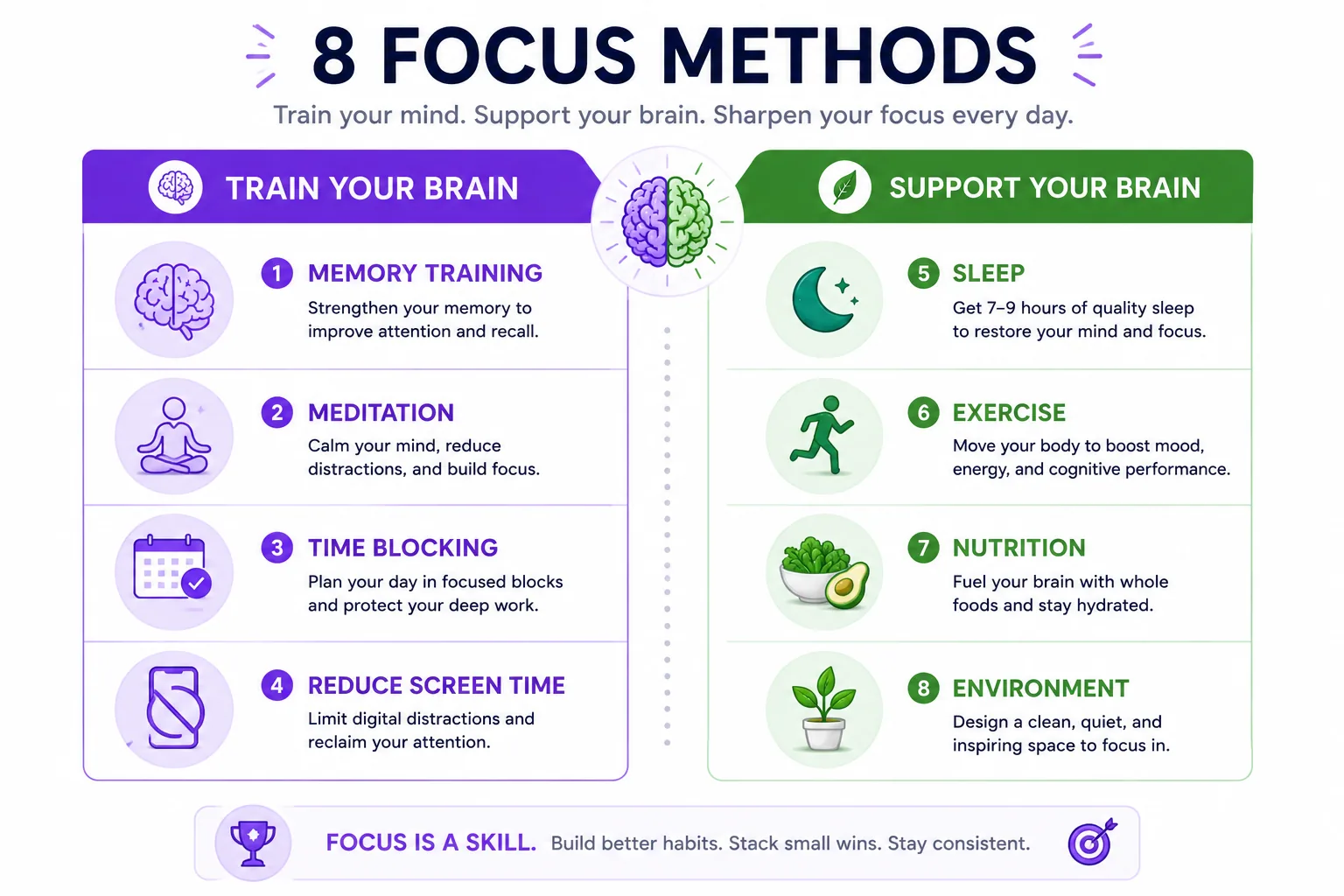
7. Eat for Focus
Blood sugar crashes destroy concentration. A breakfast high in refined carbohydrates gives you a spike of energy followed by a crash that leaves your prefrontal cortex struggling. Stable blood sugar, maintained through complex carbohydrates, healthy fats, and protein, keeps your brain’s energy supply consistent.
Specific nutrients support attention: omega-3 fatty acids (fatty fish, walnuts) maintain neuronal membrane function, choline (eggs) supports acetylcholine production for attention and learning, and antioxidants (berries, leafy greens) protect against neuroinflammation that impairs focus. (Full breakdown in our post on foods that boost memory.)
How to start: Swap refined carb breakfasts (toast, cereal, pastries) for protein and healthy fat (eggs, avocado, nuts, yoghurt). Notice how your mid-morning focus changes.
8. Design Your Environment for Focus
Your environment shapes your attention more than you realise. Research consistently shows that visual clutter increases cognitive load, even when you’re not consciously looking at it. Your brain is processing every object in your peripheral vision, which drains the attentional resources available for your actual task.
Noise is similarly impactful. A 2023 study found that music with lyrics interfered with cognitive tasks requiring attention. Silence or white noise/brown noise produced better focus outcomes. If you work in a noisy environment, noise-cancelling headphones with ambient sound are a simple, high-impact investment.
How to start: Clear your desk to the minimum needed for the current task. Put your phone in another room (not face-down on the desk, in another room). Try working with brown noise or lo-fi instrumental music instead of music with lyrics.
Building a Focus Routine That Compounds
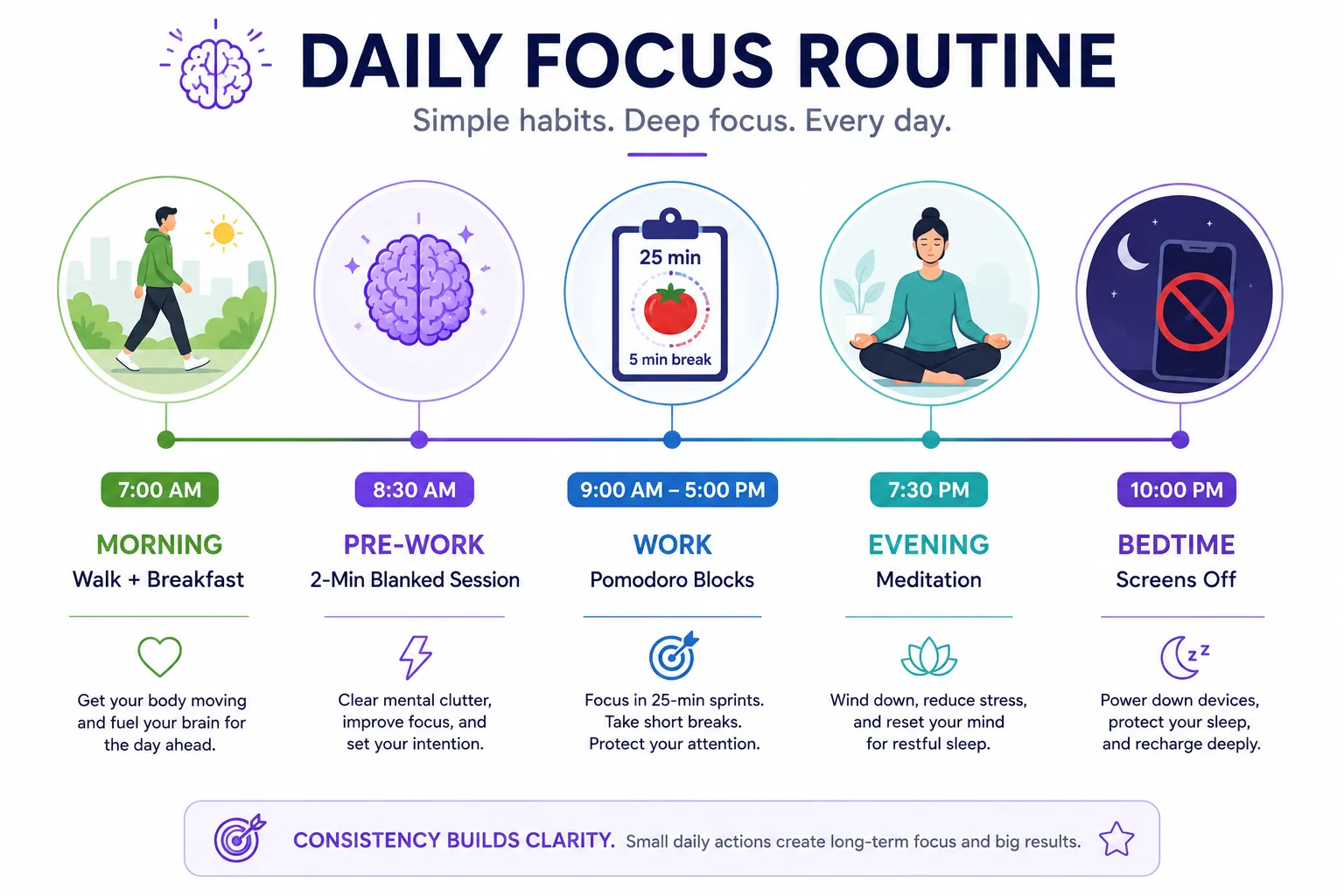
You don’t need all eight methods at once. But combining a few creates a compounding effect where each one amplifies the others. Here’s a practical stack:
Morning: 20-minute walk + protein-based breakfast. Primes your prefrontal cortex with blood flow, BDNF, and stable energy.
Before your first work block: 2-minute Blanked session. Warms up your attention and working memory systems.
During work: 25-minute Pomodoro blocks. Phone in another room. Brown noise or silence. One task per block.
Evening: 10-minute meditation. Trains the noticing-and-redirecting cycle that strengthens sustained attention over time.
Bedtime: Screens off one hour before sleep. 7 to 9 hours. Non-negotiable.
This routine takes roughly 35 to 40 minutes of dedicated time (the walk, the Blanked session, and the meditation) and restructures the rest of your day around focus-supporting habits. Within 2 to 4 weeks of consistent practice, you should notice measurably improved concentration. Within 8 to 12 weeks, the neural changes that support sustained attention become structural. (For the full improvement timeline, see our post on how long it takes to improve your memory.)
Focus isn’t something you either have or don’t. It’s a skill built on specific neural systems that respond to training. The prefrontal cortex gets stronger when you challenge it. The default mode network gets weaker when you practise overriding it. The attention-memory loop reinforces itself with every session.
Start with the smallest step: one 2-minute Blanked session tomorrow morning, followed by one 25-minute focused work block with your phone in another room. That’s it. Everything else builds from there.
Frequently asked questions
Why can’t I concentrate anymore?
How long does it take to improve concentration?
Does meditation actually help with focus?
Can memory games improve concentration?
Is poor concentration a sign of ADHD?
Train your memory. Play Blanked free.
A free visual memory game built around how memory actually works. 6 game modes, 400+ levels.
Download on the App Store