How Your Phone Is Replacing Your Memory (2026)


On this page (16)
Quick: what is your best friend’s phone number? What about your partner’s? Your mum’s? Twenty years ago, you knew a dozen phone numbers by heart. Now you probably do not know more than two.
This is not because your memory got worse. It is because your phone made remembering unnecessary. Your brain, being ruthlessly efficient, stopped encoding information it knew was stored somewhere else. Why memorise a number when it is in your contacts? Why remember directions when GPS will guide you? Why recall what someone said in a meeting when you recorded it?
This process has a name. It is called cognitive offloading, and the research on what it does to your memory is both fascinating and slightly alarming.
The Experiment That Changed Everything
In 2011, psychologist Betsy Sparrow and her colleagues at Columbia University published a study in Science that introduced the world to what is now called the Google Effect. The experiment was elegantly simple.
Participants were given trivia statements to read. Half were told the statements would be saved on a computer for later access. Half were told the statements would be deleted. When tested on recall, the group who believed the information would be saved remembered significantly less than the group who believed it would be deleted.
But here is the twist: the group who believed the information was saved were better at remembering where it was saved. They did not store the fact. They stored the location of the fact.
Your brain, it turns out, treats Google and your phone the way it used to treat a knowledgeable friend. In cognitive psychology, this is called transactive memory: a system where you remember not the information itself, but who or what has the information. Before the internet, you might remember that your colleague Sarah knows a lot about tax law, so you would go to her when you needed tax information rather than learning it yourself. Now, your brain does the same thing with your phone. It stores the meta-information ("Google has this") and discards the actual information.
What Is Cognitive Offloading?
Cognitive offloading is the act of reducing the mental processing demands of a task by using an external tool. Writing a shopping list is cognitive offloading. Setting a calendar reminder is cognitive offloading. Taking a photo of a parking sign so you remember the restriction is cognitive offloading.
In moderation, cognitive offloading is genuinely useful. Your working memory has a capacity of roughly 3 to 5 items. Offloading routine information to external tools frees up that limited capacity for higher-order thinking. This is why writing things down can improve your performance on complex tasks: it clears working memory space.
The problem is not offloading itself. The problem is what happens when offloading becomes the default for everything. When your brain learns that it does not need to encode information because an external device will always be available, it stops trying. The encoding system that would normally process and store that information gradually weakens from disuse. A 2025 review in Frontiers in Psychology described this as "substitutive offloading" where technology does not just assist cognition but replaces it, leading to measurable changes in memory encoding, problem-solving strategies, and even goal formation.
The 4 Ways Your Phone Replaces Your Memory
1. Factual Knowledge (The Google Effect)
When you know you can Google something in 3 seconds, your brain deprioritises encoding it. Why store the capital of Mozambique when Google is faster than your hippocampus? This is rational in isolation, but the cumulative effect is a gradual erosion of your general knowledge base.
The meta-analysis of Google Effect studies found that the phenomenon is stronger on mobile phones than on computers (because phones are always with you, making the information feel even more permanently accessible) and that people with larger existing knowledge bases are less susceptible. The more you already know, the better your brain is at encoding new information, because it has more existing connections to hook new facts onto. The less you know (because you have been offloading for years), the harder encoding becomes. It is a self-reinforcing cycle.
2. Spatial Navigation (The GPS Effect)
GPS navigation has fundamentally changed how your brain processes spatial information. When you follow turn-by-turn directions, you are not building a mental map. You are following instructions. Your hippocampus, which is responsible for spatial memory and mental map construction, is essentially idle during GPS-guided navigation.
A striking 2024 population-based study found that taxi drivers and ambulance drivers, who navigate actively and frequently, had the lowest rates of Alzheimer’s-related deaths among all occupational groups. This is consistent with the famous London taxi driver studies showing that years of active navigation physically enlarged the posterior hippocampus. The implication is concerning: if active navigation protects the hippocampus, passive GPS-following may be removing a form of daily cognitive exercise that your brain needs.
3. Social Memory (The Contacts Effect)
Your phone stores every phone number, birthday, address, and anniversary. You no longer need to remember any of them. This is convenient, but it eliminates one of the most natural forms of daily memory exercise: the social recall that used to happen dozens of times per day.
Twenty years ago, calling a friend required retrieving their number from memory. Now it requires tapping a name. The retrieval step, which is the most powerful memory-strengthening mechanism available, has been completely eliminated. Your brain no longer practises the recall of social information because the phone does it for you.
4. Experiential Memory (The Photo Effect)
This is the most counterintuitive finding in the cognitive offloading research. Taking photos of an experience reduces your memory of that experience.
In a landmark 2014 study by Henkel, participants toured a museum. They were asked to photograph some objects and simply observe others. The next day, the photographed objects were remembered with significantly less detail than the observed ones. This was called the photo-taking impairment effect, and it has been replicated across multiple studies.
The mechanism is the same as the Google Effect: when your brain knows the photo will preserve the visual information, it reduces encoding effort. You are outsourcing the memory to the camera, and your brain responds by storing less. The irony is sharp: you take the photo to remember the moment, and the act of taking it makes you more likely to forget it.
Subsequent research found that the effect persists even when participants do not expect to have access to the photos later, suggesting that the act of photographing itself disrupts the encoding process by diverting attention from the experience to the device.
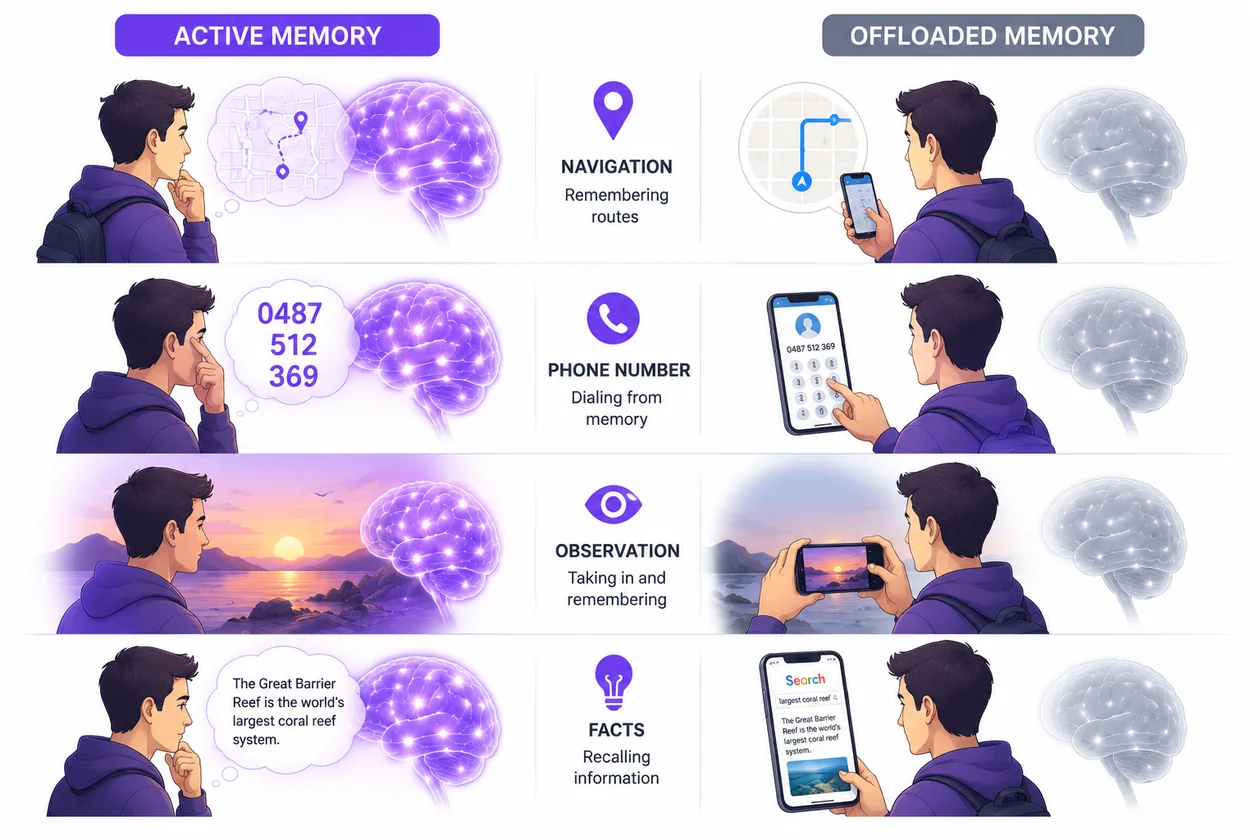
The Hidden Cost: Use It or Lose It
The phrase "use it or lose it" applies directly here. Your brain allocates resources based on demand. Neural pathways that are frequently activated get strengthened through neuroplasticity. Pathways that are rarely activated get weakened and eventually pruned.
When you stop encoding phone numbers, your phonological memory system gets less exercise. When you stop navigating mentally, your spatial memory circuits weaken. When you stop observing experiences carefully (because the camera will capture them), your visual encoding system gets less practice.
The concern is not that any single act of offloading is harmful. It is that the cumulative, habitual, default-mode offloading of memory across every domain of daily life may be gradually weakening the cognitive systems that encode, store, and retrieve information. You are not just outsourcing individual memories. You may be reducing the capacity of the memory system itself.
This is not proven beyond doubt. The long-term effects of widespread cognitive offloading are still being studied. But the direction of the evidence is consistent: heavy offloaders show poorer performance on memory tasks, reduced encoding effort, and weaker internal memory strategies compared to light offloaders.
The Photo Paradox
The photo-taking impairment effect deserves special attention because it contradicts what most people believe about photography and memory.
The standard assumption is: "I take photos so I can remember." The research says: "Taking photos makes you remember less."
However, the research also reveals an important nuance. Reviewing photos later can reactivate memories that would otherwise have been lost. The photo itself is not the problem. The problem is the encoding disruption at the moment of capture. If you take a photo and later revisit it deliberately, the photo becomes a retrieval cue that can trigger associated memories.
The optimal approach, based on the research, is not to stop taking photos. It is to observe first, then photograph. Spend 10 seconds actually looking at the scene, encoding its visual details, its colours, its spatial layout, its emotional significance. Then take the photo. This way, you get both: a strong internal memory from deliberate observation and an external backup from the photo.
This deliberate observation step is exactly the skill that visual memory training strengthens. When you train yourself to encode visual scenes quickly and accurately (as you do in every Blanked session), you build the habit of actually looking at things rather than immediately reaching for the camera. The stronger your visual encoding skill, the more you get from every experience, photographed or not.
How to Take Your Memory Back
The goal is not to throw your phone away. The goal is to be intentional about what you offload and what you encode internally. Here are the strategies that the research supports:
1. Choose What Deserves Internal Storage
Some information genuinely belongs on your phone: meeting times, shopping lists, one-time reference numbers. Other information benefits from internal encoding: directions to places you visit regularly, phone numbers of people you care about, facts relevant to your work and interests. Be deliberate about which category each piece of information falls into.
2. Navigate Without GPS Once a Week
Pick one regular journey and learn the route from memory. Study the map before you leave. Pay attention to landmarks. Build the mental map. This single habit exercises your hippocampal spatial memory system in a way that GPS-following never does.
3. Observe Before You Photograph
When you encounter something you want to remember, spend 10 seconds deliberately encoding it before reaching for your camera. Notice the visual details, the spatial layout, the colours, the emotional quality. Then take the photo. You get the internal memory and the external backup.
4. Recall Before You Search
When you need to remember something, try to retrieve it from memory before opening Google. Even if you fail (and you often will at first), the retrieval attempt itself strengthens the memory pathway. Over time, you will find that more information is available in your internal memory than you expected. (This is the same active recall principle that makes studying effective. See our post on why you forget things so quickly for the encoding science behind this.)
5. Train the System Itself
Cognitive offloading weakens the encoding system through disuse. Targeted memory training strengthens it through focused exercise. Two minutes of daily visual memory training with Blanked directly exercises the encode-store-retrieve cycle that offloading bypasses. You study a visual scene, the scene vanishes, and you recall details from memory. No external device to fall back on. No option to offload. Pure internal memory, exercised daily.
This is what makes memory training uniquely valuable in the age of cognitive offloading. It is the one app on your phone that makes your memory stronger rather than weaker. Every other app replaces a cognitive function. Blanked exercises one.
6. Protect Your Focus During Experiences
The biggest memory cost of your phone is not the offloading. It is the attention fragmentation. Every time you check your phone during an experience (a conversation, a meal, a walk, a lecture), you disrupt the sustained attention that encoding requires. Keeping your phone out of sight during experiences you want to remember is the single highest-leverage intervention.
Your phone is an extraordinary tool. It has given you instant access to the sum of human knowledge, effortless navigation of any city on earth, and a camera that captures moments in millisecond precision. But every capability it gained, your internal memory systems lost a reason to practise.
The fix is not to reject the tool. It is to recognise the trade-off and consciously exercise the cognitive systems that the tool is replacing. Remember some things on purpose. Navigate some routes from memory. Observe before you photograph. Recall before you search. And give your visual memory system the 2 minutes of daily exercise it needs to stay sharp in a world that is constantly trying to make it redundant.
Frequently asked questions
Are smartphones making us forgetful?
What is the Google Effect?
Does taking photos reduce memory?
Is cognitive offloading bad?
Can you reverse the effects of cognitive offloading?
Train your memory. Play Blanked free.
A free visual memory game built around how memory actually works. 6 game modes, 400+ levels.
Download on the App Store