What Happens When You Stop Training Your Memory? (2026)

On this page (7)
You have been training your memory for three weeks. Your scores are improving. You feel sharper. Then life happens. A busy week at work, a holiday, a stretch where you just do not feel like opening the app. Two weeks pass. Three. A month.
What has happened to the progress you made? Did those neural pathways you strengthened just vanish? Is your brain back to where it started? Or did you lock in some permanent gains that survive a break?
The answer is more nuanced than "use it or lose it" suggests. Some benefits fade. Some stick around for years. And the difference between the two comes down to how long you trained, how consistently you showed up, and whether you ever came back for what researchers call booster sessions.
The Short Answer
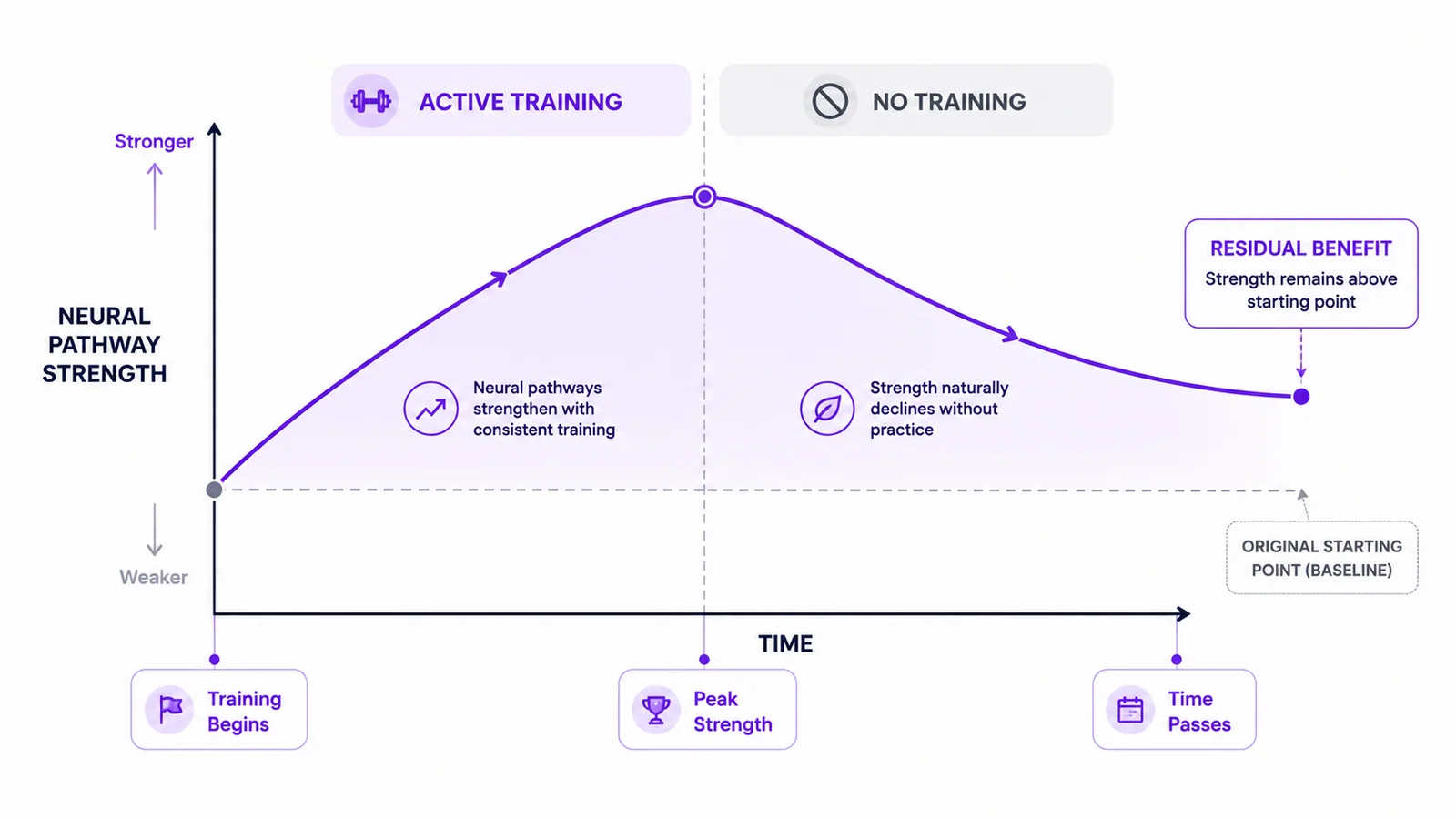
When you stop training your memory, task-specific performance begins to decline within 2 to 4 weeks. The speed improvements fade first. The accuracy improvements last longer. And the structural brain changes (if you trained long enough to produce them) can persist for months or even years, though they gradually weaken without maintenance.
But here is the important part: restarting training after a break produces faster gains than starting from scratch. Your brain retains a residual benefit even after the measurable performance improvements have faded. The neural pathways you built are weakened, not destroyed. Reactivating them is faster than building them for the first time.
What “Use It or Lose It” Actually Means
The phrase "use it or lose it" is the most common way people describe the relationship between mental activity and cognitive health. It is also slightly misleading, because it implies a binary: either you are using your brain and keeping it, or you are not and losing it. The reality is a gradient.
Your brain is constantly remodelling itself through a process called neuroplasticity. Every skill you practise strengthens the neural connections involved in that skill. Every skill you neglect sees those connections gradually weaken. This is not a switch that flips. It is a dial that turns slowly in one direction or the other.
The biological mechanism is called synaptic pruning. Your brain allocates resources efficiently. Connections that are frequently activated get strengthened (through long-term potentiation). Connections that are rarely activated get weakened and eventually pruned (through long-term depression). This is not your brain punishing you for stopping. It is your brain reallocating resources toward whatever you are currently doing instead.
This means "use it or lose it" should really be "use it and strengthen it, stop using it and slowly weaken it." The rate of weakening depends on how strong the connections were in the first place, which brings us to the most important study in this entire field.
The ACTIVE Trial: 20 Years of Evidence
The Advanced Cognitive Training for Independent and Vital Elderly (ACTIVE) study is the largest and longest-running clinical trial on cognitive training ever conducted. It began in 1998 with 2,832 adults aged 65 and older, and the latest results, published in February 2026, track outcomes over 20 years.
The study is uniquely valuable for understanding what happens when you stop training, because most participants received only 10 sessions of training over 5 to 6 weeks and then stopped. Some received booster sessions at 11 months and 35 months. The rest received no further training at all.
Here is what happened:
At 5 years: All three training groups (memory, reasoning, and speed-of-processing) retained measurable benefits compared to the control group. The improvements had faded somewhat from the immediate post-training peak, but they were still statistically significant. Participants had not trained for nearly 5 years, yet their brains had held onto a meaningful portion of the gains.
At 10 years: Reasoning and speed-of-processing training maintained their effects on targeted cognitive abilities a full decade after the original 5 to 6 weeks of training. Reasoning showed an effect size of 0.23 and speed-of-processing showed an effect size of 0.66. All three groups reported less difficulty with everyday tasks like managing finances, preparing meals, and following medication schedules.
At 20 years: The February 2026 follow-up found that participants who received speed-of-processing training with booster sessions were 25% less likely to be diagnosed with dementia compared to the control group. This is one of the first results from a large randomised trial to demonstrate that any intervention can reduce long-term dementia incidence. (Full evidence overview in our post on whether brain training works.)
The takeaway is striking: just 10 to 18 sessions of training (initial sessions plus boosters) produced measurable benefits that lasted decades. But there is an important nuance buried in the data.
How Quickly Do Benefits Fade?
The ACTIVE Trial shows that some benefits persist for years. But it also shows that the benefits are strongest immediately after training and decline over time without maintenance. Understanding the timeline of that decline helps you make better decisions about your own training.
Week 1 to 2 after stopping: Task-specific performance begins to decline. The speed improvements you built fade first, because processing speed is highly sensitive to recency of practice. If you were getting faster at visual memory tasks, you will notice your reaction times slowing within the first two weeks.
Week 3 to 6 after stopping: Accuracy on trained tasks starts declining. The encode-store-retrieve cycle that felt effortless at the peak of your training streak starts requiring more effort. You can still do it, but it takes more concentration than it did when you were practising daily.
Month 2 to 6 after stopping: Performance continues to decline but at a slower rate. The steepest drop happens in the first month. After that, the decline curve flattens. This is because the surface-level performance gains (speed, fluency) fade quickly, but the deeper structural changes (synaptic strengthening, neural efficiency) erode much more slowly.
Month 6 and beyond: If you trained consistently for several weeks or months, a residual benefit remains even after 6 months of no training. The ACTIVE Trial participants who received just 10 sessions still showed benefits 5 years later. The benefits were smaller than immediately after training, but they were real and measurable.
The critical variable is how long and how consistently you trained before stopping. A 3-day training stint will leave almost no residual benefit. A 3-month daily training habit will leave a foundation that takes months to fully erode. This is why consistency matters more than session length.
Why Stopping Feels Fine (At First)
One of the reasons people stop training is that the decline is not immediately obvious. You do not wake up the day after missing a session and feel noticeably worse. The erosion is gradual and subtle, which makes it easy to rationalise.
This is similar to physical fitness. If you stop going to the gym for a week, you do not suddenly feel weaker. You might even feel refreshed from the rest. But over weeks and months, the strength and endurance you built quietly fade. By the time you notice the decline, you have already lost a significant portion of your gains.
Memory works the same way. The first thing to go is processing speed: you get slightly slower at encoding and retrieving visual information, but you do not notice because you are not measuring it. The second thing to go is the automatic fluency you had at peak training: tasks that felt effortless start requiring conscious effort, but since you are not doing them, you do not notice that either.
The decline only becomes obvious when you try to use the skill in daily life. You forget where you put something. You cannot recall a face you saw yesterday. You lose track of visual details you would have caught easily a month ago. These moments feel like random lapses, but they are the cumulative result of neural pathways that are no longer being maintained. (For more on why these everyday memory failures happen, see our post on why you forget things so quickly.)
The Booster Effect: Why Maintenance Beats Marathons
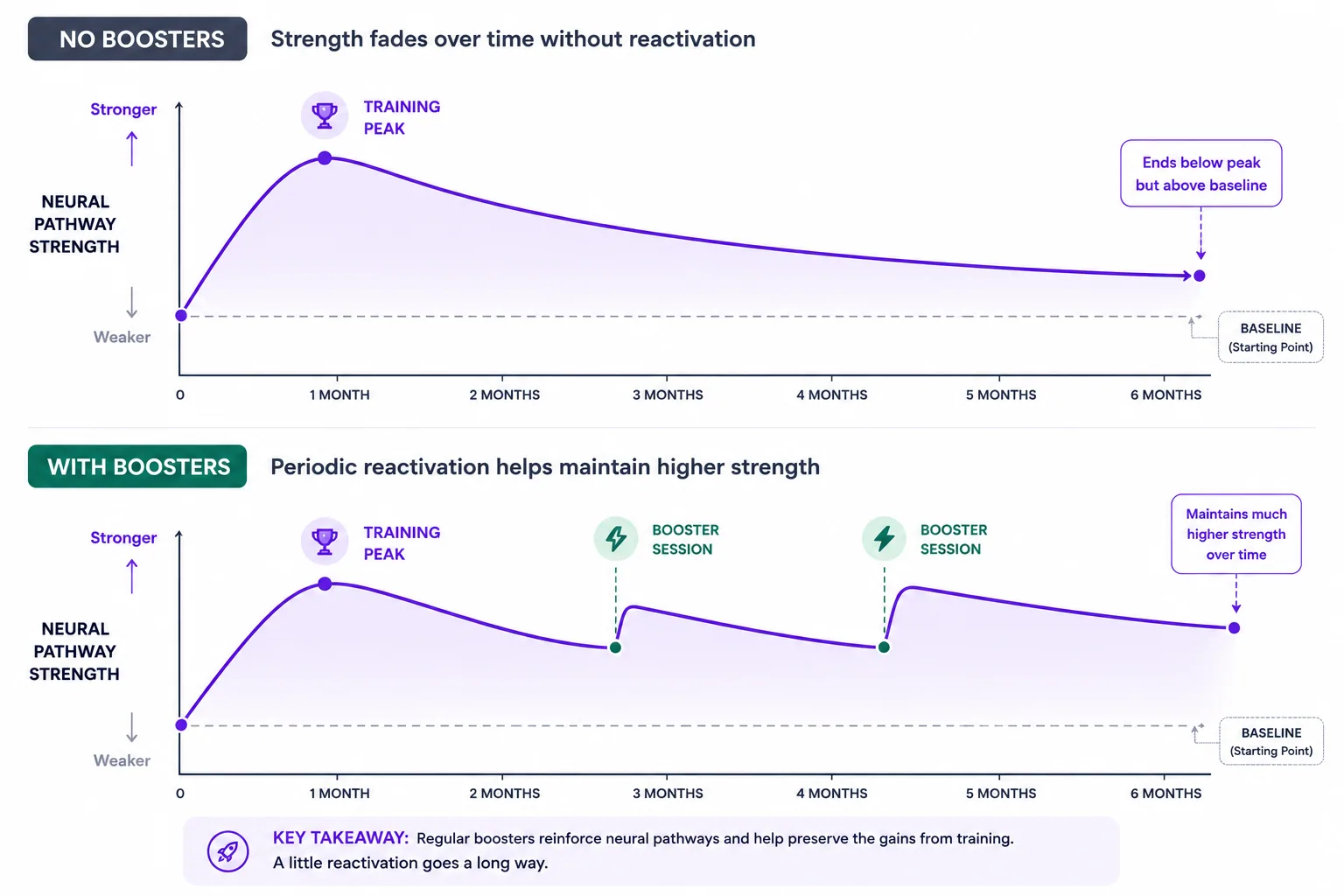
The most actionable finding from the ACTIVE Trial is the power of booster sessions. Participants who received booster training (4 sessions at 11 months and 4 sessions at 35 months after the initial training) showed significantly stronger long-term benefits than those who only received the initial 10 sessions.
The speed-of-processing group with boosters showed a 25% reduction in dementia risk over 20 years. Without boosters, the benefits were smaller. The boosters did not need to be extensive: just four 75-minute sessions each time. But they caught the declining neural pathways before they fully eroded and restrengthened them.
This has a direct practical implication: you do not need to train every single day forever to maintain benefits. But you do need to come back.
Think of it as maintenance versus construction. Building a neural pathway requires consistent daily effort (the construction phase). Maintaining a neural pathway requires periodic reactivation (the maintenance phase). The construction phase is where daily training matters most, and it is why streaks are so powerful for building the initial habit. The maintenance phase is where even occasional training can preserve a large portion of your gains.
The research suggests that the optimal approach is:
- Phase 1 (weeks 1 to 8): Daily training to build the neural pathways. This is the construction phase. Consistency is critical here.
- Phase 2 (ongoing): Regular training (daily is ideal, but even 3 to 4 times per week) to maintain and continue strengthening those pathways.
- If you miss time: Come back as soon as you can. A booster period of daily training for 1 to 2 weeks can reactivate pathways that have started to weaken. The longer you wait, the more rebuilding is required.
What This Means for Your Daily Training
If you are currently on a training streak, the research gives you two reasons to keep going:
1. Every day you train, you are deepening the neural pathways that produce the benefits. The longer and more consistently you train, the more durable those pathways become, and the slower they will fade if you ever do stop. A 60-day streak builds more resilient pathways than a 10-day streak. This is not just motivational talk. It is the biology of long-term potentiation and neuroplastic change.
2. If you miss a day or even a week, the damage is not catastrophic. Your gains do not vanish overnight. But the longer the gap, the more erosion occurs. The best thing you can do after missing time is start again immediately rather than waiting for a "fresh start" on Monday or next month. Every day you wait is another day of synaptic weakening.
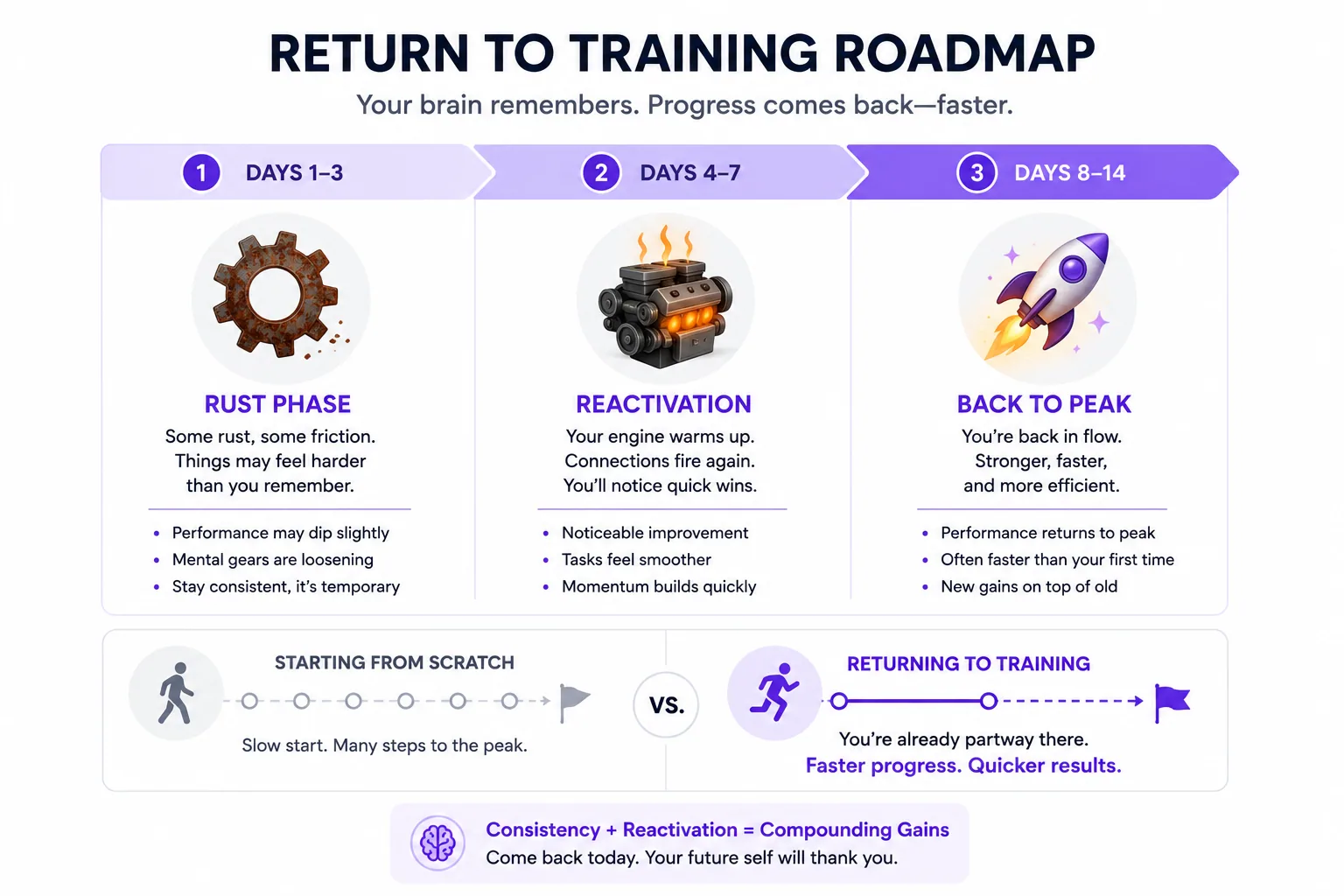
If you have been away from training for a while, here is what to expect when you come back:
- Days 1 to 3: You will feel rusty. Scores will be lower than your peak. This is normal. The pathways are still there, just weakened.
- Days 4 to 7: The rust starts to clear. You will notice your speed and accuracy returning faster than they did when you first started. This is the residual benefit at work: reactivation is faster than initial construction.
- Days 8 to 14: Most people are back to near their previous level within two weeks of consistent daily training. From there, continued training pushes you beyond your old peak.
This is why Blanked’s streak system includes streak shields. Missing one day should not cost you the motivational momentum of a 30-day streak. The shield protects your streak while you get back on track, because the research is clear: the most damaging thing is not missing a day. It is letting one missed day turn into a month.
Your memory is not a fixed trait. It is a living system that responds to what you do with it. Train it and it gets stronger. Stop training and it gradually weakens. Come back and it rebuilds faster than the first time.
The ACTIVE Trial proves that even modest training can produce benefits lasting decades, if you maintain the habit. The McGill acetylcholine study shows that 10 weeks of training can reverse age-related brain chemical changes. The neuroscience is clear: your brain rewards consistency.
If you are reading this and your Blanked streak is still intact, keep going. You are building something durable. If your streak has broken, open the app right now. Two minutes. One session. The pathways are waiting to be reactivated. Blink misses you.
Frequently asked questions
Do brain training benefits last after you stop?
How quickly do you lose memory training gains?
Can you regain lost memory training benefits?
How often do you need to train to maintain benefits?
Is it better to train every day or do longer sessions less often?
Train your memory. Play Blanked free.
A free visual memory game built around how memory actually works. 6 game modes, 400+ levels.
Download on the App Store