How Exercise Improves Your Memory (The Research) 2026

On this page (12)
If a pharmaceutical company developed a drug that grew the hippocampus by 2%, reversed age-related brain shrinkage by 1 to 2 years, reduced dementia risk, lowered cortisol, improved sleep quality, and enhanced memory encoding, it would be the most prescribed medication in history.
That drug already exists. It is exercise. And it is free.
The relationship between physical activity and memory is one of the most well-established findings in cognitive neuroscience. It is not speculative. It is not correlational guesswork. Randomised controlled trials have demonstrated that aerobic exercise physically increases the size of the brain structure responsible for memory formation, and the biological mechanisms are understood at the molecular level.
This post covers what happens in your brain when you exercise, which types of exercise produce the strongest memory benefits, how much you actually need, and how exercise interacts with cognitive training to produce better results than either alone.
BDNF: The Molecule That Connects Exercise to Memory
The primary mechanism linking exercise to memory improvement is a protein called brain-derived neurotrophic factor, or BDNF. Sometimes called "Miracle-Gro for the brain" in neuroscience literature, BDNF plays a central role in the survival, growth, and maintenance of neurons.
Here is what BDNF does:
- Promotes neurogenesis. BDNF stimulates the birth of new neurons in the dentate gyrus of the hippocampus, one of only two brain regions where new neurons are produced throughout adult life.
- Strengthens synapses. BDNF enhances long-term potentiation (LTP), the process by which repeated neural firing strengthens connections between neurons. This is the cellular mechanism behind learning and memory formation.
- Supports neuronal survival. BDNF helps existing neurons resist damage and maintain their connections. This is particularly important in the context of ageing, when neuronal loss accelerates.
- Enhances synaptic plasticity. BDNF increases the brain’s capacity for neuroplastic change, making it easier to form new connections and adapt to new information.
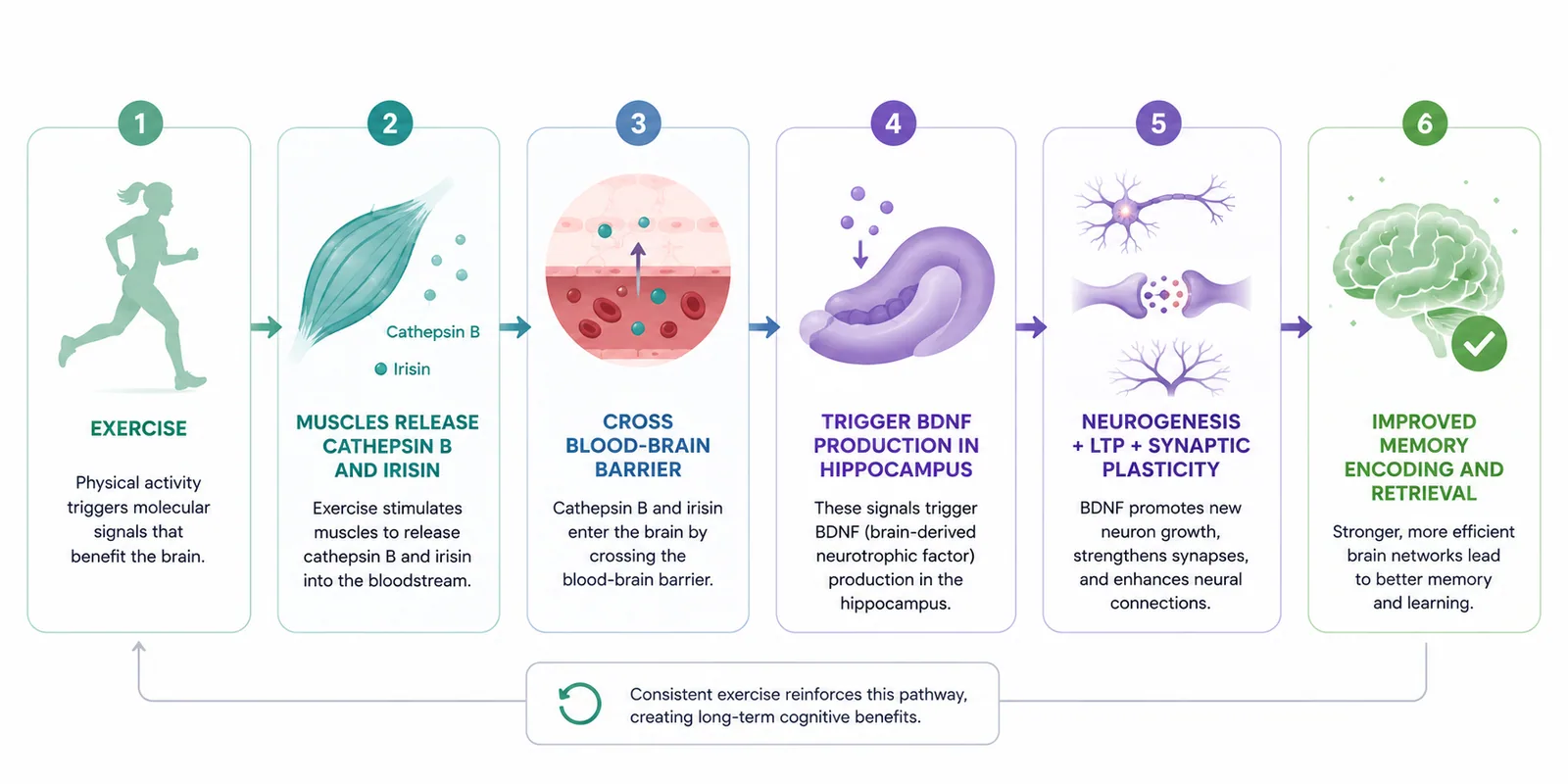
Exercise is one of the most potent natural BDNF boosters available. During aerobic exercise, muscles release proteins including cathepsin B and irisin that cross the blood-brain barrier and trigger BDNF production in the hippocampus. The more intense the exercise, the greater the BDNF release. But even moderate-intensity exercise (a brisk walk, a light jog, a bike ride) produces measurable increases in BDNF levels.
A 2025 review in Frontiers in Neuroscience found that moderate-intensity aerobic exercise performed for 30 to 40 minutes, 3 to 4 times per week, optimally stimulates BDNF production and hippocampal neurogenesis. The effect is dose-dependent: more consistent exercise produces more sustained BDNF elevation and greater neuroplastic benefit.
Exercise Physically Grows Your Hippocampus
The most striking evidence for exercise’s effect on memory comes from brain imaging studies that show exercise physically increasing the size of the hippocampus.
The landmark study is Erickson et al. (2011), published in the Proceedings of the National Academy of Sciences. In a randomised controlled trial with 120 older adults, participants were assigned to either a moderate-intensity walking programme (40 minutes, 3 times per week) or a stretching control group for one year.
The results:
- The walking group showed a 2% increase in hippocampal volume.
- The stretching group showed a 1.4% decrease in hippocampal volume (the normal rate of age-related shrinkage).
- The 2% increase effectively reversed 1 to 2 years of age-related hippocampal loss.
- Hippocampal volume increases were directly associated with increased serum BDNF levels.
- The walking group also showed significant improvements in spatial memory.
This study is important for several reasons. First, it was a randomised controlled trial, not a correlational study. The exercise caused the hippocampal growth, not the other way around. Second, the exercise was walking. Not marathon training, not high-intensity interval training. Walking. Three times a week. For 40 minutes. That is accessible to virtually everyone.
Subsequent meta-analyses have confirmed the finding: aerobic exercise preserves and can increase hippocampal volume in older adults. The hippocampus normally shrinks by 1 to 2% per year after age 50. Exercise appears to partially or fully counteract that shrinkage. For more on how ageing affects different memory systems, see our post on memory and ageing.
Acute vs Chronic Exercise: Different Benefits
Exercise affects memory through two distinct timescales, and understanding the difference helps you design an optimal routine.
Acute Effects (Single Session)
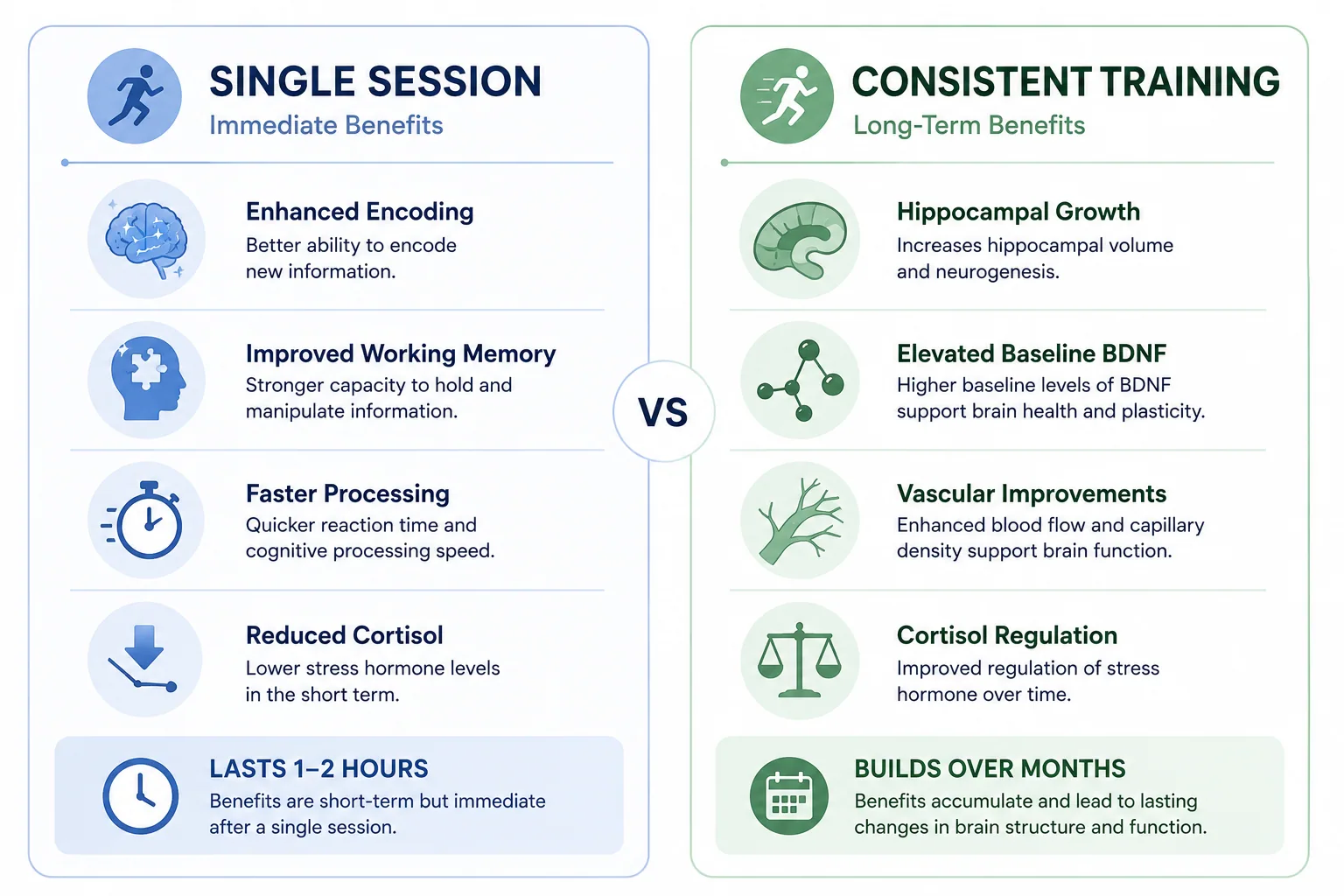
A single exercise session produces immediate, temporary cognitive benefits that last 1 to 2 hours after the session ends:
- Enhanced encoding. Information studied within 1 to 2 hours after exercise is encoded more effectively into long-term memory. The BDNF spike from exercise enhances hippocampal function in real time.
- Improved working memory. A single session of moderate exercise improves working memory performance for up to 2 hours. The prefrontal cortex receives increased blood flow and neurotransmitter support.
- Faster processing speed. Reaction times and processing speed improve acutely after exercise, which supports faster and more accurate memory retrieval.
- Reduced cortisol. Exercise metabolises excess cortisol, temporarily relieving the hippocampal suppression that chronic stress produces. This creates a window of enhanced encoding capacity.
This is why exercising before studying or before a cognitively demanding task produces better results than exercising afterwards. The acute BDNF spike creates a window of enhanced neuroplasticity that you can exploit for learning.
Chronic Effects (Consistent Training Over Weeks to Months)
The structural benefits (hippocampal growth, sustained BDNF elevation, neurogenesis) require consistent exercise over weeks to months. These are the changes that produce lasting memory improvements rather than temporary boosts:
- Hippocampal growth becomes measurable after approximately 6 to 12 months of consistent aerobic exercise.
- Baseline BDNF levels increase with regular exercise, meaning your brain has higher resting levels of the protein that supports memory formation, even on days you do not exercise.
- Vascular improvements (increased cerebral blood flow, new capillary formation) develop over months and improve the delivery of oxygen and nutrients to memory-critical brain regions.
- Cortisol regulation improves with regular exercise. Chronic exercisers have lower resting cortisol and a more efficient stress response, which protects the hippocampus long-term.
The pattern mirrors what we see in cognitive training: acute sessions produce temporary improvements, while consistent daily practice produces structural change. This is why both exercise and memory training reward consistency over intensity.
What Type of Exercise Is Best for Memory?
Not all exercise produces the same cognitive benefits. The research points to a clear hierarchy:
Aerobic Exercise (Strongest Evidence)
Walking, running, cycling, swimming, and dancing have the strongest evidence base for memory improvement. Aerobic exercise produces the largest BDNF increases, the most significant hippocampal volume changes, and the clearest improvements in memory task performance. The Erickson study used moderate-intensity walking, which means you do not need extreme cardio to get the benefits.
The optimal dose, based on the 2025 Frontiers review: 30 to 40 minutes at moderate intensity (60 to 70% of maximum heart rate), 3 to 4 times per week. That is roughly a pace where you can hold a conversation but feel slightly out of breath.
Resistance Training (Growing Evidence)
Weight training and bodyweight exercises also produce cognitive benefits, though through partially different mechanisms. Resistance exercise increases IGF-1 (insulin-like growth factor 1) and myokines that cross the blood-brain barrier and support neuronal health. Studies show improvements in executive function and attention after resistance training programmes, and some evidence suggests hippocampal benefits as well.
The cognitive benefits of resistance training may be most pronounced for executive function (planning, decision-making, task switching) rather than declarative memory specifically. For overall brain health, a combination of aerobic and resistance training appears to be optimal.
High-Intensity Interval Training (HIIT)
Short bursts of intense exercise followed by recovery periods produce larger acute BDNF spikes than steady-state cardio. However, the evidence for long-term memory benefits from HIIT specifically (as opposed to moderate aerobic exercise) is less extensive. HIIT is time-efficient and produces significant cardiovascular and metabolic benefits, but if memory improvement is your primary goal, moderate-intensity aerobic exercise has the deeper evidence base.
Mind-Body Exercise (Yoga, Tai Chi)
Yoga and Tai Chi show modest cognitive benefits in the research, likely through cortisol reduction and improved sleep rather than direct BDNF stimulation. They complement aerobic exercise well but are not substitutes for it when the goal is memory improvement.
How Much Exercise Do You Need?
The research converges on a remarkably achievable minimum:
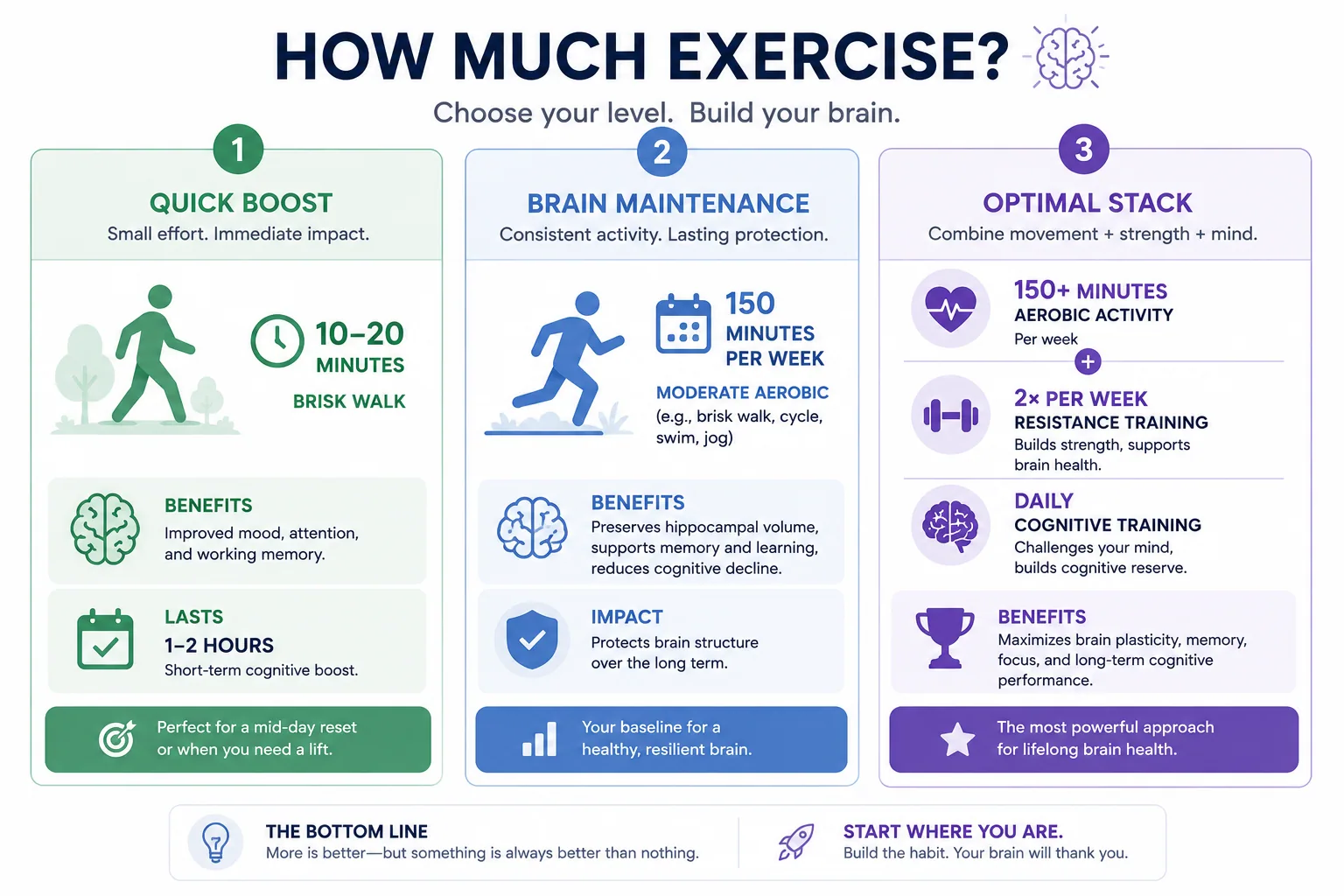
For acute memory benefits: 10 to 20 minutes of moderate aerobic exercise. Even a brisk 10-minute walk before a study session or important meeting produces measurable improvements in encoding and working memory.
For structural brain benefits: 150 minutes per week of moderate aerobic exercise (the WHO recommendation). This can be broken into 30-minute sessions 5 times per week, or 40-minute sessions 3 to 4 times per week. The Erickson study used 40 minutes, 3 times per week.
For optimal results: Combine 150+ minutes of weekly aerobic exercise with 2 resistance training sessions. Add daily cognitive training to target the neural pathways that exercise is priming.
The critical finding is that the minimum effective dose is low. Walking counts. You do not need to run marathons or spend hours in the gym. The hippocampal growth in the Erickson study came from walking at a moderately brisk pace. If you are currently sedentary, simply adding 3 weekly walks of 30 to 40 minutes would put you in the range that the research shows produces structural brain benefits.
Exercise Plus Cognitive Training: The Combination Effect
Here is where it gets interesting for anyone already training their memory. Exercise and cognitive training appear to produce complementary benefits that are stronger together than either alone.
Exercise creates the conditions for neuroplastic change. It floods the hippocampus with BDNF, promotes neurogenesis, increases blood flow, and primes neural circuits for strengthening. But exercise alone does not direct those new resources toward specific cognitive skills. It builds the infrastructure without telling the brain what to build.
Cognitive training provides the direction. When you train your visual memory with Blanked, you are activating specific neural circuits in the visuospatial sketchpad and hippocampus. The encode-store-retrieve cycle tells your brain exactly which connections to strengthen. If you exercise before training, the BDNF spike creates a window where those connections are more receptive to strengthening.
Think of it this way: exercise is the fertiliser. Cognitive training is the seed. The fertiliser makes the soil richer and more conducive to growth, but you still need to plant something specific to get a specific crop. BDNF makes your brain more plastic. Memory training directs that plasticity toward the circuits you want to strengthen.
A practical approach:
- Morning: 20 to 40 minutes of aerobic exercise (walk, run, cycle). This primes your brain with BDNF and creates a window of enhanced neuroplasticity.
- Within 1 to 2 hours after exercise: Complete your daily Blanked session. The BDNF window means the visual memory circuits you activate during training are more responsive to strengthening. Download Blanked for free and try timing your session after your next workout.
- Evening: Protect your sleep. The consolidation of everything you encoded during the BDNF window happens during deep sleep. Exercise improves sleep quality, which further amplifies the memory benefits.
This three-step cycle (exercise to prime, train to direct, sleep to consolidate) is the most comprehensive approach to memory improvement that the research currently supports. Each step reinforces the others.
Exercise is not just good for your body. It is one of the most powerful tools available for protecting and improving your memory. The mechanisms are understood (BDNF, neurogenesis, hippocampal growth, cortisol regulation). The evidence is strong (randomised controlled trials, not just correlations). And the minimum dose is achievable (walking, 3 times a week, 30 to 40 minutes).
You do not need to become an athlete. You need to move consistently. Pair that movement with targeted memory training and adequate sleep, and you are giving your brain everything it needs to build and maintain the neural infrastructure behind a strong memory.
Try Blanked for free. Time your session after your next walk. Two minutes of visual memory training on a BDNF-primed brain. That is the optimal stack.
Frequently asked questions
Does exercise improve memory?
How quickly does exercise improve memory?
What is the best exercise for brain health?
Can walking improve memory?
Should I exercise before or after studying?
Does exercise help with age-related memory loss?
Train your memory. Play Blanked free.
A free visual memory game built around how memory actually works. 6 game modes, 400+ levels.
Download on the App Store