How Multitasking Destroys Your Memory (2026)

On this page (15)
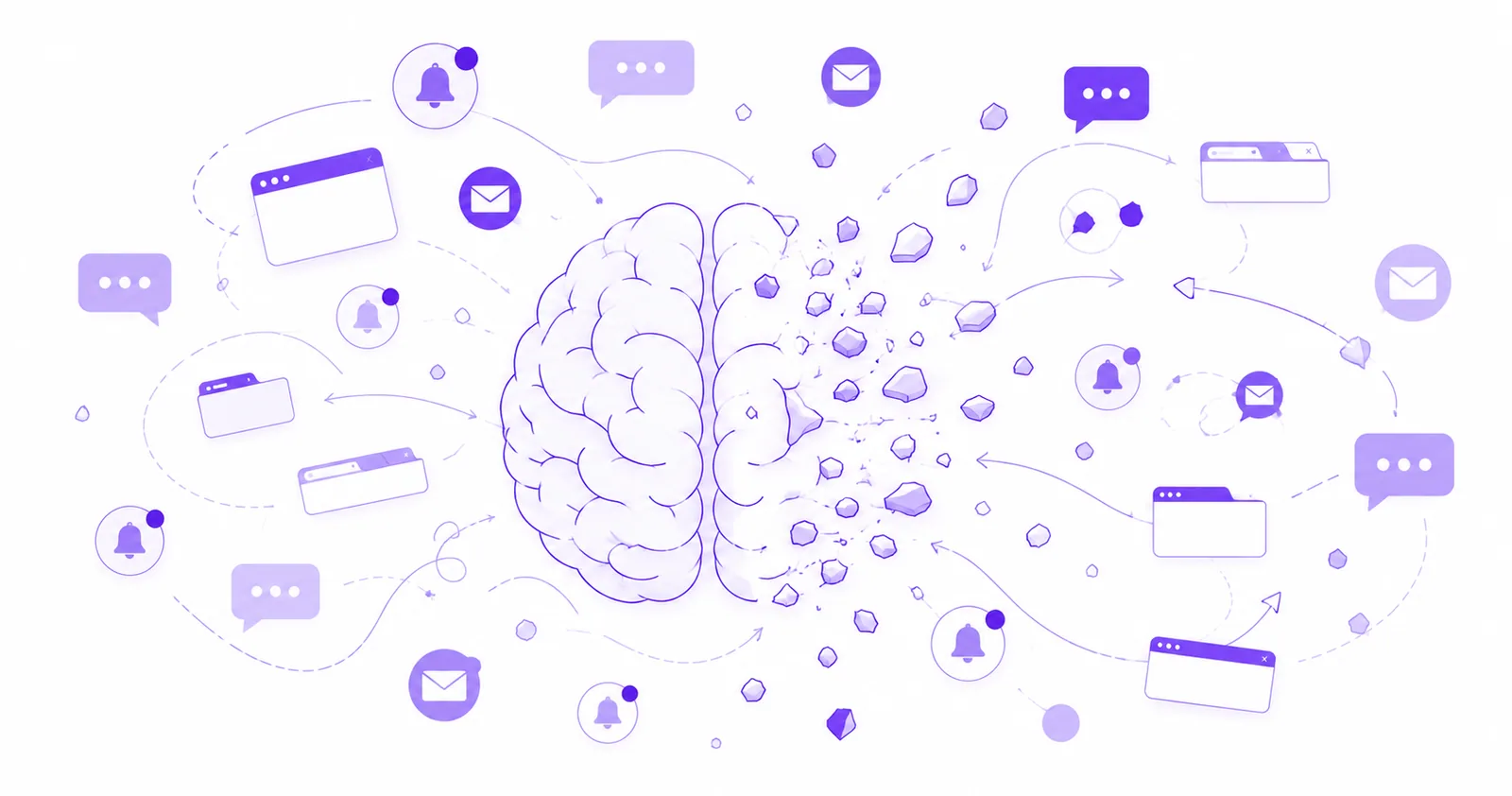
You are reading this while something else is open in another tab. Or your phone just buzzed and you glanced at it. Or you are mentally running through your to-do list while processing these words. That is multitasking, and it is doing more damage to your memory than you realise.
The research is unambiguous: your brain cannot process two cognitively demanding tasks simultaneously. What feels like multitasking is actually rapid task switching, and every switch costs you time, cognitive energy, and most importantly, the ability to encode information into memory. That lost encoding is why you forget where you put your keys, why you cannot recall what someone just told you, and why you feel mentally exhausted by 3pm despite not doing any single task particularly well.
This post explains what actually happens in your brain when you multitask, why it destroys your memory specifically, and what to do instead.
Your Brain Cannot Multitask
This is not a motivational statement. It is a neurological fact. Your prefrontal cortex, the region responsible for attention, decision-making, and working memory, can only consciously process one cognitively demanding task at a time.
When you think you are multitasking (writing an email while listening to a meeting, texting while cooking, scrolling your phone while watching television), your brain is actually switching between those tasks in rapid succession. It handles one for a fraction of a second, then drops it and picks up the other. Back and forth. Hundreds of times per hour.
The American Psychological Association calls this "task switching" and has identified two distinct stages that happen every time you switch: goal shifting (deciding "I want to do this now instead of that") and rule activation (turning off the mental rules for the previous task and loading the rules for the new one). Both stages take time and cognitive resources. Both stages happen every single time you switch, no matter how small the interruption.
Research consistently shows that task switching can consume up to 40% of your productive time. But the productivity cost is only half the problem. The other half, and the part most people miss, is what task switching does to your memory.
How Task Switching Wrecks Your Memory
Memory formation requires three steps: encoding (taking information in), storage (holding it), and retrieval (getting it back out). Multitasking sabotages the very first step.
Encoding Failure
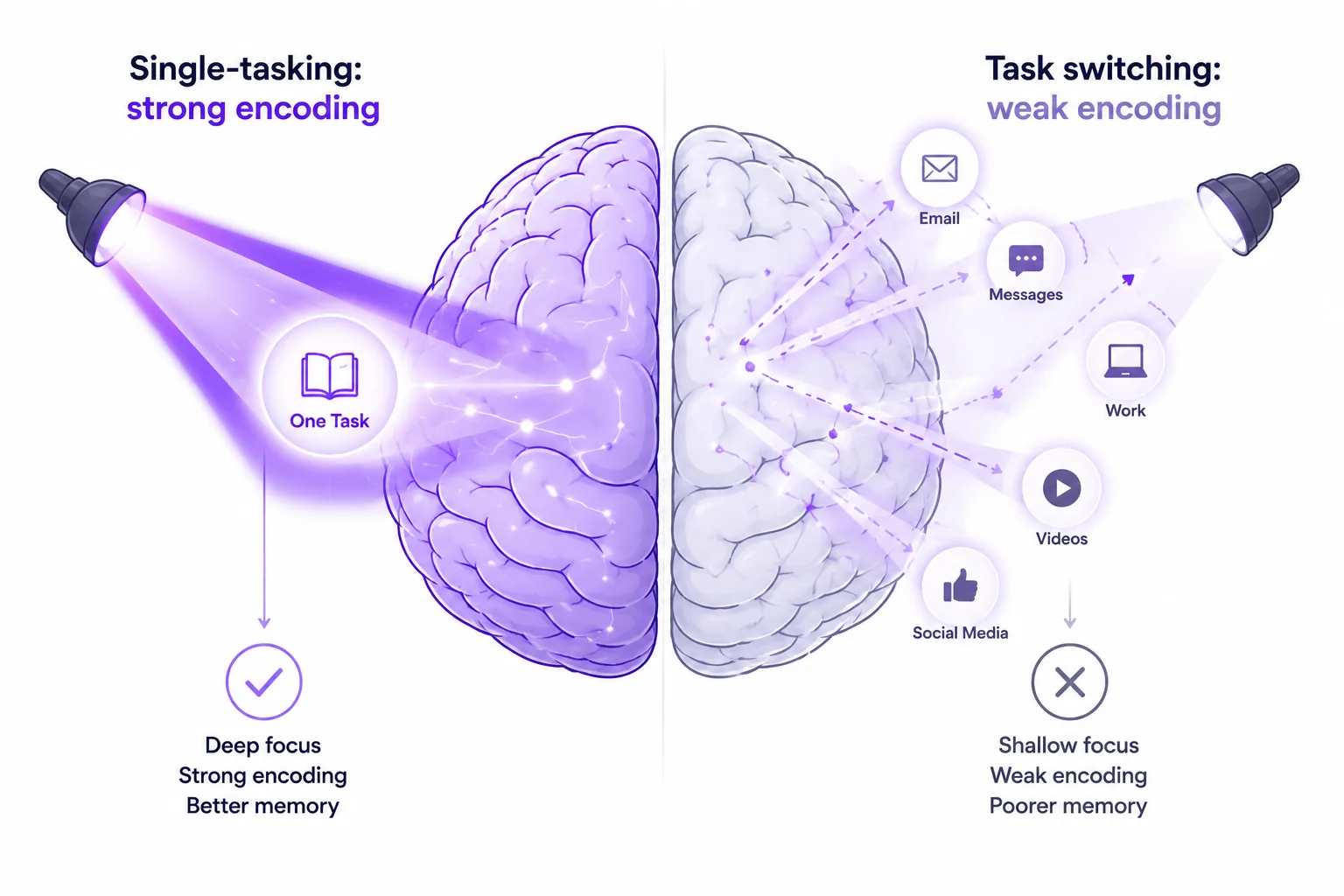
To encode information into memory, your brain needs focused attention directed at that information for a sustained period. The hippocampus, which converts short-term experiences into long-term memories, requires a clean signal from the prefrontal cortex to know what to store. When you are switching between tasks, the prefrontal cortex is constantly reconfiguring itself, sending fragmented, interrupted signals to the hippocampus.
The result: the information never gets properly encoded in the first place. You did not forget where you put your keys. You never stored the location because your attention was on your phone when you set them down. You did not forget what your colleague said in the meeting. You never encoded it because you were writing a message at the same time. (We explored this encoding failure in detail in our post on why you forget things so quickly.)
Working Memory Overload
Working memory has a capacity of roughly 3 to 5 items. When you switch tasks, each task requires loading its own set of information into working memory: the context, the rules, where you left off, what needs to happen next. Switching between two tasks does not mean your working memory handles 3 items from task A and 3 items from task B simultaneously. It means your brain dumps the items from task A, loads the items for task B, and when you switch back, dumps task B and reloads task A.
Every dump-and-reload cycle wastes cognitive resources and risks losing information. This is why you walk into a room and forget why you are there: the act of walking through a doorway (a physical "task switch") can be enough to dump whatever your working memory was holding.
Consolidation Disruption
Even information that survives encoding can be disrupted during the consolidation process. Consolidation (the transfer from short-term to long-term memory) requires periods of relative cognitive quiet. Your brain needs time to replay and strengthen the neural connections that form new memories. Constant task switching fills every cognitive gap with new input, leaving no quiet space for consolidation to occur.
This is why people who multitask throughout the day often feel like the hours disappeared but they cannot remember what they actually did. The experiences were real, but the constant switching prevented proper consolidation. The day happened, but much of it was never stored.
Attention Residue: The Ghost of the Last Task
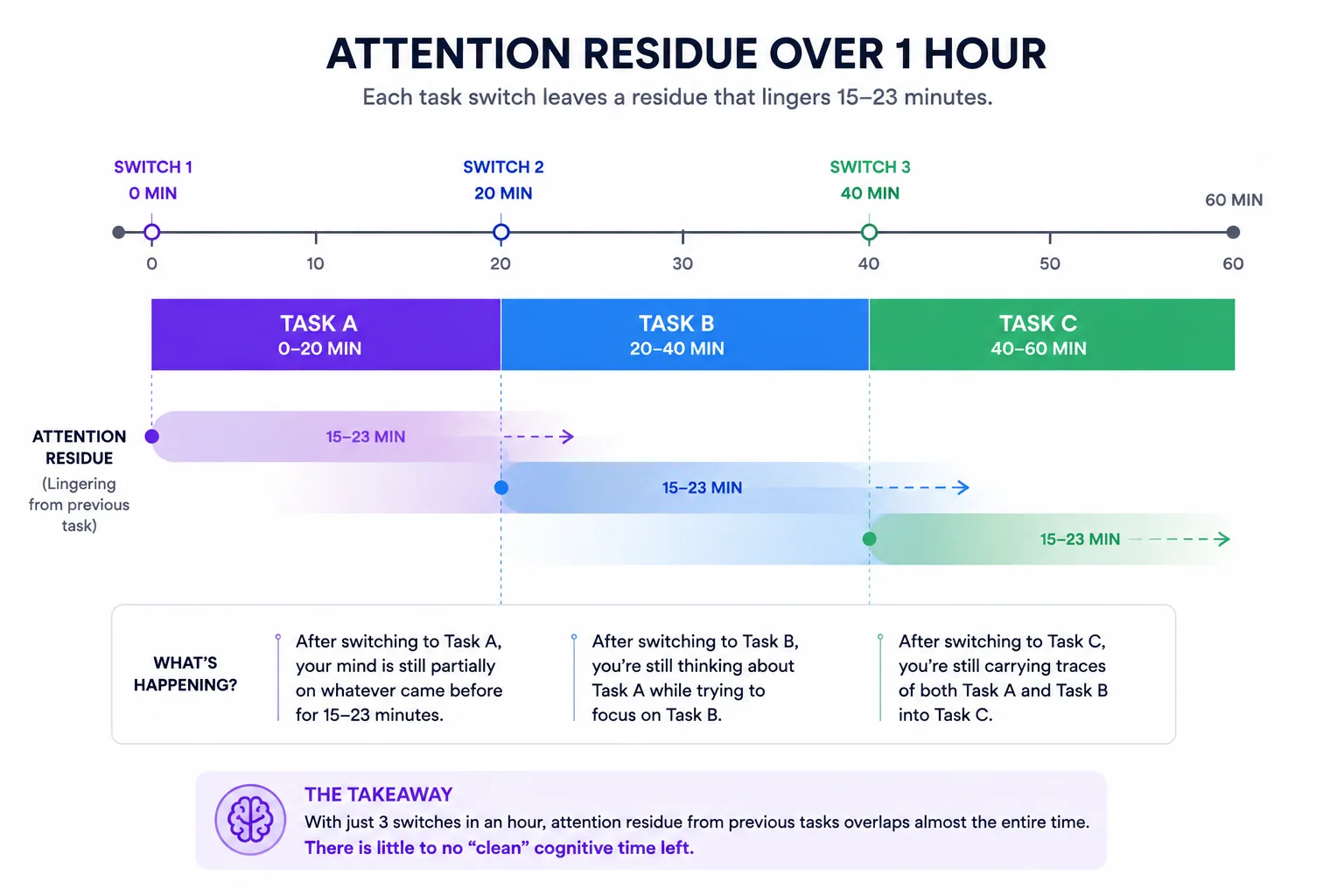
One of the most damaging aspects of task switching is a phenomenon called attention residue. When you switch from Task A to Task B, your brain does not cleanly close Task A. A portion of your cognitive resources remains allocated to Task A, thinking about it, monitoring it, holding fragments of it in working memory, even while you are supposedly focused on Task B.
Research shows that attention residue effects last 15 to 23 minutes after switching. That means if you check your phone for 30 seconds in the middle of a conversation, your brain is still partially processing whatever you saw on your phone for up to 23 minutes after you put it down. During that entire period, your ability to encode the conversation into memory is impaired.
The implications are severe. If you switch tasks just 3 times per hour (which is far fewer than most people), you are spending the majority of every hour in a state of impaired cognitive function. Your working memory is perpetually divided between the current task and the residue of previous tasks. You are never fully present for any of them.
The Digital Multitasking Problem
Modern digital environments are specifically designed to make you multitask. Notifications, badges, sounds, pop-ups, and infinite scroll are all engineered to interrupt your current task and pull your attention to a new one. Every interruption triggers a task switch. Every task switch costs you encoding quality.
A 2024 review published in Frontiers in Psychiatry found that chronic digital multitasking is associated with reduced executive function, diminished working memory capacity, greater difficulty filtering irrelevant information, and elevated mental fatigue. The researchers warned that the cognitive consequences are likely to worsen as digital environments become more fragmented.
The specific memory problem with digital multitasking is that it trains your brain to be interrupted. When you habitually respond to every notification, you are training your prefrontal cortex to break focus at the first stimulus. Over time, this weakens your ability to sustain attention even when you want to, because the "check for interruptions" impulse becomes automatic.
This is the opposite of what memory training does. Effective memory training strengthens the encode-store-retrieve cycle by requiring sustained focus on a single task. Digital multitasking weakens it by constantly interrupting that cycle. The two forces work in direct opposition. (For the full research on how screen habits affect cognition, see our post on screen time and memory.)
What Chronic Multitasking Does to Your Brain Over Time
Short-term multitasking impairs performance temporarily. But chronic multitasking, the habitual pattern of constant switching that defines most people’s working days, produces longer-lasting changes:
Reduced grey matter density. Research has found that people who habitually engage in heavy media multitasking show reduced grey matter density in the anterior cingulate cortex, a region critical for attention control and error detection. This does not mean multitasking "causes" brain damage in the way a head injury does. It means that chronic multitasking is associated with structural differences in the brain regions responsible for focused attention.
Weakened attentional control. Studies consistently find that heavy multitaskers perform worse on tests of attentional control than light multitaskers. They are more easily distracted, more susceptible to irrelevant stimuli, and worse at filtering out noise. Counterintuitively, heavy multitaskers are also worse at task switching itself, despite doing it more often.
Impaired working memory capacity. Chronic multitaskers show inferior working memory performance in laboratory tests. The capacity to hold and manipulate information, the very skill that underpins comprehension, problem-solving, and learning, is measurably weaker in people who habitually switch between tasks.
The encouraging news is that these changes are not permanent. The brain’s neuroplasticity works in both directions. Just as chronic multitasking can weaken attentional networks, targeted single-task training can strengthen them. The neural pathways respond to whatever you consistently do. Change the habit, and the brain adapts.
How to Stop Multitasking and Protect Your Memory
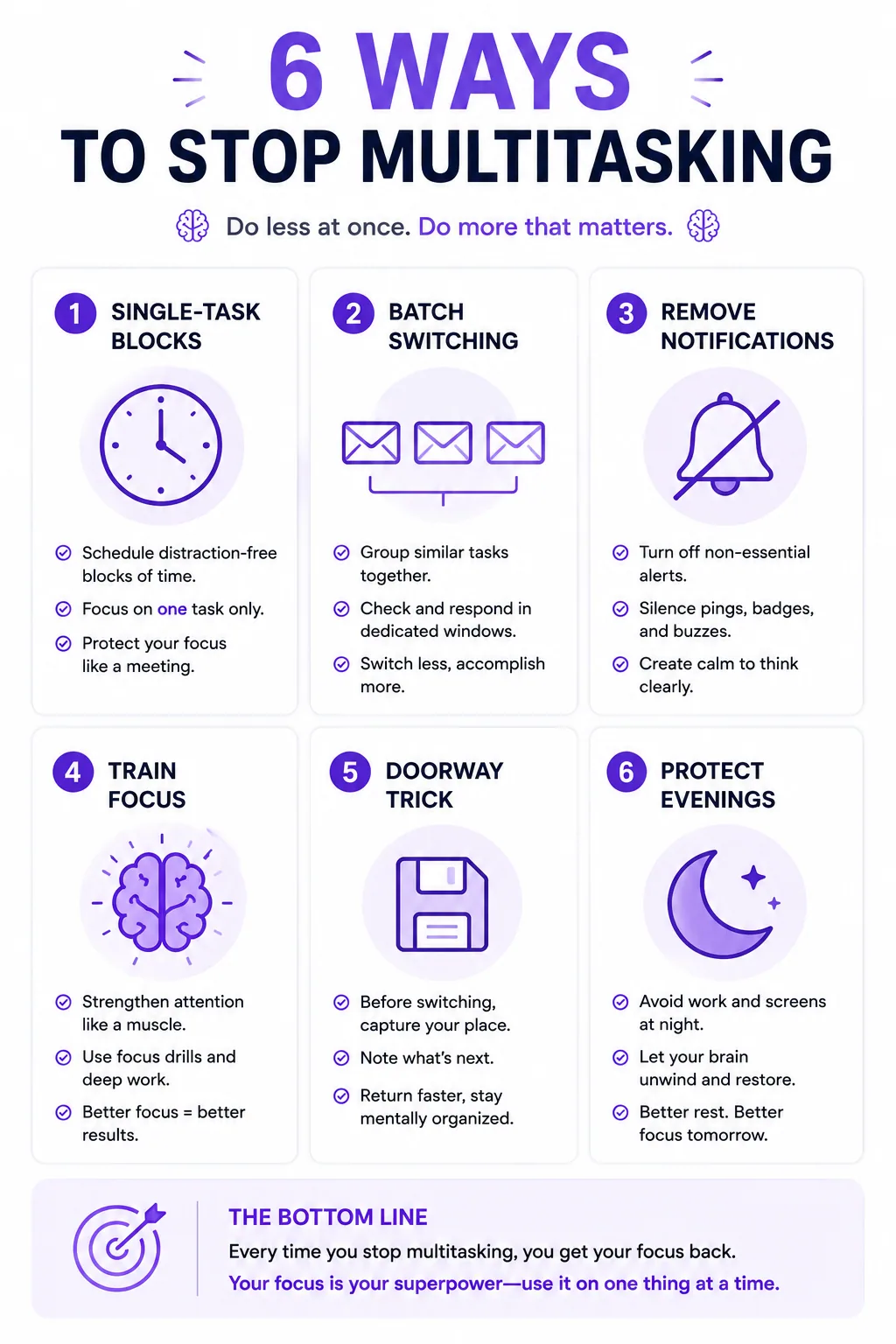
The solution is not willpower. It is environment design and habit replacement. Here are the strategies backed by the research:
1. Create Single-Task Blocks
Dedicate specific time blocks (even just 25 minutes) to one task with all other inputs closed. No second screen, no phone visible, no email tab. The Pomodoro Technique (25 minutes focused, 5 minutes break) is effective not because of the timer itself, but because it creates a clear boundary between "focus" and "everything else." During the 25 minutes, your brain gets the sustained, uninterrupted attention time it needs to encode information properly.
2. Batch Your Switching
Instead of checking email, messages, and notifications throughout the day (creating dozens of micro-switches), batch them into specific times. Check email at 9am, 12pm, and 4pm. Check messages once per hour. This reduces the total number of task switches and gives your brain longer stretches of uninterrupted encoding time between each one.
3. Remove Notification Triggers
Every notification is an involuntary task switch, even if you do not act on it. Seeing a notification pop up triggers the goal-shifting stage (your brain starts thinking about whether to respond) even if you choose not to switch. Turn off all non-essential notifications. Move your phone out of sight during focused work. The research is clear: out of sight is genuinely out of mind.
4. Train Your Focus Directly
Your ability to sustain attention on a single task is a skill, and like any skill, it responds to training. This is where memory training and attention training overlap. When you complete a Blanked session, you are practising exactly the skill that multitasking erodes: sustained, focused attention on a single visual task, with no interruptions, for a defined period. Two minutes of pure single-tasking every day, training your brain to hold information and retrieve it without switching. (For a full focus-building programme, see our post on how to improve concentration.)
5. Use the Doorway Trick in Reverse
The "doorway effect" (forgetting why you walked into a room) happens because the physical transition triggers a working memory reset. Use this principle intentionally: before switching tasks, take 10 seconds to mentally close the current task. Summarise where you left off, write down your next step, and consciously "save" your progress. This reduces attention residue because your brain does not need to keep monitoring the unfinished task.
6. Protect Your Evenings
Consolidation, the process that converts short-term memories into long-term ones, happens primarily during sleep. If you spend your evening multitasking (scrolling your phone while watching television while half-listening to a conversation), you flood your brain with fragmented, poorly encoded input right before the consolidation window. Reducing multitasking in the hour before bed gives your brain cleaner material to consolidate overnight.
Multitasking feels productive. It feels like you are doing more. But the research consistently shows you are doing more things worse, remembering less of all of them, and burning through cognitive energy faster. Every notification you respond to, every tab you switch between, every time you check your phone mid-conversation, you are pulling the plug on your brain’s encoding system.
The fix is not complicated. It is doing one thing at a time, properly, with your full attention. That is what your brain was designed for. That is how memories are formed. And that is why training your memory with a focused, single-task exercise matters more than ever in a world designed to keep you switching.
Try Blanked for free. Two minutes. One task. Zero switching. Your working memory will notice the difference.
Frequently asked questions
Does multitasking damage your brain?
Why do I forget things when I multitask?
How long does attention residue last?
Can you train yourself to stop multitasking?
Is listening to music while working multitasking?
Train your memory. Play Blanked free.
A free visual memory game built around how memory actually works. 6 game modes, 400+ levels.
Download on the App Store