Short-Term vs Long-Term Memory: The Difference (2026)


On this page (13)
You can hold a phone number in your head for about 20 seconds. You can remember your childhood address for decades. Both of these are memory, but they’re handled by completely different systems in your brain, with different capacities, different durations, and different biological mechanisms.
Understanding the difference between short-term and long-term memory isn’t just an academic exercise. It explains why you forget someone’s name 30 seconds after hearing it, why cramming for exams doesn’t work, and why daily memory training produces better results than occasional marathon sessions. Here’s how both systems work, where they break down, and what you can do about it.
The Simple Version
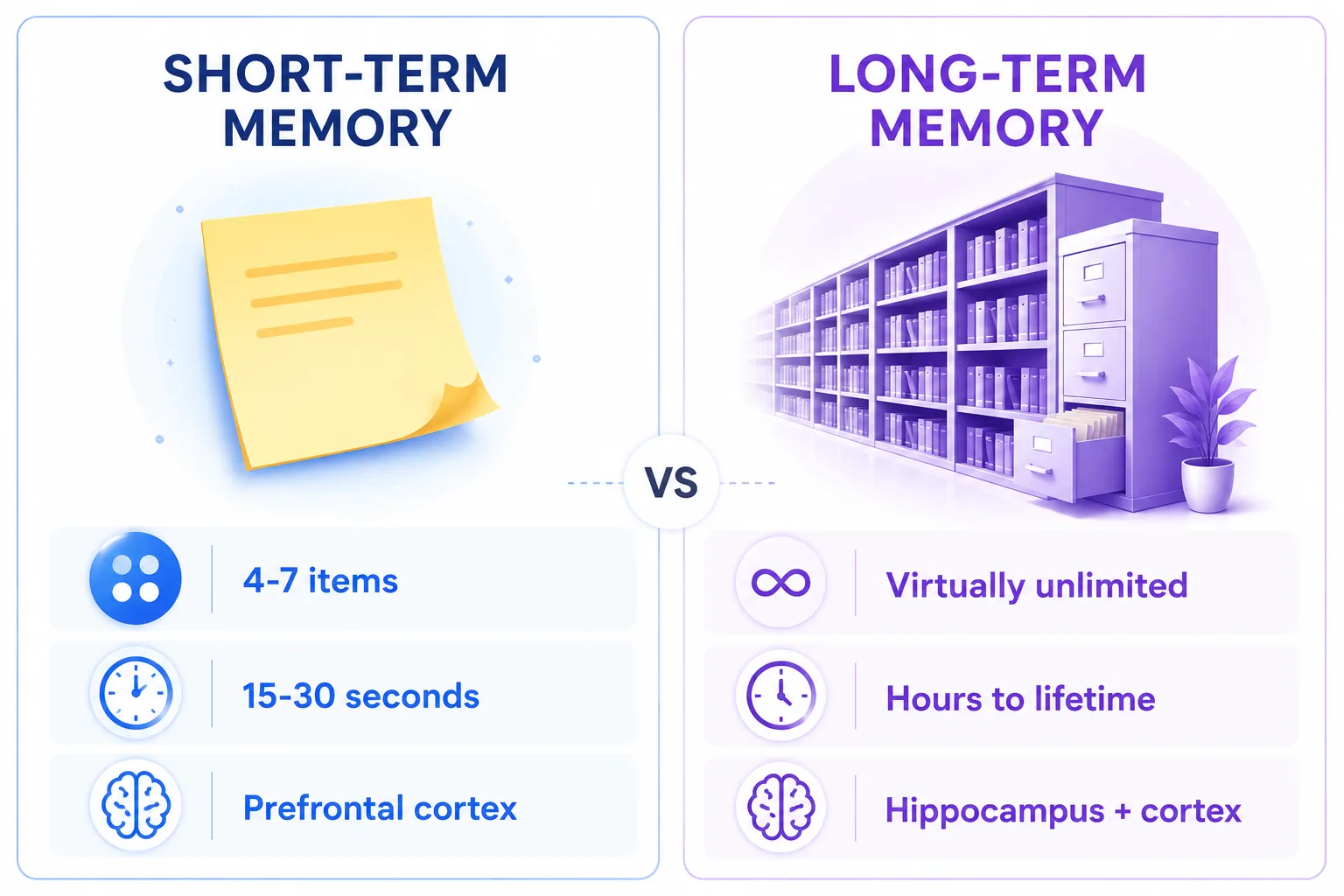
Short-term memory holds a small amount of information for a brief period, typically 15 to 30 seconds, unless you actively rehearse it. It has a capacity of roughly 4 to 7 items. Think of it as a sticky note: useful for the moment, but the information disappears quickly.
Long-term memory stores information for extended periods, from hours to an entire lifetime. It has a virtually unlimited capacity. Think of it as a library: vast, organised (sometimes poorly), and permanent enough to last decades.
The critical question is how information moves from the sticky note to the library. That transfer process is where most memory failures happen, and it’s where training can make the biggest difference.
Short-Term Memory: Your Brain’s Scratchpad
Short-term memory is the system that holds information you’re actively thinking about right now. When someone tells you their name, when you glance at a price tag, when you read a sentence and hold the beginning in mind while processing the end, that’s short-term memory at work.
Capacity: George Miller’s famous 1956 research suggested short-term memory holds about 7 items (plus or minus 2). More recent research has revised this downward to roughly 4 items for most people. The actual number depends on the type of information and whether you’re using chunking strategies to group items together.
Duration: Without rehearsal (actively repeating or thinking about the information), short-term memories decay within 15 to 30 seconds. This is why you can hold a phone number in your head long enough to dial it, but if someone interrupts you, the number vanishes.
Encoding: Short-term memory primarily encodes information acoustically (by sound) and visually (by appearance). This is why similar-sounding words are harder to remember in short-term memory than visually similar ones. When you repeat a phone number to yourself, you’re using acoustic encoding. When you picture a visual scene, you’re using visual encoding.
Brain regions: Short-term memory is primarily managed by the prefrontal cortex, the same region responsible for attention, decision-making, and executive control. This is why anything that impairs prefrontal function (stress, sleep deprivation, multitasking) also impairs short-term memory.
Long-Term Memory: Your Brain’s Hard Drive
Long-term memory is the system that stores information beyond the immediate moment. Everything you “know”, from your own name to how to ride a bicycle to what you ate for dinner last Tuesday, is stored in long-term memory.
But long-term memory isn’t a single system. It’s divided into several types, each handling different kinds of information:
Explicit (Declarative) Memory
This is memory you can consciously recall and describe in words. It’s divided into two subtypes:
Episodic memory stores personal experiences and events. Your first day at school, your last holiday, what happened at dinner yesterday. These are autobiographical memories with a time and place attached.
Semantic memory stores facts and general knowledge. The capital of France, how many days are in a year, what the word “neuroplasticity” means. This information is detached from the specific experience of learning it. You know Paris is the capital of France, but you probably don’t remember the exact moment you learned it.
Implicit (Non-Declarative) Memory
This is memory that operates below conscious awareness. You can’t easily describe it in words, but it influences your behaviour:
Procedural memory stores skills and motor sequences. Riding a bicycle, typing on a keyboard, tying your shoes. Once learned, these skills become automatic and don’t require conscious thought.
Priming is when exposure to one stimulus influences your response to a subsequent stimulus. If you see the word “yellow” and then are asked to name a fruit, you’re more likely to say “banana” than “apple.” You’re not aware this is happening, but your brain has been primed.
Brain regions: Long-term memory formation depends heavily on the hippocampus, a seahorse-shaped structure deep in the temporal lobe. The hippocampus acts as a transfer station, converting short-term memories into long-term ones through a process called consolidation. Once consolidated, memories are distributed across the cortex. Procedural memories rely more on the cerebellum and basal ganglia.
How Information Moves From Short-Term to Long-Term
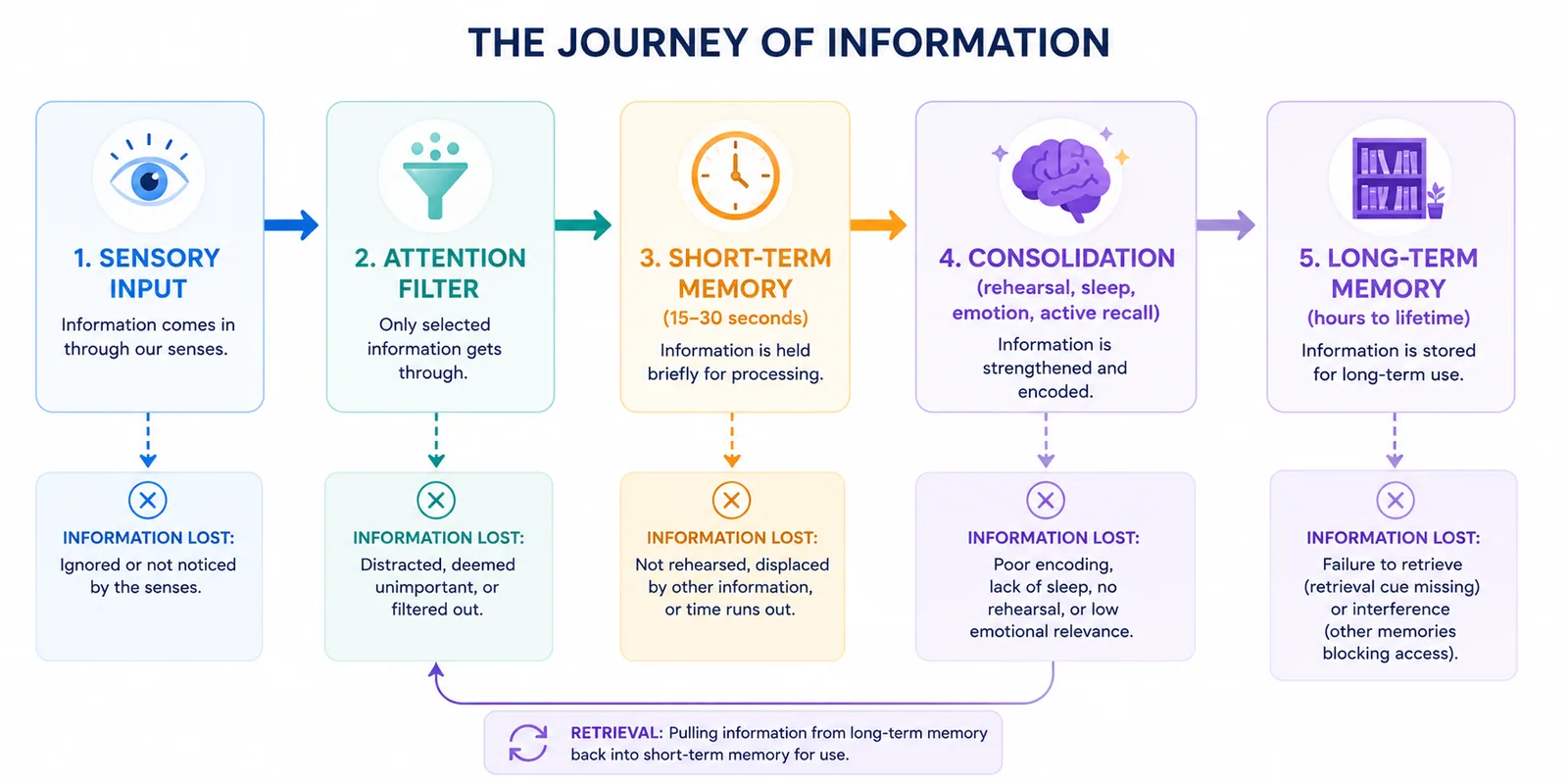
This is the most important part of the entire memory system, and it’s where most everyday memory failures happen. Information doesn’t automatically move from short-term to long-term storage. It requires specific conditions:
1. Attention. If you don’t pay attention to information in the first place, it never enters short-term memory properly, which means it can never be consolidated into long-term memory. This is why you “forget” where you put your keys. You didn’t forget. You never encoded the location because your attention was elsewhere. (We explored this in detail in our post on why you forget things so quickly.)
2. Rehearsal. Repeating information (either by saying it aloud or by revisiting it mentally) keeps it active in short-term memory and increases the likelihood of transfer to long-term storage. This is why students who reread their notes retain more than those who read once, though active recall is far more effective than passive rereading.
3. Emotional significance. The amygdala tags emotionally charged experiences as important, which strengthens hippocampal consolidation. This is why you vividly remember your wedding day but can’t recall what you had for lunch three Tuesdays ago. Emotional intensity acts as a priority flag for long-term storage.
4. Sleep. Memory consolidation happens primarily during sleep, particularly during slow-wave (deep) sleep and REM sleep. The hippocampus replays the day’s experiences during sleep, strengthening the synaptic connections that form long-term memories. Cut your sleep short and you physically prevent this consolidation process. (Full breakdown in our post on how sleep affects memory.)
5. Active recall. The act of retrieving information from memory (not looking at your notes, but trying to remember without them) strengthens the neural pathway between the cue and the stored information. This is the most powerful technique for moving information from fragile short-term traces into durable long-term storage.
Where Working Memory Fits In
You’ll often see the terms “short-term memory” and “working memory” used interchangeably, but they’re not quite the same thing. Short-term memory is the passive holding of information. Working memory is the active manipulation of that information.
When you hold a phone number in your head, that’s short-term memory. When you hold two phone numbers in your head and compare them to decide which one is correct, that’s working memory. Working memory is short-term memory plus processing.
Alan Baddeley’s influential model of working memory describes it as having several components: the phonological loop (for verbal and acoustic information), the visuospatial sketchpad (for visual and spatial information), and the central executive (which directs attention and coordinates the other components). (For more on this, see our working memory glossary entry.)
Working memory is what Blanked primarily trains. When you study a visual scene and then recall details from memory, you’re exercising the visuospatial sketchpad and the central executive simultaneously. The scene vanishes, you hold it in working memory, and you retrieve specific details. That cycle strengthens the neural systems responsible for both holding and processing visual information. (For the neuroscience, see our post on what happens to your brain when you play memory games.)
Why You Forget: The Weak Points in Each System
Forgetting happens at different stages for different reasons:
Short-Term Memory Failures
Decay. Information in short-term memory simply fades within 15 to 30 seconds without rehearsal. This is normal and automatic.
Displacement. When new information enters short-term memory and it’s already full, older items get pushed out. This is why interruptions destroy your train of thought. The new stimulus displaces what you were holding.
Interference. Similar information competes for the same cognitive space. Trying to remember two similar phone numbers at once causes them to interfere with each other, making both harder to recall.
Long-Term Memory Failures
Encoding failure. The information was never properly stored in the first place. You weren’t paying attention, so the memory was never formed. This is the most common cause of everyday “forgetting.”
Retrieval failure. The information is stored but you can’t access it. It’s the tip-of-the-tongue phenomenon: you know you know it, but you can’t pull it up right now. The memory exists but the retrieval pathway is weak.
Interference. Similar memories compete with each other. Proactive interference is when old memories make it harder to recall new ones (you keep driving to your old office instead of the new one). Retroactive interference is when new memories disrupt old ones (learning a new password makes you forget the old one).
Decay over time. Without periodic retrieval or use, long-term memories gradually weaken. The synaptic connections that store them are slowly pruned through the brain’s “use it or lose it” principle. This is why neuroplasticity works in both directions: strengthening pathways you use and weakening pathways you don’t.
How to Strengthen Both Systems
The research on memory improvement points to specific strategies for each system:
Strengthening Short-Term/Working Memory
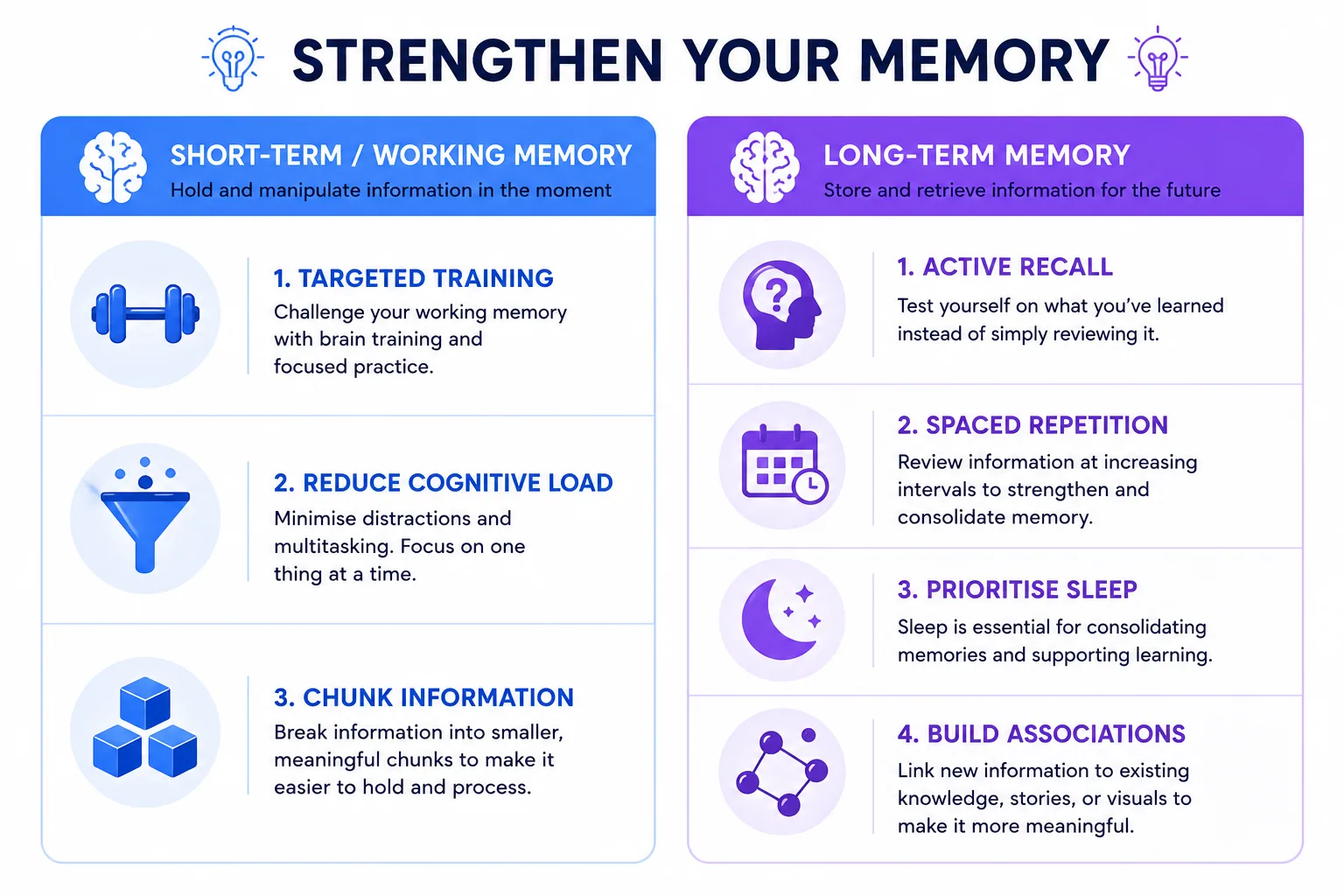
Train it directly. Working memory responds to targeted training. Visual memory exercises that require you to hold a scene in mind and recall details from it directly exercise the visuospatial sketchpad and central executive. Research shows improvements in working memory capacity after 2 to 4 weeks of consistent daily practice. Blanked is designed around exactly this: 2 minutes of daily working memory exercise through the encode-store-retrieve cycle.
Reduce cognitive load. Multitasking, notification interruptions, and cluttered environments all drain working memory resources. Simplifying your environment frees up capacity for what actually matters.
Chunk information. Grouping individual items into larger meaningful units effectively increases your working memory capacity. Instead of remembering 10 individual digits, chunk them into 3 groups of 3 or 4. This is why phone numbers are formatted with spaces.
Strengthening Long-Term Memory
Use active recall. Retrieving information from memory without looking at your notes is the single most effective strategy for strengthening long-term storage. Every successful retrieval reinforces the neural pathway.
Space your practice. Spaced repetition (reviewing information at increasing intervals) exploits the way consolidation works. Each review session catches the memory just before it fades, strengthening it further each time. This is far more effective than massed practice (cramming).
Prioritise sleep. Seven to nine hours of quality sleep is not optional for memory. The hippocampal replay process that consolidates short-term memories into long-term storage happens during deep sleep. Cutting sleep cuts consolidation.
Build associations. Information connected to existing knowledge is easier to store and retrieve. The Memory Palace technique works because it connects new information to well-established spatial memories. The more connections you create, the more retrieval pathways you have.
For a comprehensive guide to exercises that target both systems, see our post on brain exercises for adults. And for the full timeline of when you’ll see improvements from consistent training, see how long it takes to improve your memory.
Your memory isn’t one system. It’s a collection of interconnected systems, each with different strengths, limitations, and failure points. Understanding those differences is the first step to training them effectively. Short-term memory is limited but trainable. Long-term memory is vast but requires the right conditions to store information properly. And the transfer between them, the consolidation process, is where most everyday memory problems actually live.
If you want to start training the system that underpins everything else, try Blanked for free. Two minutes of daily visual working memory training. Your short-term memory gets the workout. Your long-term memory gets the benefits. And Blink will be watching to make sure you don’t skip a day.
Frequently asked questions
What is the main difference between short-term and long-term memory?
How does short-term memory become long-term memory?
Is working memory the same as short-term memory?
Can you improve short-term memory?
Why do I forget things so quickly?
Train your memory. Play Blanked free.
A free visual memory game built around how memory actually works. 6 game modes, 400+ levels.
Download on the App Store