Why You Remember Some Things and Forget Others (2026)

On this page (12)
You remember your first kiss but not your third Tuesday at work. (Though almost no one remembers anything before about age three, a puzzle explained by childhood amnesia.) You remember the plot of a film you watched once 15 years ago but not what your boss said in yesterday’s meeting. You can picture your childhood kitchen in vivid detail but cannot recall where you put your phone 20 minutes ago.
This feels random. It feels like your memory is unreliable, inconsistent, and slightly broken. It is none of those things. Your brain is being extremely selective about what it stores, and the selection criteria are specific, predictable, and well understood by neuroscience.
This post explains the 7 factors that determine whether a piece of information makes it into long-term memory or gets discarded, why emotional memories are disproportionately vivid (and why a smell can trigger a memory so powerfully), and how you can use these principles to remember the things that actually matter.
Your Brain Is Not a Camera
The most common misconception about memory is that it works like a recording device: everything you experience gets stored somewhere, and forgetting is a retrieval failure. This is wrong. Your brain does not record everything (with rare exceptions like hyperthymesia, where almost nothing is forgotten). It filters aggressively, stores selectively, and discards the vast majority of what you experience.
This is not a flaw. It is a survival feature. If your brain stored every visual detail, every sound, every sensation from every moment of every day, you would be overwhelmed by useless information and unable to prioritise what matters. Forgetting is how your brain keeps the signal-to-noise ratio manageable.
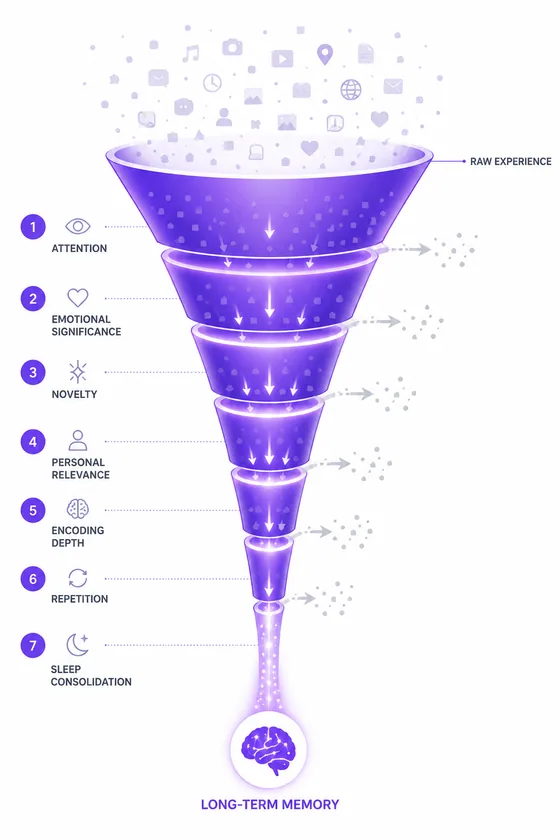
The question "why do I remember some things and forget others" is really asking: what are my brain’s filtering criteria? What makes a piece of information pass through the gate into long-term storage? The answer involves 7 factors that work together, often simultaneously, to determine which experiences survive and which are discarded.
The 7 Factors That Decide What You Remember
1. Attention
Attention is the first and most important filter. If you do not pay attention to something, it never enters working memory properly, which means it never has a chance of being consolidated into long-term storage. This is the single most common reason for everyday forgetting.
You did not forget where you put your keys. You never encoded the location because your attention was on your phone when you set them down. You did not forget your colleague’s name. You never stored it because you were thinking about what to say next when they introduced themselves. (We explored this in detail in our post on why you forget things so quickly.)
Attention acts as the gatekeeper. Everything that makes it into long-term memory first had to pass through the attention filter. No attention, no memory. This is why deliberate focus is the single most powerful tool for improving memory: it determines what enters the system in the first place.
2. Emotional Significance
Your amygdala tags emotionally charged experiences as important, which triggers enhanced hippocampal consolidation. Fear, joy, surprise, anger, sadness, and excitement all increase the likelihood that an experience will be stored in long-term memory. The stronger the emotion, the stronger the memory.
This is why you remember your wedding day in vivid detail but cannot recall an ordinary Wednesday from the same year. The emotional intensity flagged one as important and the other as routine. Your brain stored what felt significant and discarded what did not.
A 2025 study at Boston University published in Science Advances demonstrated a new principle called "graded prioritisation." The researchers found that emotional events do not just enhance their own memory. They reach backward in time and rescue nearby mundane memories that would otherwise have been forgotten. The more emotionally significant the event, the more surrounding memories were preserved. Your brain uses emotional moments as anchors that stabilise an entire window of experience around them.
3. Novelty
Your brain is wired to notice and remember new things. Novel experiences activate the dopamine system, which enhances hippocampal encoding. Your first day at a new job, your first time visiting a city, the first time you tried a particular food: all of these are encoded more strongly than the hundredth repetition of the same experience.
This is why time feels like it passes more quickly as you age. When you are young, nearly everything is novel, so your brain creates dense memory records. As you age, routine dominates, fewer experiences trigger the novelty response, and fewer distinct memories are formed. The time was the same. The memory density was different.
4. Personal Relevance
Information that connects to your existing knowledge, interests, goals, or identity is encoded more strongly than information that feels abstract or disconnected. This is called the self-reference effect: processing information in relation to yourself produces better memory than processing it in relation to others or in the abstract.
This explains why two people can attend the same lecture and remember completely different parts. The information that connected to each person’s existing knowledge and interests was encoded more strongly. Memory is not a passive recording. It is an active process shaped by who you are.
5. Encoding Depth
How deeply you process information determines how durably it is stored. Shallow processing (reading words on a page without thinking about their meaning) produces weak memories. Deep processing (asking why, connecting to existing knowledge, creating visual images, generating examples) produces strong memories.
This is called levels of processing theory, and it explains why active recall is so much more effective than rereading. When you actively retrieve information from memory, you are processing it at the deepest possible level: reconstructing it from stored neural patterns. When you passively reread it, you are processing it at the shallowest level: recognising familiar words without engaging the encoding machinery.
6. Repetition and Retrieval
The more times you encounter or retrieve a piece of information, the stronger the memory trace becomes. Each retrieval strengthens the synaptic connections that represent that memory through long-term potentiation. This is the biological basis of the spacing effect: distributed practice over time produces stronger memories than massed practice because each retrieval session catches the memory just before it fades and strengthens it further.
This is also why streaks and daily consistency matter for any kind of training. Each daily session is a retrieval event that strengthens the neural pathways involved. Miss a day and those pathways weaken slightly. Miss a week and the weakening becomes significant. The repetition is not just practice. It is biological maintenance.
7. Sleep
Sleep is not just rest. It is the consolidation phase where your hippocampus replays the day’s experiences and selectively strengthens the memories that meet its storage criteria. During slow-wave deep sleep, the hippocampus transfers important experiences from temporary short-term storage into durable long-term storage. During REM sleep, memories are integrated with existing knowledge and emotional associations.
Information encountered just before sleep has a consolidation advantage because it enters the hippocampal replay queue first. This is why studying before bed (with a wind-down period) produces better retention than studying in the morning. And it is why sleep deprivation is so devastating for memory: it does not just make you tired, it physically prevents the consolidation process from occurring. (Full breakdown in our post on how sleep affects memory.)
Why Emotional Memories Feel So Vivid
Emotional memories do not just survive better. They feel different. They are more vivid, more detailed, and more confidently recalled than neutral memories. Psychologists call these flashbulb memories: the intensely vivid recollections of where you were and what you were doing when you learned about a significant event.
The mechanism is well understood. When the amygdala detects emotional significance, it modulates hippocampal encoding in several ways: it increases the release of norepinephrine (which enhances attention and encoding), it triggers cortisol release (which in acute bursts enhances consolidation), and it strengthens the connection between the emotional context and the sensory details of the experience.
However, recent research from Rice University has revealed an important nuance: emotional memories feel vivid, but they are not necessarily accurate in detail. The brain stores the gist (the central emotional narrative) with high fidelity while the peripheral details may be distorted or fabricated. You vividly remember the feeling, the significance, and the core event, but the specific details (what colour shirt someone was wearing, the exact time, the precise words used) may be reconstructed rather than recalled.
This gist-versus-detail trade-off explains why eyewitness testimony is unreliable despite feeling absolutely certain. The emotional intensity of the event enhanced the central memory while the peripheral visual memory details were encoded poorly because attention was narrowed to the emotional core.
The Gist vs Detail Trade-Off
Your brain does not store memories as complete, high-resolution recordings. It stores them as a combination of gist (the meaning, significance, and narrative) and detail (the sensory specifics: colours, sounds, exact words, spatial layouts).
Emotional arousal strengthens gist encoding at the expense of detail encoding. This is called the emotional attention narrowing effect. Under stress or emotional intensity, your attention narrows to the most significant elements of the scene, and peripheral details are not encoded.
This has practical implications for everyday memory. If you want to remember the details of an experience (not just the feeling), you need to deliberately broaden your attention during the experience. Notice the sensory details: what does the room look like? What sounds are present? What are the specific visual elements? This deliberate visual encoding is the counterbalance to the brain’s natural tendency to store gist and discard detail.
Training your visual memory directly strengthens your ability to encode and retain details rather than just gist. When you study a visual scene in Blanked and recall specific details (colour, position, quantity, sequence), you are practising exactly the skill that natural emotional memory tends to neglect. This is one of the reasons visual memory training has practical value beyond score improvement: it builds the encoding habits that capture details, not just narratives.
How to Make Important Information Stick
Now that you understand the 7 factors, you can use them deliberately to remember what matters:
Give it your full attention. Put your phone away. Close unnecessary tabs. Make eye contact during conversations. The attention filter is binary: either the information enters working memory or it does not. Half-attention produces half-encoding at best.
Attach emotional significance. If you need to remember something, make it matter. Ask yourself why it is important. Connect it to something you care about. Generate curiosity about it. The amygdala responds to emotional engagement of any kind, including interest and curiosity.
Make it novel. Present information to yourself in unusual, vivid, or surprising ways. This is why the Memory Palace technique works: placing mundane information in bizarre visual scenes exploits the novelty response. A mental image of a giant banana sitting on your desk is more memorable than reading "banana" on a list.
Connect it to yourself. Relate new information to your own experience, knowledge, and goals. The self-reference effect means personal connections create stronger encoding than abstract processing.
Process it deeply. Do not just read it. Ask why. Ask how. Generate your own explanation. Create a visual representation. Teach it to someone else. Every additional processing step creates another retrieval pathway.
Retrieve it repeatedly. Test yourself on the information rather than rereading it. Space your retrieval attempts over increasing intervals. Each successful retrieval strengthens the memory trace. (For the timeline of when these repetitions produce results, see our post on how long it takes to improve your memory.)
Sleep on it. Encounter important information in the evening and protect your sleep. The hippocampal consolidation process during deep sleep will do the heavy lifting of transferring it from temporary to durable storage.
Your memory is not random. It is selective. And once you understand the selection criteria, you can work with them instead of against them. Pay attention to what matters. Process it deeply. Retrieve it often. Sleep well. And train the system itself so that it has more capacity and stronger encoding when you need it.
Try Blanked for free and start strengthening the visual encoding system that captures the details your brain would otherwise discard. Two minutes a day. The 7 factors decide what you remember. Training decides how well the system performs.
Frequently asked questions
Why do I remember traumatic events so clearly?
Why can I remember childhood events but not last week?
Why do I forget names but remember faces?
Is it normal to forget most of your day?
Can I train myself to remember more?
Train your memory. Play Blanked free.
A free visual memory game built around how memory actually works. 6 game modes, 400+ levels.
Download on the App Store