Memory Games for Adults: Do They Work? (2026 Guide)

On this page (18)
There are thousands of memory games available for adults. Card matching games. Pattern recall puzzles. Word association exercises. Free browser games. Premium app subscriptions. Some promise to make you smarter. Some claim to prevent dementia. Some just want you to watch ads between rounds.
The question is whether any of them actually work. And the honest answer is: some do and most do not. The difference comes down to a few specific design features that separate genuine cognitive training from entertainment dressed up as brain exercise.
This guide explains what makes a memory game effective, reviews the different types available, covers what the research says, and helps you identify which ones are worth your time.
The Honest Answer
Memory games for adults can produce real, measurable improvements in memory performance. But only if they meet specific criteria. The research is clear on what those criteria are, and most games on the market fail to meet them.
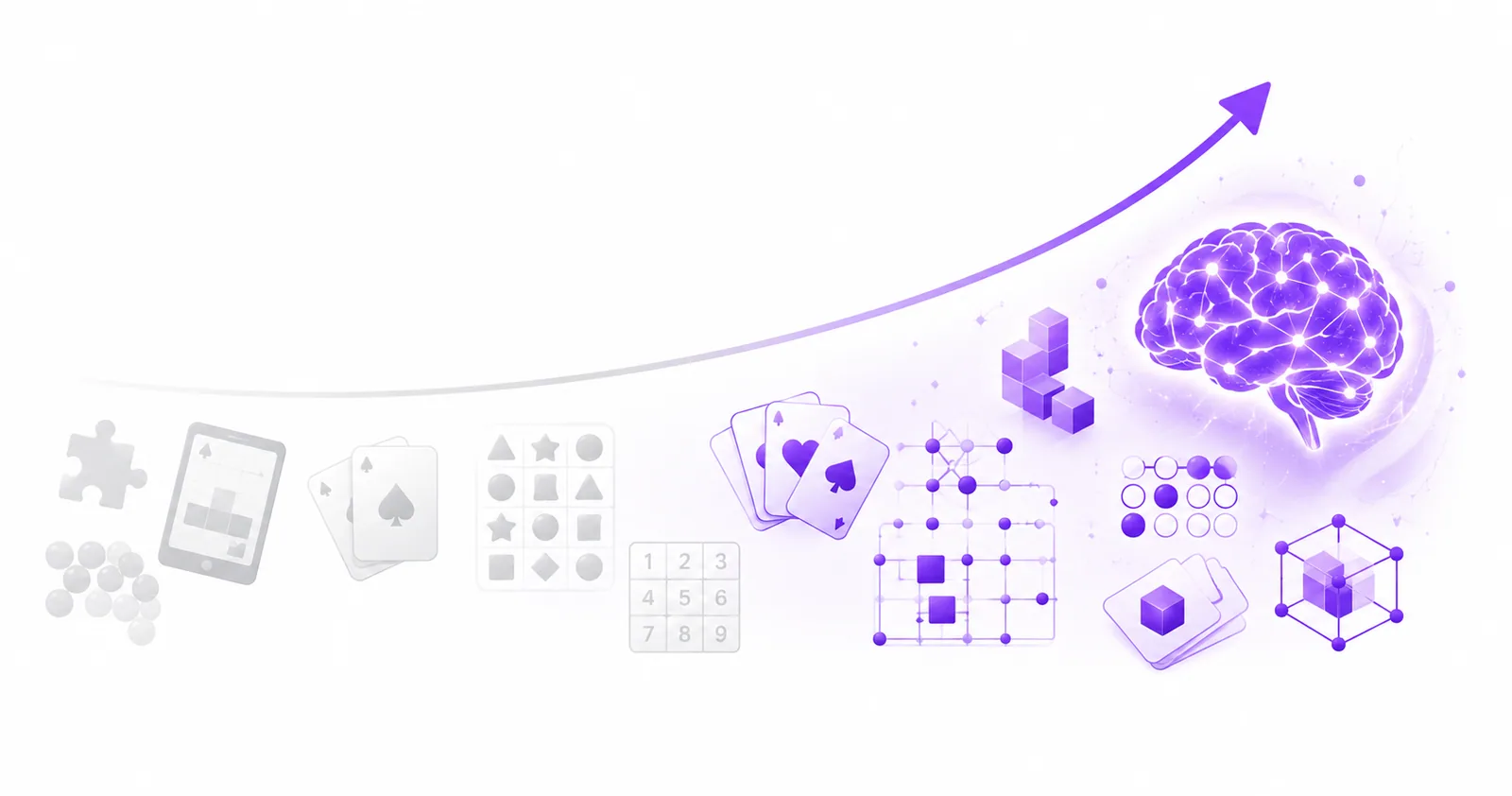
The games that work share three features: adaptive difficulty (the game gets harder as you improve), active recall (you retrieve information from memory rather than simply recognising it), and consistency mechanisms (features that keep you coming back daily). The games that do not work are static (the same difficulty every time), passive (matching visible cards rather than recalling hidden information), and built for engagement rather than training.
The distinction matters because your brain adapts to any repeated stimulus. A card-matching game that stays at the same difficulty will feel easier over time, but that feeling of ease is your brain adapting to the task, not getting stronger. Once adaptation is complete, no further neuroplastic change occurs. You are just going through the motions. Effective memory training keeps you at the edge of your ability, where the productive struggle happens.
What Makes a Memory Game Effective
Based on the cognitive training research, effective memory games for adults need the following features:
1. Adaptive Difficulty
This is the single most important feature. The game must automatically increase difficulty as your performance improves. If you are scoring 90% consistently, the next round should be harder. If you are struggling at 50%, it should ease back slightly. This keeps your brain perpetually working at the edge of its capacity, which is where long-term potentiation (the cellular mechanism of memory improvement) actually occurs.
Static difficulty games (the same 4x4 card grid every time, the same word list every session) stop producing cognitive benefits once your brain adapts. This typically takes 1 to 2 weeks for most simple games.
2. Active Recall
The game must require you to retrieve information from memory, not simply recognise it. There is a critical difference between seeing two cards and deciding if they match (recognition) versus studying a scene, having it disappear, and answering questions about it from memory (recall). Recognition is easier and produces weaker memory training effects. Recall forces your brain to reconstruct information from stored neural patterns, which strengthens those patterns far more effectively.
This is the same principle that makes flashcards effective for studying: the act of trying to remember before seeing the answer strengthens the memory trace. Games built around the encode-store-retrieve cycle (study information, hide it, recall it) produce stronger training effects than games built around matching visible information.
3. Consistency Mechanisms
The most effective game in the world is useless if you play it once and forget about it. The research consistently shows that daily practice over weeks is required for measurable improvement. This means the game needs features that bring you back every day: streak tracking, daily challenges, progress visualisation, or a session length short enough that "I do not have time" is never a valid excuse.
This is not a trivial design consideration. It is arguably the most important one after adaptive difficulty. The neuroscience of habit formation shows that consistency beats intensity. Two minutes daily produces better results than 30 minutes weekly.
4. Targeted Cognitive Domain
Games that try to train everything at once tend to train nothing effectively. The research on near transfer (the type of transfer that is well-established) shows that training a specific cognitive skill improves that specific skill. Training visual memory improves visual memory. Training verbal memory improves verbal memory. A game that jumps between maths, vocabulary, visual puzzles, and reaction time in a single session is less effective at improving any one skill than a game that targets one domain deeply.
The 5 Types of Memory Games for Adults
1. Card Matching Games
The classic: flip cards, find pairs, remember locations. These are the most common "memory games" available and are what most people think of when they hear the term. Free browser versions are everywhere.
Effectiveness: Low. Card matching is a recognition task, not a recall task. You are choosing between visible options rather than reconstructing information from memory. Most versions have static difficulty (the grid does not get harder as you improve). They are fine as casual entertainment but produce minimal training benefit beyond the first few sessions.
2. Pattern and Sequence Games
Games that show you a pattern (a sequence of colours, a grid of highlighted tiles, a series of images) and ask you to reproduce it from memory. Simon-style games, matrix recall, sequence repetition.
Effectiveness: Moderate. These use genuine recall (the pattern disappears and you reproduce it), which is better than matching. However, most free versions have static difficulty or very slow difficulty progression. They target short-term memory but often lack the depth to train visual long-term memory or working memory processing.
3. Word and Language Games
Crosswords, word searches, vocabulary games, and verbal recall exercises. These target verbal memory and language processing rather than visual memory.
Effectiveness: Moderate for verbal skills. Crosswords and word games maintain verbal fluency and vocabulary recall. However, they do not train visual memory, spatial memory, or working memory processing. They are complementary to visual training, not a substitute for it.
4. Traditional Board and Card Games
Chess, bridge, mahjong, and similar strategy games that require holding information in working memory while planning ahead.
Effectiveness: Moderate to high for working memory. Strategy games naturally exercise working memory because they require holding board state, opponent moves, and future plans simultaneously. The difficulty adapts naturally (opponents get harder as you improve). However, they require significant time commitment per session (30 to 60+ minutes) and the cognitive training is indirect rather than targeted.
5. Dedicated Cognitive Training Apps
Apps specifically designed for memory training with adaptive difficulty, progress tracking, and research-backed exercise design. Blanked, Lumosity, Peak, BrainHQ, Elevate, and others.
Effectiveness: Highest, when designed correctly. These use all four criteria: adaptive difficulty, active recall, consistency mechanisms, and targeted cognitive domains. The key differentiator is specificity. Some apps (like Elevate) train language and maths broadly. Some (like BrainHQ) focus on processing speed with deep clinical backing. Blanked focuses exclusively on visual memory through six game modes built around the encode-store-retrieve cycle. (For a full comparison of the major apps, see our best brain training apps 2026 roundup.)
What the Research Actually Says
The evidence on memory games for adults is more nuanced than either the sceptics or the marketing departments suggest:
Near transfer is well-established. Training a specific memory skill improves that specific skill. Visual memory training improves visual memory. Working memory training improves working memory capacity. This has been demonstrated across dozens of studies and meta-analyses. If you practise recalling visual scenes daily, you will get better at recalling visual scenes. (Full evidence review in our post on whether brain training works.)
Far transfer is debated. Whether memory game training improves general intelligence, academic performance, or unrelated cognitive skills is still contested. The ACTIVE Trial (the largest and longest clinical trial) found that cognitive training benefits persisted for 20 years and that speed-of-processing training with booster sessions reduced dementia risk by 25%. Other studies have found more limited far-transfer effects.
Not all games are equal. The research that shows positive results used games with adaptive difficulty and targeted training. The research that shows negative results often used games without these features. This distinction is critical: the question is not "do memory games work?" but "which memory games work, and under what conditions?"
Consistency is the strongest predictor. Across all studies, the participants who trained most consistently showed the greatest improvements. The specific game matters, but less than the frequency and duration of training. A good game played daily beats a perfect game played occasionally.
What to Look for (And What to Avoid)
Look For
- Adaptive difficulty that automatically adjusts to your performance level.
- Active recall (information disappears and you retrieve it from memory, not matching visible items).
- Short session length (2 to 10 minutes). Long sessions do not produce better results and reduce consistency.
- Streak or consistency tracking that motivates daily practice.
- Progress data showing improvement over time.
- Targeted focus on a specific cognitive skill rather than scattershot coverage.
Avoid
- Static difficulty (the same grid, the same level, every time).
- Ad-heavy free games where the primary business model is showing you ads between rounds rather than delivering effective training.
- Exaggerated claims ("raise your IQ by 20 points", "prevent Alzheimer’s"). No game can make these promises honestly.
- Recognition-only tasks (matching visible cards without a recall component).
- No progress tracking (if the game does not track your improvement, it is probably not designed around improvement).
The Best Memory Games for Adults in 2026
Based on the criteria above, here are the categories of memory games worth considering:
For visual memory training: Blanked. Six game modes (Classic, Speed Recall, Snap Match, Sequence, Counting Blitz, Colour Chain) built around the encode-store-retrieve cycle with adaptive difficulty. Sessions take about 2 minutes. All game content is free. Blanked+ (£19.99/year) adds Memory Analytics and cosmetics. Focuses exclusively on visual memory rather than spreading across multiple domains. (See our beginner’s guide for how each mode works.)
For processing speed: BrainHQ. The strongest clinical evidence base in the industry (300+ peer-reviewed studies, including the ACTIVE Trial). Focuses on auditory and visual processing speed. More clinical in feel than other apps. Approximately £95/year.
For language and maths: Elevate. Over 40 games across writing, reading, speaking, listening, and maths. Apple’s App of the Year. Practical, real-world skill focus. Approximately £49.99/year.
For broad cognitive training: Peak and Lumosity both offer multi-domain training with adaptive difficulty and progress tracking. Neither has the clinical depth of BrainHQ or the visual memory focus of Blanked, but both are solid general-purpose options.
For zero cost: Blanked’s free tier includes all six game modes, 380+ levels, and the full streak system with no content restrictions. If budget is a factor, this is the strongest free option available.
For detailed comparisons between these apps, see our posts on Blanked vs Lumosity and Blanked vs Peak.
How to Get the Most From Memory Games
Choosing the right game is only half the equation. How you use it determines whether you see real results:
Play daily, not occasionally. The neuroplastic mechanisms behind memory improvement require repeated daily activation. Set a specific time (morning works best for most people) and treat it like brushing your teeth: a non-negotiable daily habit. A fixed daily memory challenge makes the cue concrete: one puzzle, every morning, two minutes.
Keep sessions short. Research shows that 2 to 10 minutes of daily training is sufficient. Longer sessions do not produce proportionally better results and increase the risk of skipping sessions entirely. Blanked sessions take about 2 minutes specifically because the research shows this is the sweet spot for consistency.
Track your progress. Measurable improvement is both motivating and informative. If your scores are plateauing, you may need a harder difficulty level or a different game mode. If they are steadily climbing, your training is working.
Combine with lifestyle factors. Memory games produce the strongest results when combined with adequate sleep (for consolidation), regular exercise (for BDNF-driven hippocampal support), and reduced multitasking (for stronger encoding). The game provides the targeted stimulus. Your lifestyle creates the conditions for that stimulus to produce lasting change. (See our posts on brain exercises for adults for more strategies.)
Give it time. Measurable improvements appear after 2 to 4 weeks of consistent daily practice. Structural brain changes take longer. Do not judge a game’s effectiveness after 3 days. Give it a genuine 4-week trial with daily sessions before deciding whether it is working.
Memory games for adults work when they are designed correctly and used consistently. The science is clear on both points. The question is not whether games can improve your memory. It is whether you will choose an effective game and show up every day to use it. (For a quick-reference overview of the best options, see our memory games for adults page.)
Try Blanked for free. Two minutes. Six visual memory modes. Adaptive difficulty that scales with you. No ads gating the training. Your visuospatial sketchpad has been waiting for a proper workout.
Frequently asked questions
Do memory games actually improve memory in adults?
What is the best free memory game for adults?
How long should adults play memory games each day?
Can memory games prevent dementia?
At what age should adults start playing memory games?
Train your memory. Play Blanked free.
A free visual memory game built around how memory actually works. 6 game modes, 400+ levels.
Download on the App Store