Working Memory: What It Is and How to Train It (2026)

On this page (12)
You are using your working memory right now. As you read this sentence, your brain is holding the beginning of it in mind while processing the end. When you switch between browser tabs and remember what you were doing before, that is working memory. When you listen to someone giving you directions and mentally map the route while they speak, that is working memory.
Working memory is the cognitive system that holds information in your mind and does something with it. It is not just storage. It is storage plus processing, happening simultaneously, in real time. And it is one of the strongest predictors of academic performance, professional productivity, and everyday cognitive ability that psychologists have identified.
This post explains what working memory is, how it differs from short-term memory, how the system works at a biological level, what limits it, and what the research says about whether you can train it to be stronger.
What Working Memory Actually Is
Working memory is the ability to hold a small amount of information in your mind while simultaneously processing, manipulating, or using that information. The key word is simultaneously. It is not just remembering something. It is remembering something while doing something with it.
Here are some everyday examples of working memory in action:
- Following a recipe: holding the list of ingredients in mind while measuring, chopping, and tracking which step you are on.
- Mental arithmetic: holding the numbers in mind while performing the calculation (what is 47 times 3? You need to hold 47, hold 3, multiply, hold the intermediate result, and assemble the answer).
- Reading comprehension: holding the first half of a paragraph in mind while processing the second half and integrating both into a coherent understanding.
- Driving in an unfamiliar city: holding the directions in mind while monitoring traffic, reading signs, and making real-time navigation decisions.
- Conversations: remembering what the other person just said while formulating your response.
Every one of these tasks requires you to hold information and process it at the same time. That dual requirement is what separates working memory from simple storage. And it is why working memory capacity is so closely linked to intelligence, learning ability, and everyday competence.
Working Memory vs Short-Term Memory
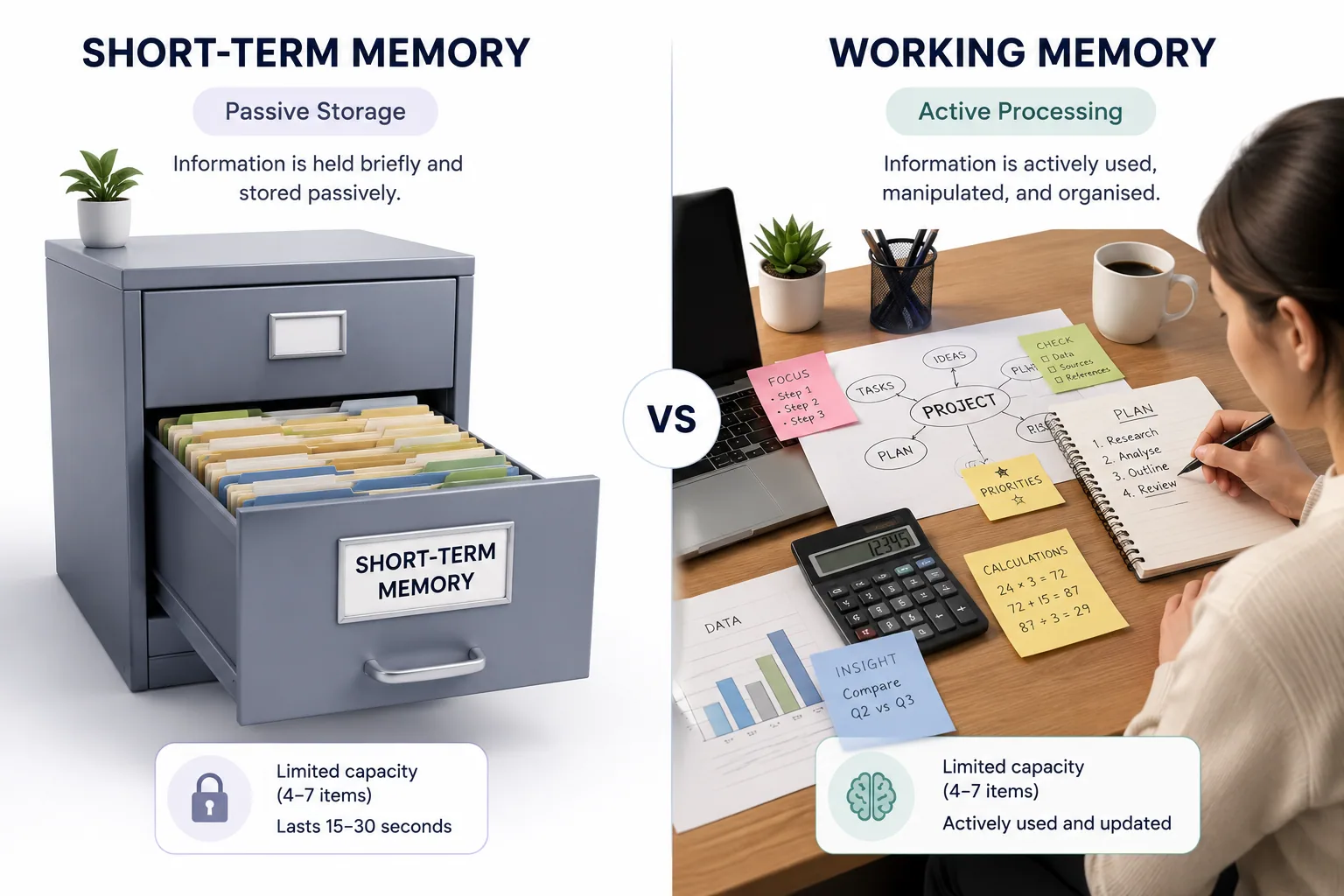
These two terms are often used interchangeably, but they describe different things. Short-term memory is the passive holding of information for a brief period, typically 15 to 30 seconds. Working memory is short-term memory plus active processing.
Think of it this way: when you hold a phone number in your head for 10 seconds, that is short-term memory. When you hold two phone numbers in your head and compare them to decide which one is correct, that is working memory. The information is the same. The difference is what your brain is doing with it.
Short-term memory is a filing cabinet. Working memory is a desk where you spread out papers, compare them, rearrange them, and make decisions. The filing cabinet just stores things. The desk is where you actually work. (For the full breakdown of how these memory systems relate to each other, see our post on short-term vs long-term memory. Note: we will update this link once the post is published.)
How Working Memory Works: The Baddeley Model
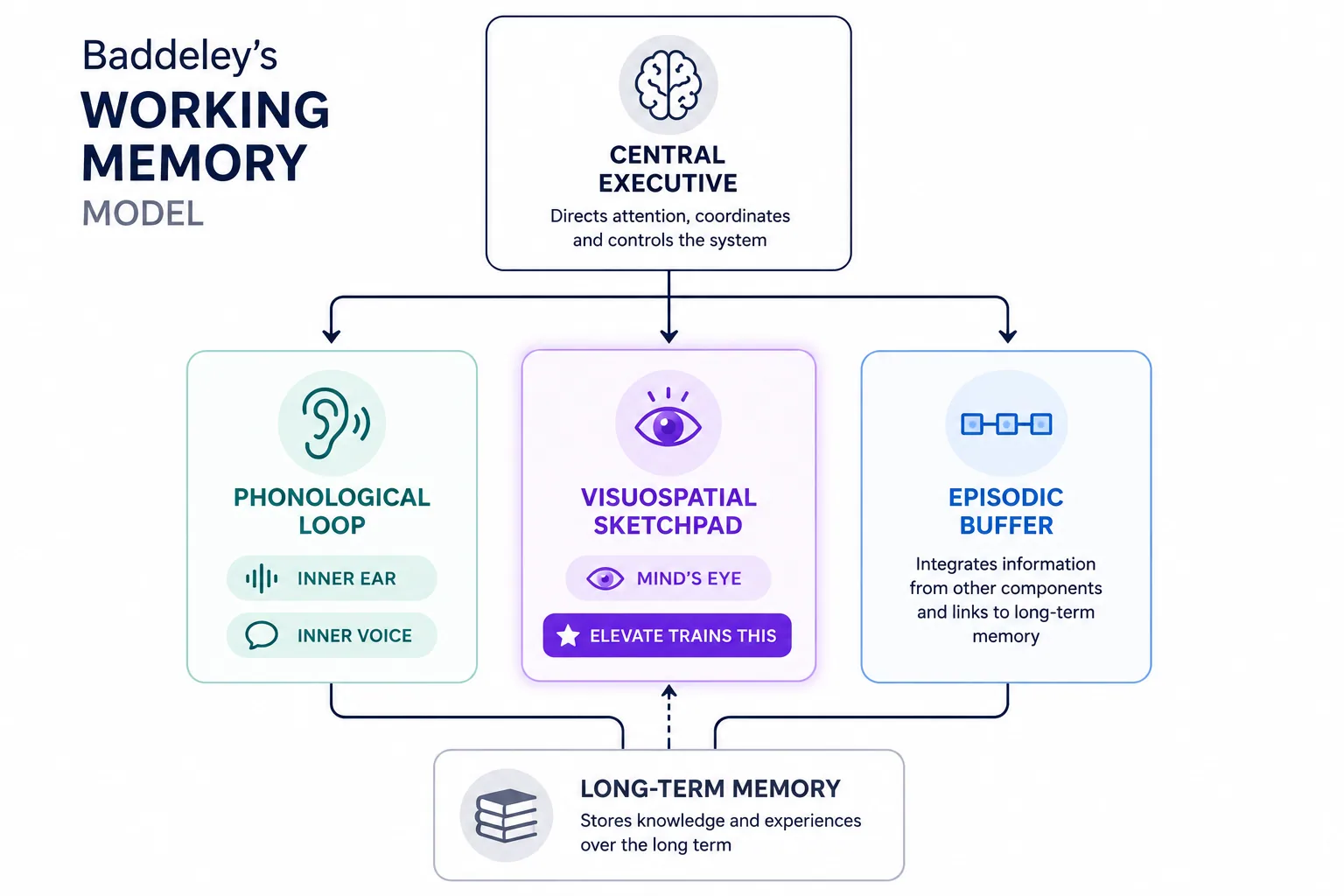
The most widely accepted model of working memory was proposed by Alan Baddeley and Graham Hitch in 1974, and it has been refined over the decades since. The model describes working memory as having four components, each handling a different type of information:
The Central Executive
This is the control system. It directs attention, coordinates information from the other components, and decides what to focus on. When you are in a noisy room trying to follow a conversation, the central executive is filtering out the noise and directing your attention to the speaker. It has limited capacity, which is why multitasking degrades performance: the central executive cannot effectively direct attention to two demanding tasks at once. (We explored this in our post on focus and concentration.)
The Phonological Loop
This component handles verbal and acoustic information. It has two parts: the phonological store (your "inner ear," which holds sounds for 1 to 2 seconds) and the articulatory rehearsal process (your "inner voice," which refreshes information by mentally repeating it). When you repeat a phone number to yourself, you are using the articulatory rehearsal process to keep it active in the phonological store.
This is why similar-sounding words are harder to remember than dissimilar ones in short-term tasks. "Cat, hat, mat, bat" is harder to hold in working memory than "pen, day, fish, cloud" because similar sounds compete for space in the phonological store.
The Visuospatial Sketchpad
This is the component that handles visual and spatial information. It is your "mind’s eye." When you picture someone’s face, mentally rotate an object, or remember the layout of a room, you are using the visuospatial sketchpad.
This component is divided into visual processing (what things look like) and spatial processing (where things are in relation to each other). You can picture a red car (visual) and simultaneously know it is parked to the left of a blue house (spatial). Both operations happen in the visuospatial sketchpad.
This is the component that Blanked primarily trains. When you study a scene of colourful shapes, the scene vanishes, and you answer questions about what you saw, you are exercising the visuospatial sketchpad intensely. The encode-store-retrieve cycle in every Blanked session is a direct workout for this system. (For a breakdown of how each game mode targets different aspects, see our beginner’s guide.)
The Episodic Buffer
Added to the model in 2000, the episodic buffer integrates information from the phonological loop, visuospatial sketchpad, and long-term memory into coherent episodes. It is the component that lets you combine what you are seeing, hearing, and remembering into a unified experience. When you watch a film and follow the plot (combining visual information, dialogue, and your memory of earlier scenes), the episodic buffer is doing the heavy lifting.
Why Working Memory Matters More Than You Think
Working memory capacity is one of the most powerful predictors of cognitive performance across almost every domain researchers have studied:
Academic achievement. Working memory is a stronger predictor of academic success than IQ in primary school children. Students with higher working memory capacity perform better in reading comprehension, mathematics, and science, because all three subjects require holding information in mind while processing new input. (For specific study strategies that leverage this, see our post on memory training for students.)
Professional performance. Every cognitively demanding job relies on working memory. Programmers hold code logic in mind while debugging. Doctors hold patient symptoms in mind while considering differential diagnoses. Lawyers hold case facts in mind while constructing arguments. The capacity to hold and process information simultaneously is the common thread.
Everyday competence. Forgetting why you walked into a room, losing your train of thought mid-sentence, struggling to follow complex instructions: these are not signs of a bad memory. They are signs of working memory being overloaded. The information was there, but the processing system ran out of capacity.
Attention and focus. Working memory and attention are deeply intertwined. The central executive directs attention, and attention determines what enters working memory. Weak working memory makes sustained attention harder because distractions displace the information you were holding. This is why working memory deficits are closely linked to ADHD symptoms.
What Limits Working Memory
Working memory is fundamentally limited. Understanding those limits is the first step to working within them and eventually expanding them.
Capacity. The classic estimate was 7 plus or minus 2 items (George Miller, 1956), but modern research has revised this to roughly 3 to 5 items for most people. That is not a lot. It means your brain can juggle about 4 things at once before performance degrades. This is a biological constraint, not a failure of willpower.
Duration. Without active rehearsal or processing, information in working memory decays within about 15 to 30 seconds. This is why interruptions are so costly: they displace the information you were holding, and it may not come back. (This decay process is explored in detail in our post on why you forget things so quickly.)
Interference. Similar information competes for the same cognitive resources. Trying to hold two similar phone numbers in working memory is harder than holding a phone number and a colour, because the numbers interfere with each other in the phonological loop while the colour uses the visuospatial sketchpad. This is why Baddeley’s model separates verbal and visual processing: they use different resources and can operate simultaneously without interfering.
Cognitive load. The more processing a task requires, the less capacity remains for storage, and vice versa. This is the fundamental trade-off of working memory. A simple maths problem uses minimal processing, leaving room for storage. A complex maths problem consumes most of the processing capacity, which is why you might lose track of intermediate results mid-calculation.
Stress and sleep deprivation. Both significantly impair working memory function. Cortisol (the stress hormone) disrupts prefrontal cortex activity, which is where the central executive operates. Sleep deprivation has a similar effect. One night of poor sleep can reduce working memory capacity by 20 to 30%. (Full breakdown in our post on how sleep affects memory.)
Can You Actually Train Working Memory?
This is the most debated question in cognitive training research, and the honest answer is nuanced.
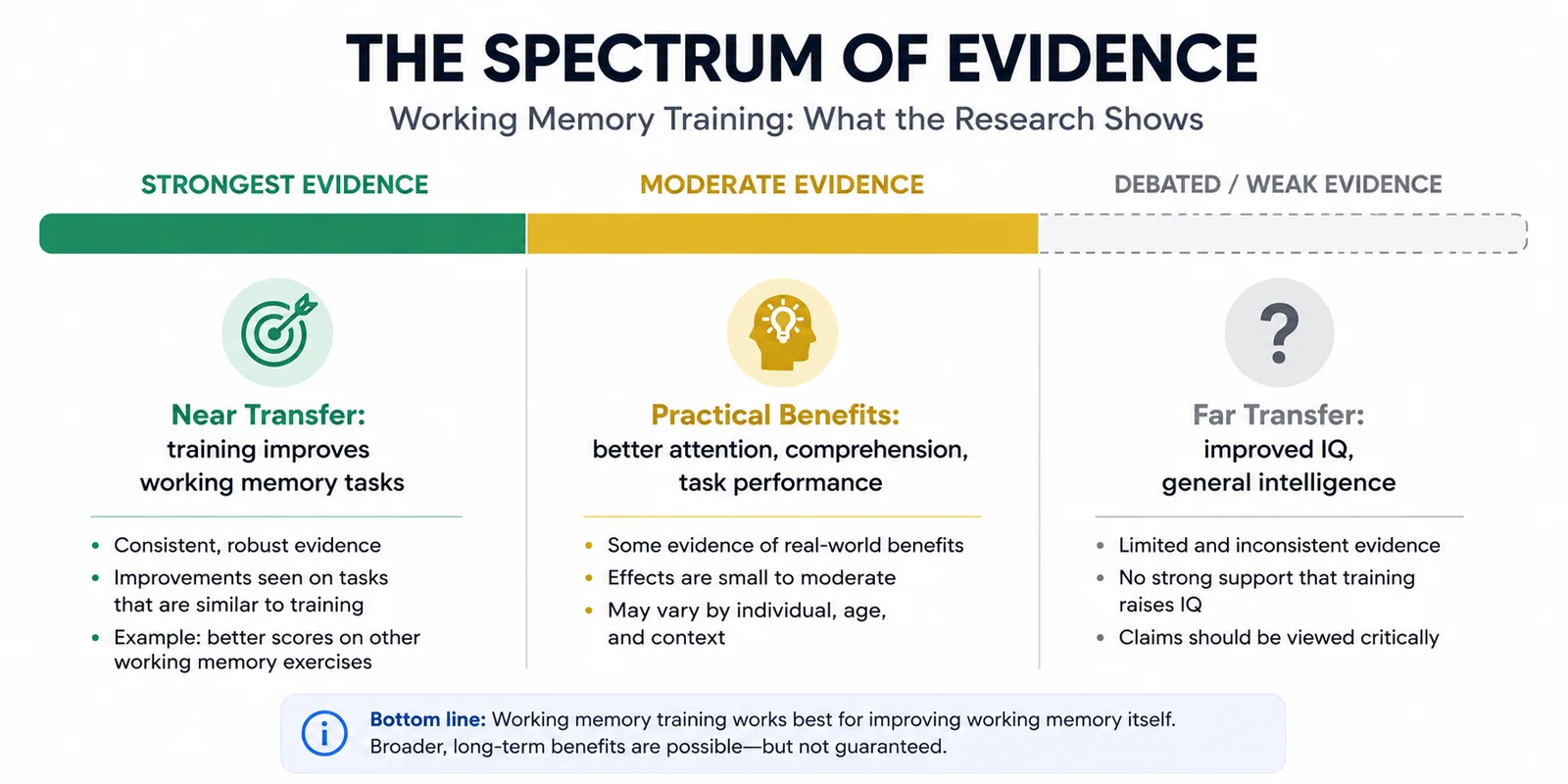
The strong evidence: near transfer. Multiple meta-analyses have confirmed that working memory training improves performance on working memory tasks. If you practise holding and manipulating visual information, you get better at holding and manipulating visual information. A 2025 study at Northeastern University found that 568 participants who completed brain training games showed measurable improvements in working memory skills, with faster learners showing the greatest gains. This near-transfer effect is well-established and reproducible.
The debated evidence: far transfer. Whether working memory training improves general intelligence, academic performance, or other cognitive abilities beyond working memory itself is more contested. Some studies show modest far-transfer effects, particularly the ACTIVE Trial, which found that cognitive training benefits persisted for 10 years and reduced dementia risk. Others, particularly a 2025 randomised controlled trial with Australian primary school children, found no evidence of far transfer from adaptive working memory training. (For the full evidence breakdown, see our post on whether brain training actually works.)
The emerging evidence: mood and mental health. A 2026 systematic review and meta-analysis published in Translational Psychiatry found that working memory training produced a small but significant reduction in depressive symptoms. Twenty-seven randomised controlled trials with 1,692 participants showed that training the ability to hold and process information may have benefits beyond cognition.
The practical reality. Even if the far-transfer debate remains open, the near-transfer evidence is strong. Training your working memory makes your working memory better. And since working memory is the bottleneck behind attention, comprehension, problem-solving, and everyday cognitive performance, making it stronger has practical value regardless of whether it also raises your IQ score.
How to Train Working Memory
Based on the research, effective working memory training shares several features:
1. Adaptive difficulty. The task must get harder as you improve. If the difficulty stays static, your brain adapts and stops being challenged, which means the neuroplastic changes that drive improvement stop happening. This is the single most important design feature of effective training.
2. The encode-store-retrieve cycle. Effective working memory exercises require you to take in information (encode), hold it while it is no longer visible (store), and then answer questions about it (retrieve). This cycle directly exercises the storage and processing components of working memory. Blanked is built entirely around this cycle: you study a visual scene, the scene vanishes, and you recall details from memory. Every session, every level, every mode.
3. Consistency over intensity. Research consistently shows that daily short sessions outperform occasional long ones. The neuroplastic mechanisms behind working memory improvement (long-term potentiation, synaptic strengthening) require repeated activation over time, not single marathon sessions. This is why Blanked sessions are designed to take about 2 minutes: short enough that you will actually do it every day. (For the full improvement timeline, see our post on how long it takes to see results.)
4. Visuospatial challenge. Most everyday working memory demands involve visual and spatial processing: remembering faces, navigating environments, recalling where you left things, processing visual scenes. Training the visuospatial sketchpad directly targets these real-world applications. Blanked’s six game modes (Classic, Speed Recall, Snap Match, Sequence, Counting Blitz, and Colour Chain) each target different facets of visuospatial working memory.
5. Engagement and habit design. The best training programme in the world is useless if you don’t use it consistently. This is why Blanked incorporates streaks, streak shields, milestone cosmetics, and Blink (the mascot who reacts to your performance): not as gimmicks, but as evidence-based habit mechanisms that keep you coming back. The research is clear that consistency matters more than anything else.
A Simple Daily Working Memory Routine
If you want a structured approach, here is a routine that takes less than 10 minutes and targets all the major components:
Morning (2 minutes): Complete your daily Blanked session. This targets the visuospatial sketchpad through the encode-store-retrieve cycle. Download Blanked for free to start.
During the day (2 to 3 minutes): Practise mental arithmetic without a calculator. Calculate tips, estimate grocery totals, work out percentages in your head. This targets the phonological loop and central executive.
Evening (3 to 5 minutes): Before bed, try to recall the details of your day in reverse order: what happened last, then before that, then before that. This exercises the episodic buffer and strengthens the consolidation process that happens during sleep.
For additional exercises that complement this routine, see our post on brain exercises for adults.
Working memory is not a fixed trait. It is a system. Systems can be understood, optimised, and strengthened. The research shows that targeted, consistent, adaptive training improves working memory performance. The question is not whether it works. The question is whether you will show up every day to do it.
If you want to start training the system that sits behind everything else you do, try Blanked for free. Two minutes. One visual memory challenge. Every day. Your visuospatial sketchpad will thank you, even if it cannot say so.
Frequently asked questions
What is working memory in simple terms?
What is the difference between working memory and short-term memory?
Can working memory be improved?
How long does it take to improve working memory?
What are the best exercises for working memory?
Train your memory. Play Blanked free.
A free visual memory game built around how memory actually works. 6 game modes, 400+ levels.
Download on the App Store